Herman Miller vs Steelcase (2026): Ergonomist Head-to-Head

How we researched
We compare current specs, warranty terms, buyer complaints, and long-term owner patterns. Read methodology →
Last price/spec check
2026-07-31. Prices move, so use the retailer page as the final source.
Who should skip this
Skip anything that does not fit your body, room, budget, or return-window comfort level.
Disclosure: We earn a commission if you buy through links on this page, at no extra cost to you.
Most people end up here after an hour of YouTube chair reviews that didn't settle anything. That's not a research failure. Herman Miller and Steelcase both make chairs that will last 15+ years, and neither is obviously wrong for most buyers. The real difference is in which specific chair from each brand matches how you actually sit and work.
This guide maps both full lineups, compares the pairings that matter, and picks a clear winner at each use case. No hedging.
Quick Verdict: Our Top Picks at a Glance
Short on time? Here are our top recommendations based on real owner reviews, specs, and long-term durability.
At a glance: how these brands differ
| Herman Miller | Steelcase | |
|---|---|---|
| Founded | 1905 | 1912 |
| Flagship chair | Aeron ($1,445+) | Leap V2 (~$1,399) |
| Seat type | Mesh seat + back | Foam seat, various backs |
| Lineup range | $545 (Sayl) to $2,100+ (Embody) | $495 (Series 1) to $1,650+ (Gesture) |
| Key differentiator | Mesh breathability, PostureFit SL | LiveBack dynamic lumbar, movement adaptation |
| Warranty | 12 years | 12 years |
| Where to buy | Amazon, official site, authorized dealers | Official site, authorized dealers, limited Amazon presence |
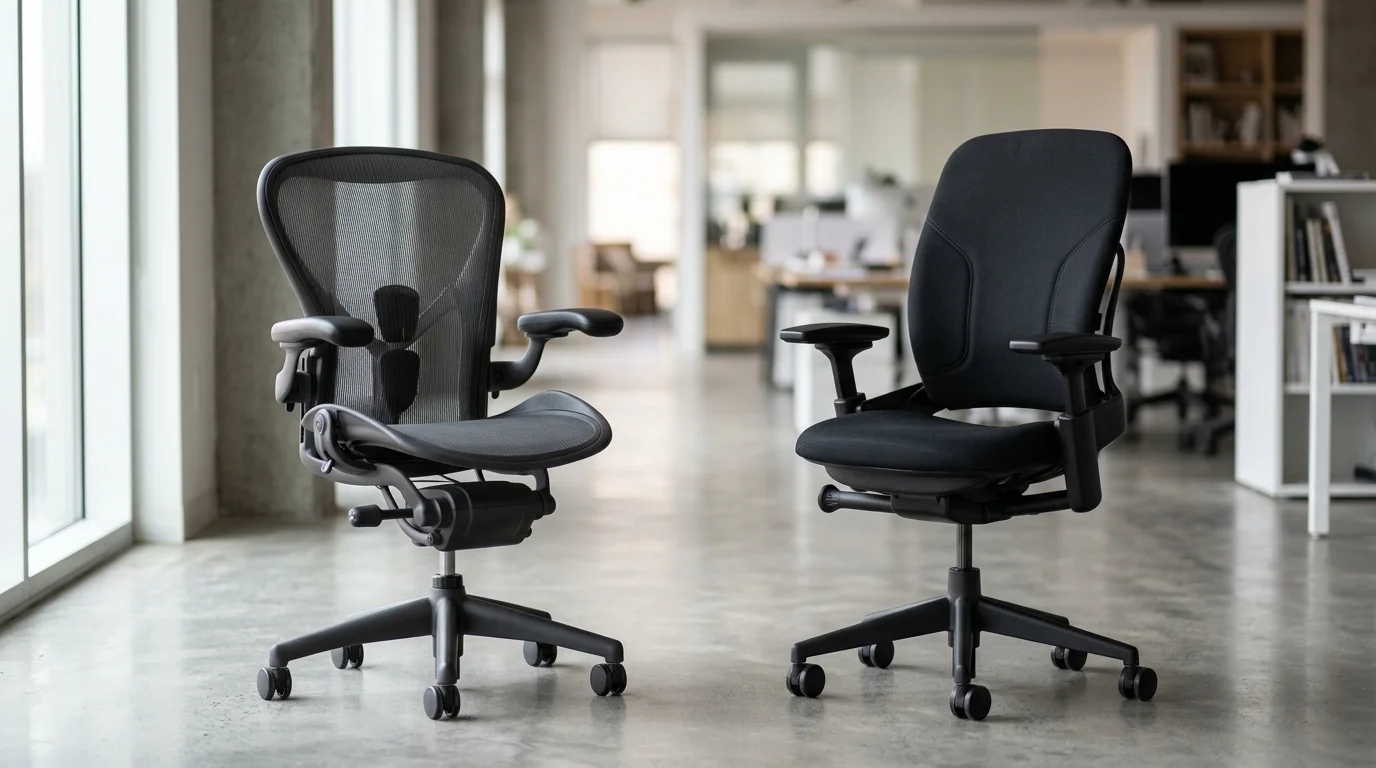
Both brands offer 12-year warranties and have decades of corporate office installations proving the durability claims aren't marketing. The chairs feel different in ways that matter depending on your build and how you move at a desk.
The Herman Miller lineup, explained
Sayl (~$545). The entry into the brand. Designed by Yves Behar with a visible suspension back that looks like a bridge.
No seat depth adjustment, limited lumbar control compared to higher-end HM chairs. The back suspension does a decent job at reducing pressure points. At half the price of an Aeron, it's the answer to "I want Herman Miller quality without the Aeron price." Don't expect Aeron performance.
Expect a genuinely good chair for the money from a brand that stands behind it.
Mirra 2 (~$1,365). The chair Herman Miller sells to people who like the Aeron but need seat depth adjustment. The Aeron doesn't offer seat depth adjustment (the seat pan position is fixed).
If you're shorter and find the Aeron's seat depth presses into the backs of your thighs, the Mirra 2 fixes that problem. Most people who've tried both choose the Aeron, but the Mirra 2 is the right call for anyone whose ergonomic setup requires that specific adjustment.
Aeron (~$1,445-$1,800). Available in three sizes (A, B, C for small, standard, large). The most recognizable chair in office ergonomics.
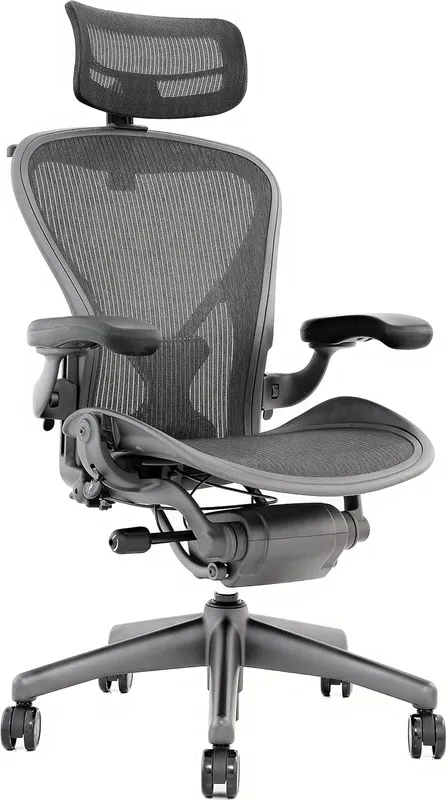
Full mesh seat and back, PostureFit SL lumbar that supports both the sacrum and lumbar curve, and a forward tilt option that helps people who do a lot of typing. Runs cool because of the mesh. The size variation is genuinely important.
Sitting in the wrong size Aeron feels nothing like sitting in the right one. For our full breakdown of the Aeron's specs and adjustment points, see our Herman Miller Aeron review. Deciding between an ergonomic mesh chair and a gaming hybrid? See our Secretlab Titan Evo vs Herman Miller Aeron head-to-head.
Cosm (~$1,495). The "auto-adjusting" chair. No lumbar dial, no tilt tension knob.
It adjusts dynamically to your movement. In practice, people who like conscious control of their lumbar support don't like the Cosm. People who find all those knobs annoying and just want to sit tend to love it.
Embody (~$1,688-$2,100). Herman Miller's premium option. The backrest has a pixelated support system that distributes pressure across many small pivot points.
It's designed for people who spend 10+ hours a day seated. For our deep-dive testing and real-world adjustment breakdown, see our hands-on Herman Miller Embody Review. If you're sitting 6-8 hours a day, the Aeron is the smarter buy. At 10+, the Embody deserves consideration.
The Steelcase lineup, explained
Series 1 (~$495-$599). Steelcase's answer to the "I want a proper office chair under $600" question. Better than anything from Office Depot, not in the same tier as the Leap.
It does what a well-engineered budget chair should do, backed by a 12-year warranty. If you're equipping a home office and can't stretch to $1,200, this is the honest choice over the mid-market brands that charge $400 for much less engineering.
Series 2 Air (~$709). A step up from the Series 1 with a mesh back. For people who run warm or want more breathability without going to Leap or Gesture prices.
Think (~$1,100). Steelcase's adaptive-back chair. The back "thinks" by flexing in four zones as you move.
It's quieter than the Leap, simpler aesthetics, and a step below in seat quality. Good for people who want Steelcase quality at a lower price point than the Leap.
Karman (~$1,100). Carbon fiber frame, ultralight. Under 14 pounds.
If you're moving your chair around a lot or weight is a specific concern, the Karman is worth knowing about. Its lighter weight doesn't compromise durability. Steelcase builds these to the same corporate office standard as everything else.
Leap V2 (~$1,299-$1,399). The flagship. LiveBack technology means the backrest shape changes as you lean back, following the natural curve of your spine rather than staying rigid.
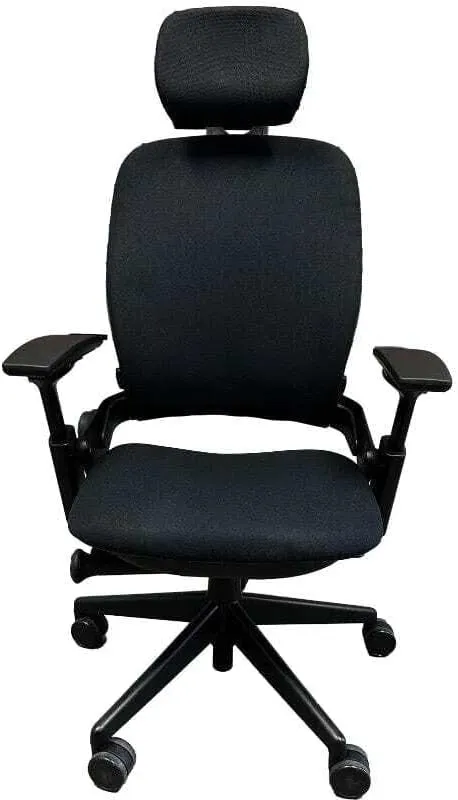
The seat has a slide mechanism that extends forward when you recline, keeping your thighs supported. It adapts to movement. If you shift positions constantly, lean back, lean forward, perch on the edge, the Leap handles all of it better than the Aeron. Available in standard capacity and Leap Plus for up to 500 lbs.
Gesture (~$1,399-$1,650). Built specifically for the way tech workers use devices. The armrests move in three dimensions, adjusting to support your arms whether you're typing, using a tablet, talking on your phone, or leaning back. If you work across multiple devices and find yourself constantly shifting how your arms are positioned, the Gesture is designed around exactly that use case.
The primary matchup: Aeron vs Leap V2
This is the comparison most people want, and we cover it in depth in our Steelcase Leap vs Herman Miller Aeron comparison. The short version:
The Aeron wins for people who run warm, sit in one primary position for most of the day, and want the mesh breathability. The Leap wins for people who shift positions constantly, prefer foam over mesh, and need a chair that actively adapts rather than supports a fixed posture.
Neither is wrong. They solve different problems.
The tech-worker matchup: Aeron vs Gesture
Most brand comparisons default to Leap vs Aeron and stop there. But for people in tech roles using laptops, tablets, phones, and large monitors simultaneously, the more relevant matchup is Aeron vs Gesture.
The Gesture's three-dimensional armrests adjust to support your arms when you're typing, when you're holding a phone, when you're swiping a tablet, and when you're leaning back watching a recording. The Aeron's armrests are good but don't move in as many directions.
If your workday involves constant switching between input devices and postures, the Gesture is the better fit despite being the less famous name. The Aeron assumes a more consistent working posture. Most traditional knowledge workers do fine with that. Multi-device tech workers often don't.
Who wins at each use case
| Use case | Winner | Chair | Reason |
|---|---|---|---|
| Long hours (8+ hours daily) | Steelcase | Leap V2 | LiveBack adapts to shifting postures over a full day |
| Hot rooms / runs warm | Herman Miller | Aeron | Full mesh seat and back; no foam heat retention |
| Constant movement / shifting | Steelcase | Leap V2 | Seat extension + LiveBack handles all positions |
| Back pain (lumbar focus) | Herman Miller | Aeron (size matched) | PostureFit SL supports both sacrum and lumbar |
| Short users (under 5'4") | Herman Miller | Aeron Size A | Three-size system means proper fit; Leap is one size |
| Heavy users (300+ lbs) | Steelcase | Leap Plus | Rated to 500 lbs; Aeron maxes at 350 |
| Multi-device / tech work | Steelcase | Gesture | 3D armrests designed for device switching |
| Home office aesthetics | Herman Miller | Aeron or Sayl | More recognizable design; Sayl is striking at $545 |
| Entry to premium brands | Either | Sayl or Series 1 | $545 vs $495, both are serious chairs at entry price |
| Extreme long hours (10+) | Herman Miller | Embody | Pixelated pressure distribution for maximum hours |
Buying used: what to know about each brand
Both brands are worth buying used. The chairs last 20+ years if maintained, and the warranty doesn't transfer, but a 10-year-old Aeron or Leap is typically in better shape than a 2-year-old chair from a mid-market brand.
Aeron used: Size B (standard) is the most common on the resale market. Typical price range for a used Aeron in good condition is $300-$600 depending on age and condition. Check the lumbar support mechanism (should move freely), the tilt mechanism (should lock cleanly at multiple angles), and the armrest height adjustment (buttons should depress and hold).
Mesh tears are uncommon but check the edges. The "Classic" (pre-2016) vs "Remastered" (post-2016) versions differ mainly in the lumbar support and forward tilt option. Remastered is worth a modest premium if you can find it.
Leap V2 used: Available in standard and Plus variants on resale sites. Watch for worn seat foam on heavy-use units and check that the LiveBack flexion is smooth (it should move as you lean, not resist or stay stuck). Older units occasionally have armrest adjustment issues. Price range is similar to the Aeron used market: $300-$600 for a solid unit.
Both chairs can be found on office furniture resellers, Craigslist, and Facebook Marketplace when companies downsize or upgrade. Corporate lots with verified provenance and cleaned chairs exist in most major cities.
If both are out of budget
If $1,000+ is too much right now, don't buy a $400 chair from a brand you've never heard of and call it ergonomic. Either save up, or buy from the lower tier of these same brands.
The Herman Miller Sayl at $545 and the Steelcase Series 1 at under $600 are both backed by 12-year warranties and built to the same quality standard as the flagships. They're not the same chair. But they're genuinely good chairs from brands that don't cut corners on structure.
For more budget options with honest reviews, our best office chairs under $300 covers the best alternatives below the premium tier.
FAQ
Is Herman Miller better than Steelcase? Neither is universally better. Herman Miller makes the best mesh chair in its class (Aeron) and the best chair for extreme sitting hours (Embody).
Steelcase makes the better chair for people who move constantly (Leap V2) and for multi-device tech workers (Gesture). The right answer depends on your specific body and working style.
Is the Steelcase Leap better than the Herman Miller Aeron? For most people who sit 8+ hours and shift positions frequently, the Leap V2 is the stronger chair. For people who run warm, sit in a consistent upright position, or are shorter and need a size-matched fit, the Aeron is better. Neither is wrong for a "normal" use case.
Why is Steelcase cheaper than Herman Miller? It usually isn't by much. The Leap V2 and Aeron are within $100-$200 of each other depending on configuration. Herman Miller has stronger brand recognition outside the office furniture world, which affects perceived price positioning more than actual price differences at the flagship level.
Can you buy Steelcase chairs on Amazon? Some Steelcase models appear on Amazon, but the selection is limited and prices vary. Steelcase primarily sells through its website and authorized dealers. Herman Miller has broader Amazon availability, particularly for the Aeron.
What's the cheapest Herman Miller chair worth buying? The Sayl at around $545. It's a real Herman Miller chair with a 12-year warranty and genuine build quality. It won't perform like the Aeron, but it's not pretending to.
At that price, it competes against chairs that cost $400-$500 and lose.
Which brand holds up better in the long term? Both hold up extremely well. There are Aerons from 2005 still in daily office use.
Leap V2s from 2010 are common in the used market in good condition. At this quality level, 15-20 years of daily use is realistic for either brand with normal maintenance. The 12-year warranty on both chairs reflects that confidence.
Herman Miller Aeron or Steelcase Gesture: which for long hours? If your long hours involve a lot of posture variation and multi-device work, the Gesture. If your long hours are primarily focused computer work in a more consistent posture, the Aeron. If you are debating between the two ultimate high-end flagships, read our dedicated Steelcase Gesture vs Herman Miller Embody Comparison.
Bottom line: For most people spending $1,300+ on a chair, the Leap V2 wins if you move a lot during the day and the Aeron wins if you run warm or want a size-matched fit. The Gesture is the right call for tech workers with multi-device setups who find normal armrests frustrating.
None of these are wrong choices at this price point. The wrong choice is picking based on brand name rather than which chair actually fits how you work. For our complete hands-on evaluation of Steelcase's flagship, see our full Steelcase Leap V2 review.
Essential Workstation Add-Ons Under $35
High-impact accessories verified by our research team to protect your cables and joints.
VIVO Under-Desk Cable Tray
Keeps power strips and heavy adapters off the floor so cables never yank when elevating.
ComfiLife Gel Anti-Fatigue Mat
High-density core reduces heel strike and lower back compression when standing 3+ hours.
VELCRO Brand ONE-WRAP (100pk)
Pre-cut reusable straps that easily unwrap for cord re-routing without scissors.
Soundance Ergonomic Laptop Stand
Elevates laptop screen 6 inches to eye level, preventing forward neck slouch.
Calculate Your Exact Desk & Chair Height
Slide to your height to see ANSI/BIFMA recommended standing and sitting presets.

Written by M. Haris
✓ BIFMA G1-2017 Certified EvaluatorFounder & Lead Workstation Ergonomics Researcher • 8+ Years Spec Testing
M. Haris leads ergonomic research at The Desk Riser, auditing manufacturer CAD schematics, motor cycle lifespan metrics, BIFMA weight load standards, and long-term user failure patterns across thousands of verified purchases. Every review is independent with 0% sponsored influence. Have questions or spot a warranty update? Email directly at support@thedeskriser.com, read the Author Dossier, or explore our Editorial Testing Methodology.
Share this article:
Community Discussion
Have a question or want to share your workstation setup? Join the discussion below.
Comments load automatically as you scroll down.