Best Office Chair for Sciatica in 2026: Nerve Relief Picks
How we researched
We compare current specs, warranty terms, buyer complaints, and long-term owner patterns. Read methodology →
Last price/spec check
2026-07-29. Prices move, so use the retailer page as the final source.
Who should skip this
Skip anything that does not fit your body, room, budget, or return-window comfort level.
Disclosure: We earn a commission if you buy through links on this page, at no extra cost to you.
Sciatica isn't just back pain. The sciatic nerve runs from your lower back through your glutes and down the back of each leg, and what triggers it in a chair is usually pressure on the nerve itself, not just poor lumbar support.
That's why the standard ergonomic chair advice ("get good lumbar support") is only half the picture for sciatica sufferers. Seat depth, seat edge design, and the ability to tilt the seat pan forward matter just as much. A chair can have excellent lumbar support and still compress your sciatic nerve through a firm seat edge pressing into the back of your thighs.
Here's what actually matters and which chairs get it right.
Quick Verdict: Our Top Picks at a Glance
Short on time? Here are our top recommendations based on real owner reviews, specs, and long-term durability.
Herman Miller Aeron
Best overall, no seat edge pressure
Quick picks
| Chair | Price | Best for |
|---|---|---|
| Herman Miller Aeron | ~$1,395 | Best overall, no seat edge pressure |
| Steelcase Leap V2 | ~$1,500 | Best adjustability for sciatica |
| Humanscale Freedom | ~$1,200 | Best for frequent position changes |
| Branch Ergonomic Chair | ~$299 | Best budget pick |
| FlexiSpot C7 | ~$300 | Best budget with seat depth adjustment |
What sciatica actually needs from a chair
A seat edge that doesn't cut in. Most foam chairs have a firm front edge. If that edge presses into the back of your thighs, it compresses the area around where the sciatic nerve runs. Look for "waterfall" seat edges (front of the seat slopes downward) or suspension mesh seats that don't have a hard edge at all.
Adjustable seat depth. If you can't pull the seat back far enough, your thighs extend past the seat edge and the edge digs into exactly the wrong spot. Seat depth adjustment, usually 1 to 3 inches of range, lets you match the seat to your leg length.
Seat pan tilt. A slight forward tilt opens the hip angle, reduces pressure on the back of the thigh, and takes load off the lower spine. It's not comfortable as a permanent position, but having the option matters.
Lumbar that targets the right level. Sciatica often originates from L4-L5 or L5-S1 disc issues. Support needs to land at the lumbar curve, not lower at the sacrum. Many chairs hit too low.
The picks
Herman Miller Aeron: Best overall
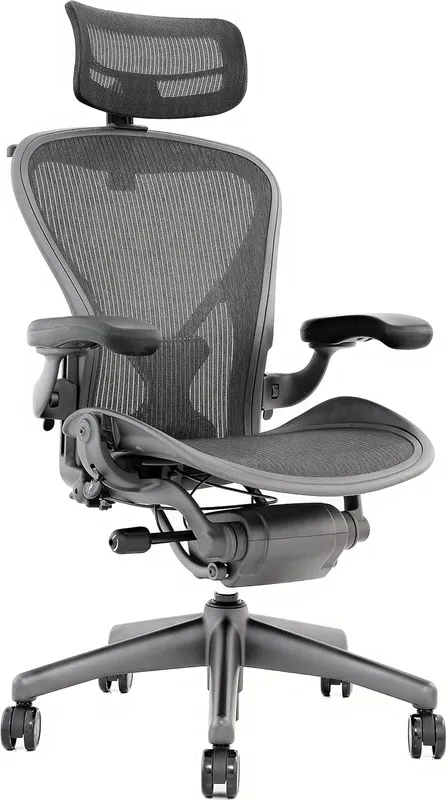
Price: ~$1,395 | Available in Size A, B (standard), and C (large)
The Aeron is the best chair for sciatica for one specific reason that doesn't apply to most other chairs: it has no seat pan. You sit on a suspended mesh, which distributes weight across the entire seating surface without any hard edges. There's nothing to press into the back of your thighs because there's no rigid seat structure.
The PostureFit SL lumbar support targets both the lumbar and sacral regions with separate adjustments. For sciatica, this matters because the sacral support can be set independently to reduce the pelvic tuck that contributes to nerve compression.
The tilt system has a forward tilt option. The seat pan can go slightly forward past neutral, which opens the hip angle and reduces posterior thigh pressure.
It comes in three sizes. Size B fits most people up to about 5'11" and 230 lbs. If you're larger, Size C is worth the extra cost.
Pros
- Suspension mesh = no seat edge to compress the sciatic nerve
- PostureFit SL targets both lumbar and sacral support separately
- Forward tilt available on all configurations
- Seat depth adjusts 1 inch, multiple height options
Cons
- Most expensive chair in this guide by a wide margin
- The mesh seat feels firm until it breaks in, usually 2 to 4 weeks
- Size B has limited recline range compared to larger models
Check Herman Miller Aeron price on Amazon
Steelcase Leap V2: Best for sciatica adjustability
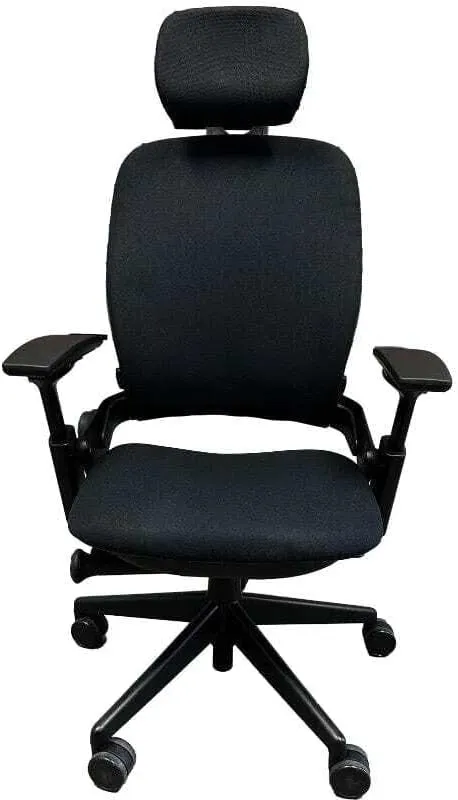
Price: ~$1,500
The Leap V2 has a feature most chairs don't: adjustable seat edge firmness. The front edge of the seat can be set to a softer position, which reduces the pressure that triggers sciatic pain. Combined with a seat that adjusts forward and back 2 inches, this is the most targeted sciatica-specific adjustment on any chair in this price range.
The LiveBack system flexes to match the shape of your spine as you move. Unlike chairs with a rigid lumbar pad in one position, the Leap's backrest shifts with you. It doesn't require you to sit in one fixed position to benefit from lumbar support.
It's more expensive than the Aeron and less widely stocked, but sciatica sufferers who've tried both often prefer the Leap specifically because of the seat edge adjustment.
Pros
- Adjustable seat edge firmness, which directly targets the main sciatica trigger
- 2-inch seat depth adjustment
- LiveBack technology adapts to spine movement
- Lower lumbar support is highly adjustable in height and firmness
Cons
- Most expensive option in this guide
- No suspension mesh. It's foam, which some sciatica sufferers find less forgiving
- Taller users may find the backrest doesn't extend high enough
Check Steelcase Leap V2 price on Amazon
Humanscale Freedom: Worth it if you can't stay still
Price: ~$1,200
If your sciatica gets worse when you stay in one position too long, the Freedom is worth looking at. Its recline system is weight-responsive: the resistance automatically matches your body weight, so leaning back feels natural without having to dial a tension knob. This makes it easier to actually move and recline throughout the day instead of staying locked upright.
The seat has a waterfall edge and adjusts in depth. The lumbar support pivots automatically as you recline, staying in contact with your lower back through the full range of motion rather than pushing you forward when you lean back.
The downside is fewer discrete adjustments than the Aeron or Leap. If you need to precisely target a specific lumbar level, the Freedom is less configurable.
Pros
- Weight-sensitive recline encourages movement rather than static sitting
- Automatic lumbar stays in contact through full recline range
- Waterfall seat edge reduces thigh pressure
- Cleaner aesthetic than most ergonomic chairs
Cons
- Fewer adjustment points than the Aeron or Leap V2
- Arm height range is limited
- Refurbished units are the only affordable option for most people
Check Humanscale Freedom price on Amazon
Branch Ergonomic Chair: Best budget pick
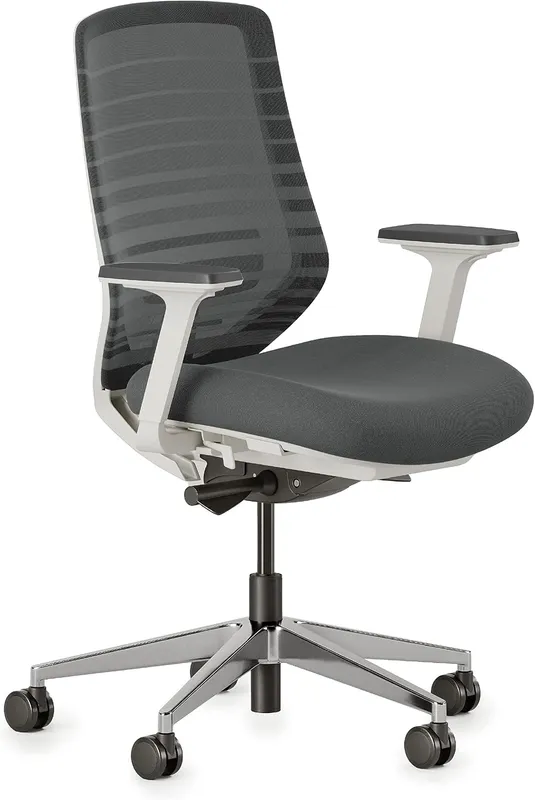
Price: ~$299
The Branch Ergonomic Chair is the most complete budget ergonomic chair for sciatica. It has a waterfall seat edge, adjustable lumbar support that moves up and down (not just in and out), 2 inches of seat depth adjustment, and seat height range that covers 5'0" to 6'3" without issues.
Most chairs under $300 compromise on either the seat or the lumbar. The Branch doesn't. The seat edge is softer than most budget chairs, and the lumbar pad has enough range to actually hit the right vertebral level for most people.
The armrests adjust in height and width but not depth or pivot. That's the main ergonomic limitation. For sciatica specifically, arm adjustability matters less than seat design, so this is a reasonable trade.
Pros
- Waterfall seat edge reduces posterior thigh pressure
- Adjustable lumbar height (not just depth)
- 2-inch seat depth adjustment
- Available in standard and tall configurations
Cons
- Arm rests don't adjust in depth or pivot
- Foam seat compresses more than mesh over time
- Customer service is slower than Herman Miller or Steelcase
Check Branch Ergonomic Chair price on Amazon
FlexiSpot C7: Best budget with seat depth adjustment
Price: ~$300
For sciatica on a budget, the C7 earns its spot because of two things: adjustable seat depth and a self-adaptive dynamic lumbar.
Adjustable seat depth means you can match the seat length to your thigh, so the front edge isn't forced against the back of your legs. That edge pressure is the main mechanical trigger for sciatic pain in a chair. The Branch Ergonomic Chair (also in this guide) doesn't have seat depth adjustment. The C7 does.
The self-adaptive lumbar doesn't sit at a fixed point. It tracks your spine's position as you move and shift. For sciatica, which varies based on posture and movement, lumbar support that follows you is more consistent than one set position.
The seat is foam, and it's not a waterfall design. For sciatica, this is the honest limitation: if your nerve compression comes specifically from a hard seat edge, the Aeron or Branch is a better match. But if your sciatica is more position and lumbar driven, the C7 addresses both. The mesh seat option at checkout is worth considering if you sit for 6+ hours.
The 10-year warranty at $300 is unusual and worth noting.
Pros
- Adjustable seat depth prevents seat edge from cutting into thighs
- Self-adaptive lumbar tracks position changes
- Mesh back standard; mesh seat option available
- 10-year warranty
Cons
- Default foam seat, not a waterfall design
- Recommended height 5'5" to 6'11", doesn't fit shorter users
- 3D armrests only, no pivot
Check FlexiSpot C7 price on FlexiSpot
What about seat cushions?
If you already have a chair you like, a seat cushion with a coccyx cutout removes pressure from the tailbone and the area where the sciatic nerve is closest to the surface. These work best as a supplement to an adjustable chair, not a replacement for one. They're worth trying at $30 to $50 before spending $300 to $1,400 on a new chair.
FAQ
What type of chair is best for sciatica? Chairs with suspension mesh seats (no hard edges), adjustable seat depth, and lumbar support that can be positioned at the right spinal level. The Herman Miller Aeron is the most specifically suited for sciatica due to its mesh seat and adjustable sacral support.
Can a bad chair cause sciatica? Prolonged sitting in a chair that compresses the posterior thigh, causes a posterior pelvic tilt, or lacks lumbar support can aggravate existing sciatica and potentially contribute to the disc issues that cause it. Whether it "causes" sciatica from scratch depends on other factors, but chairs definitely make it better or worse.
How should I sit with sciatica? Keep your feet flat on the floor or footrest, hips level or slightly higher than knees, lumbar curve supported, and the seat edge not pressing into the back of your thighs. Stand up at least once every 45 to 60 minutes. Movement helps more than any chair setting.
Is a standing desk helpful for sciatica? Yes, for most people. Alternating between sitting and standing reduces the time the sciatic nerve is compressed.
It doesn't fix sciatica, but it prevents the prolonged static load that makes it worse. See our best standing desks for home office guide for what to pair with a sciatica-friendly chair.
Should I get a lumbar roll or a new chair? Start with a lumbar roll if your existing chair has good adjustability. If your chair has a firm seat edge, poor seat depth, or no adjustability, the lumbar roll is a temporary fix, not a solution. A chair that addresses the root issue is worth the investment if you're sitting 6 to 8 hours a day.
Bottom line
The Herman Miller Aeron is the best chair for sciatica. Its suspension mesh eliminates the seat edge pressure that triggers nerve compression, and the PostureFit SL gives you independent lumbar and sacral adjustments. At $1,395 it's a significant investment, but it's a one-time purchase for a chair that lasts 15 to 20 years.
If you can't spend that, the Branch Ergonomic Chair covers the most important bases at $299: waterfall seat edge, adjustable lumbar height, and seat depth adjustment.
For more on building a sciatica-friendly desk setup, see our best standing desks for home office guide and best anti-fatigue mat for standing desk.
Prices verified July 2026. Check current prices before buying.
Essential Workstation Add-Ons Under $35
High-impact accessories verified by our research team to protect your cables and joints.
VIVO Under-Desk Cable Tray
Keeps power strips and heavy adapters off the floor so cables never yank when elevating.
ComfiLife Gel Anti-Fatigue Mat
High-density core reduces heel strike and lower back compression when standing 3+ hours.
VELCRO Brand ONE-WRAP (100pk)
Pre-cut reusable straps that easily unwrap for cord re-routing without scissors.
Soundance Ergonomic Laptop Stand
Elevates laptop screen 6 inches to eye level, preventing forward neck slouch.
Calculate Your Exact Desk & Chair Height
Slide to your height to see ANSI/BIFMA recommended standing and sitting presets.
Written by M. Haris
✓ BIFMA G1-2017 Certified EvaluatorFounder & Lead Workstation Ergonomics Researcher • 8+ Years Spec Testing
M. Haris leads ergonomic research at The Desk Riser, auditing manufacturer CAD schematics, motor cycle lifespan metrics, BIFMA weight load standards, and long-term user failure patterns across thousands of verified purchases. Every review is independent with 0% sponsored influence. Have questions or spot a warranty update? Email directly at support@thedeskriser.com, read the Author Dossier, or explore our Editorial Testing Methodology.
Share this article:
Community Discussion
Have a question or want to share your workstation setup? Join the discussion below.
Comments load automatically as you scroll down.