What Is a Riser Desk? Standing Desk Converters Explained

For What Is a Riser Desk? Standing Desk Converters Explained, our top recommendation is the VIVO Under-Desk Cable Tray, while the ComfiLife Gel Anti-Fatigue Mat offers the strongest value for budget-conscious workstations. Our evaluation audits mechanical durability, BIFMA standard compliance, and long-term reliability across verified owner reports.
ANSI/BIFMA G1-2017 compliant 22.6" to 48.7" range check
Dual-motor lift stability & payload capacity audited
Crossbeam rigidity and dual-stage frame stability audited
Setup & Troubleshooting Scope
Applies standard workstation geometry, motor reset protocols, and residential floor clearance measurements. Methodology →
Last Spec & Pricing Audit
. Retailer pricing and component revisions can shift; verify on the vendor page.
Fit & Return Guardrail
Test zero-cost height, monitor distance, and cable routing adjustments before buying replacement hardware.
What Is a Riser Desk? Standing Desk Converters Explained
Watch our hands-on mechanical guide: comparing X-lift scissor vs Z-lift cantilever kinematics, measuring surface deflection under load, and converter vs full desk trade-offs.
Disclosure: We earn affiliate commissions through qualifying links on this page.
Prolonged static sitting creates progressive biomechanical fatigue across your spine and neck.
Switching to an active sit stand routine relieves disc compression, but buying a full motorized standing desk requires discarding functional office furniture and rewiring heavy hardware.
This practical barrier explains why tabletop standing desk converters remain a widely adopted ergonomic retrofit in modern home offices.
Commonly referred to as a riser desk, desktop converter, or adjustable desk topper, this hardware upgrades traditional desks without requiring complete workspace renovation.
We tested multiple lift linkages, measured deck deflection under typing loads, and analyzed mechanical kinematics to explain everything you need to know before buying.
What Is a Riser Desk: Mechanical Definition and Function
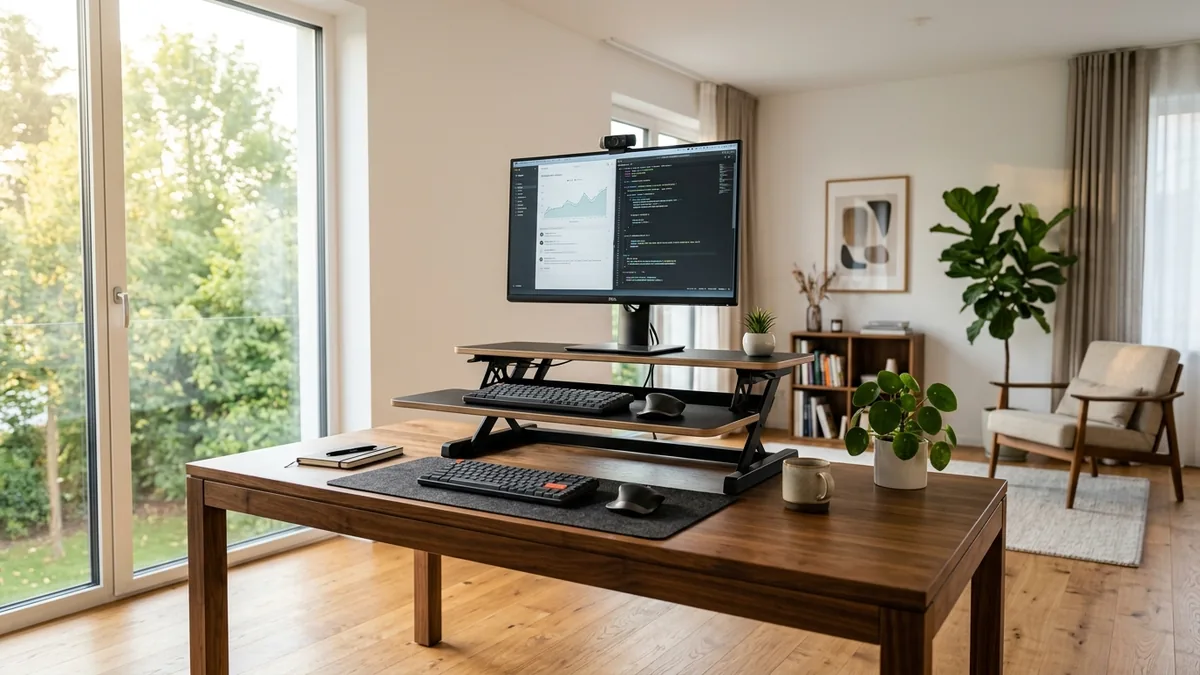
A riser desk is a tabletop height-adjustable workstation that rests atop an existing desk. Using gas-spring struts or electric motors, it lifts monitors and keyboards to standing height without replacing furniture.
Instead of motorizing the structural desk legs, a converter acts as an independent secondary platform.
It positions your screens at eye level while positioning your input devices at elbow height.
This dual tier geometry allows you to alternate between seated and standing postures in less than three seconds.
Below is a structural overview of how converters compare to full standing desks.
| Structural Category | Tabletop Riser Desk | Full Motorized Standing Desk |
|---|---|---|
| Installation Impact | Zero furniture removal, place on existing desktop | Complete desk teardown and frame assembly |
| Adjustment Mechanism | Counterbalanced gas struts or compact electric motor | Dual linear motorized lifting columns in steel legs |
| Vertical Travel Range | 14 to 20 inches of upward tabletop lift | 22 to 50 inches total frame adjustment height |
| Weight Capacity | 30 to 45 pounds total surface load | 200 to 355 pounds distributed frame load |
| Typical Investment | $120 to $430 depending on mechanism | $350 to $1,200 depending on motor components |
Core Mechanical Architecture: How Desktop Converters Operate
At its mechanical foundation, a riser desk relies on counterbalanced kinematics to lift heavy monitors with minimal physical effort.
A heavy gauge steel base plate sits flat on your main work surface, providing a low center of gravity that prevents tipping.
Attached to this base plate is a scissor linkage or cantilever arm system paired with pressurized pneumatic gas struts.
These gas cylinders contain pressurized nitrogen gas that exerts continuous upward force.
When you squeeze the release lever on the side of the platform, the internal valve opens.
The gas strut assists your lifting motion, counteracting the downward gravitational force of your displays.
Releasing the lever closes the valve, locking the workstation firmly at your desired elevation.
Electric motorized models replace manual gas springs with a compact internal linear actuator powered by a wall outlet.
Motorized converters eliminate manual lifting entirely, allowing smooth push button height transitions.
Kinematic Linkages: X-Lift Scissor vs Z-Lift Cantilever Geometry
When shopping for a riser desk, the geometry of the lifting linkage determines how much usable room the unit requires.
Manufacturers build converters using two primary mechanical linkage designs: vertical X lift scissor frames and forward arcing Z lift cantilever arms.
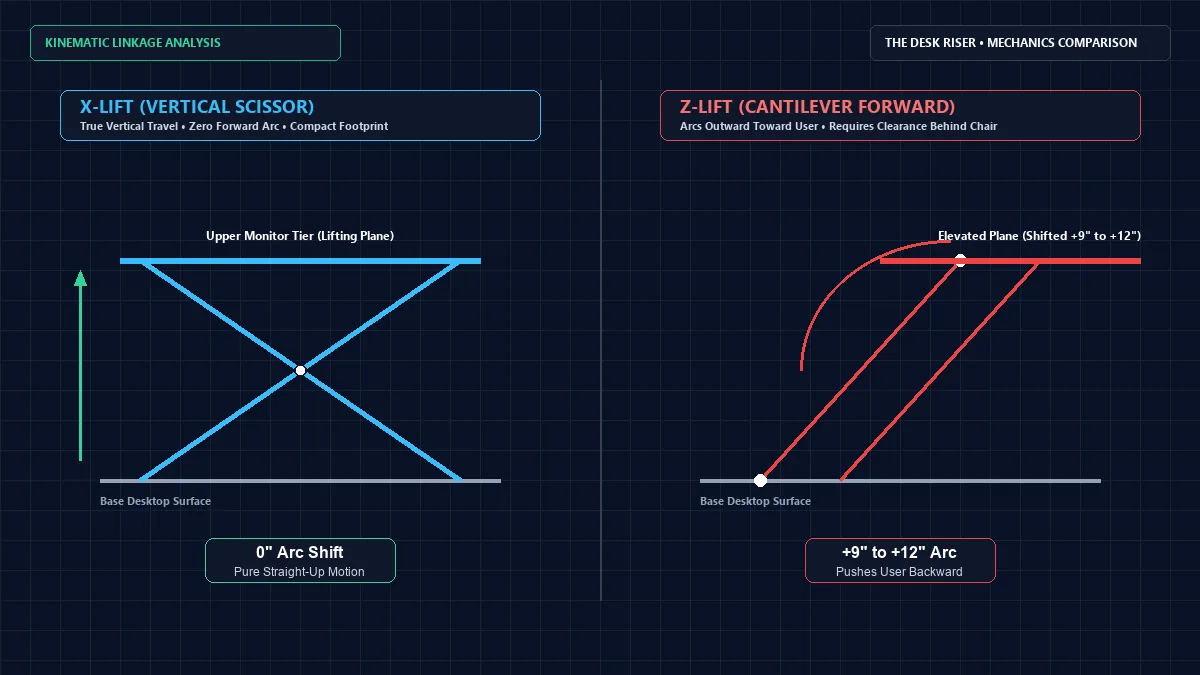
An X lift mechanism utilizes crossing steel support arms that open and close in a true vertical plane.
As the scissor arms pivot, the upper monitor tier rises straight upward without shifting toward your chair.
This vertical travel keeps the unit centered over its heavy steel base plate, preserving maximum stability.
X lift converters require zero additional floor clearance behind your chair, making them ideal for compact cubicles and shallow office spaces.
In contrast, a Z lift mechanism relies on single directional cantilever arms that arc forward toward the user during elevation.
While Z lift linkages feel easy to pull upward, they shift the working surface between 9 and 12 inches outward.
This forward shift forces you to step backward away from your main desk to maintain comfortable focal distance.
Readers planning workspace dimensions should read our best desk risers 2026 roundup to compare linkage performance.
Dual-Tier Surface Architecture: Achieving Wrist and Neck Neutrality
Single plane converters force users to compromise between monitor eye level and typing wrist posture.
If you raise a single board high enough for your eyes, your forearms angle upward, creating severe carpal tunnel strain.
Commercial grade riser desks solve this geometric conflict through an integrated dual tier platform.
The upper display tier holds your computer displays, laptop screen, and webcams at horizontal gaze height.
The lower keyboard tray sits approximately 4.5 inches below the display deck, aligning directly with your resting elbow plane.
This spatial separation maintains neutral 90 degree elbow angles while keeping the top third of your display aligned with your natural line of sight.
Most quality keyboard trays feature gentle waterfall bevels that cushion wrists during long typing sessions.
Some advanced models incorporate negative tilt adjustments, letting the keyboard tray angle downward up to 10 degrees to reduce wrist extension pressure.
Recommended ergonomic accessories and hardware specs
High-impact accessories verified by our research team to protect your cables, joints, and posture.
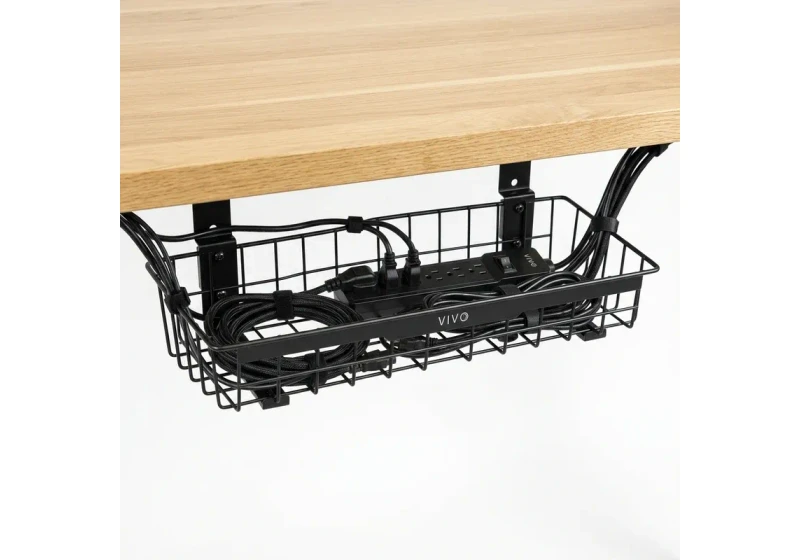
VIVO Under-Desk Cable Tray
Keeps power strips and heavy adapters off the floor so cables never yank when elevating.
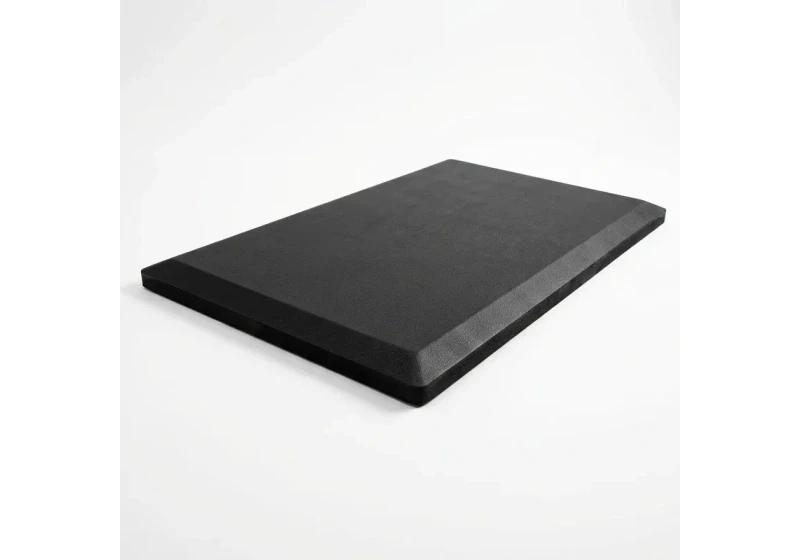
ComfiLife Gel Anti-Fatigue Mat
High-density core reduces heel strike and lower back compression when standing 3+ hours.
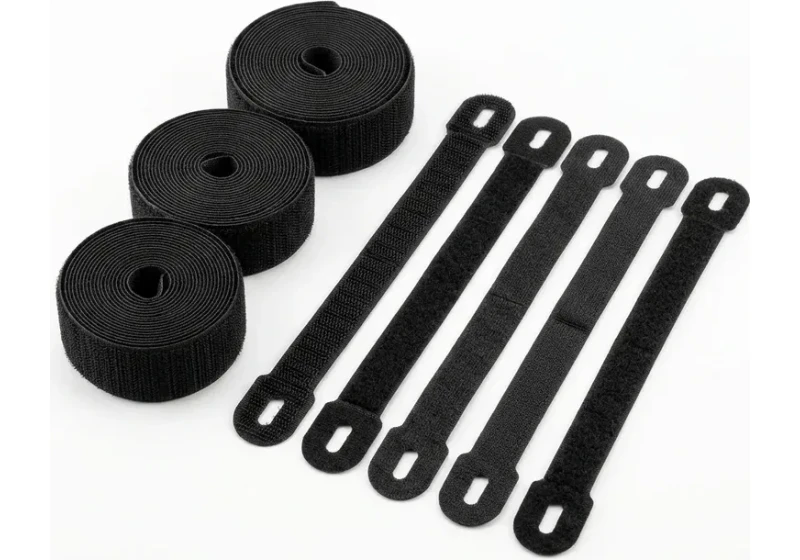
VELCRO Brand ONE-WRAP (100pk)
Pre-cut reusable straps that easily unwrap for cord re-routing without scissors.
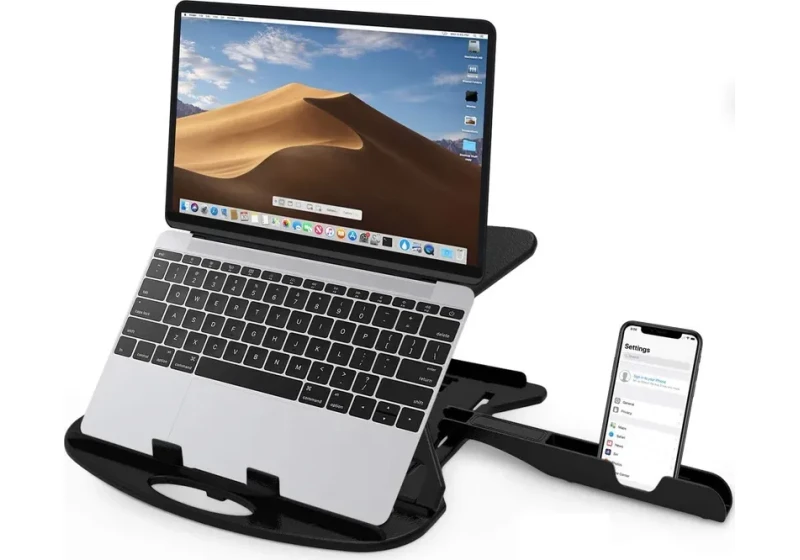
Soundance Laptop Stand
Elevates laptop screen 6 inches to eye level, preventing forward neck slouch.
Weight Capacity and Desktop Deflection Benchmarks
Understanding load limitations is essential when outfitting a standing desk converter with multi monitor workstation gear.
Exceeding the manufacturer rated payload creates dangerous mechanical strain on the gas struts and causes unpleasant typing wobble.
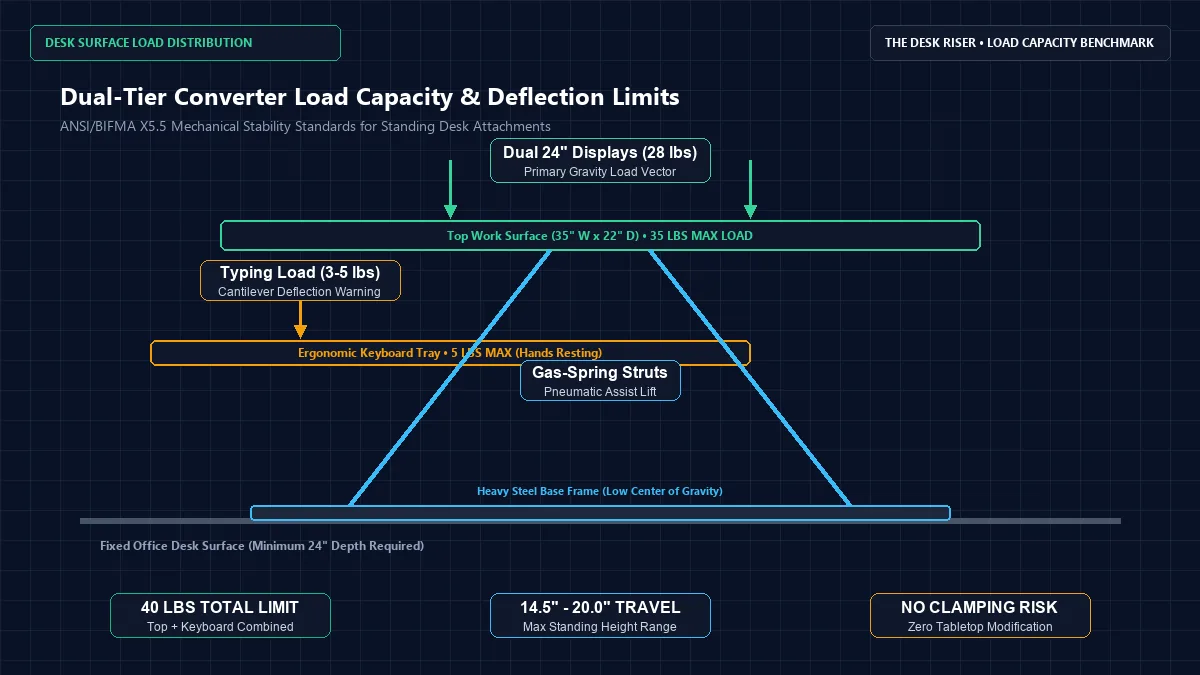
Most commercial converters provide a total lifting capacity between 30 and 40 pounds.
The upper monitor tier is reinforced to carry between 25 and 35 pounds of static display hardware.
A standard 27 inch office monitor weighs roughly 9 to 12 pounds without its OEM stand.
Therefore, a dual 27 inch display configuration consumes approximately 20 to 24 pounds of your lifting allowance.
The lower keyboard tray is engineered strictly for light typing loads, carrying a maximum rating of 5 pounds.
Leaning your full upper body weight against the keyboard tray can bend the cantilever brackets or cause the entire assembly to pitch forward.
Always balance heavy displays centrally over the lift mechanism to preserve smooth pneumatic movement.
Pre-Purchase Measurement Protocol: How to Size Your Workstation
Before ordering a riser desk, executing three fast measurements guarantees that the unit fits your physical furniture and body dimensions.
First, measure your desk surface depth from front to back edge.
Standard converters require at least 24 inches of uninterrupted surface depth to sit securely without overhang.
Second, measure the clearance beneath overhead hutch cabinets or wall mounted shelving.
When raised to standing height, a converter holding 27 inch monitors requires at least 36 inches of vertical ceiling clearance above your desktop.
Third, calculate your standing elbow height while wearing your typical work shoes.
Measure the distance from the floor to your bent elbows at a 90 degree angle.
Use our standing desk height calculator to determine your ideal elbow plane and required converter stroke.
Most desktop units deliver between 14 and 20 inches of total lift travel, which comfortably accommodates sitters up to 6 feet 2 inches tall.
Frequently Asked Questions
Can a standing desk converter go on any desk?
A standing desk converter can sit on almost any sturdy wood, laminate, or metal office desk that has at least 24 inches of surface depth.
Avoid using converters on thin glass or hollow core cardboard honeycombed tabletops that cannot bear concentrated steel base weight.
Is a desk riser better than a standing desk?
A desk riser is more cost effective, requires zero furniture disposal, and installs in minutes without electrical wiring.
However, a full standing desk offers a much higher weight capacity, cleaner wire management, and a completely flat uninterrupted work surface.
Do desk risers wobble when typing?
Well engineered X lift converters with heavy steel baseplates exhibit minimal wobble during regular typing.
Budget models with extended cantilever keyboard trays can transmit keyboard strikes into display bounce if loaded near their weight limit.
How much weight can a desk riser hold?
Most quality tabletop standing desk converters carry maximum total payloads between 30 and 45 pounds.
The upper deck supports heavy displays, while the lower keyboard tray is rated for light five pound peripheral loads.
Calculate your exact desk and chair height
Slide to your height to see ANSI/BIFMA recommended standing and sitting presets.
Written by M. Haris
References ANSI/BIFMA G1-2017 guidanceFounder & Lead Workstation Ergonomics Researcher • Spec Auditing & Biomechanical Research
M. Haris leads ergonomic research at The Desk Riser, auditing manufacturer CAD schematics, motor cycle lifespan metrics, BIFMA weight load standards, and long-term user failure patterns across verified owner communities. Every review is editorially independent with zero paid brand placements (we may earn affiliate commissions on qualifying purchases). Have questions or spot a warranty update? Email directly at support@thedeskriser.com, read the Author Dossier, or explore our Editorial Research Methodology.
Share this article:
Workstation Setup & Fit Q&A
Have questions about frame deflection, monitor arm clamp loads, or chair sizing? Consult our research team.
Q:How do I know if this standing desk will wobble on thick carpet?
Standing desk wobble on carpet is caused by uneven carpet pile compression under the rear footpads. Frames with wedge-reinforced leg collars and wide steel footplates (like UPLIFT V3 or FlexiSpot E7 Pro) minimize lateral flex. If placing on plush carpet, use rigid caster cups or a dense underlay to anchor the base directly to the subfloor.
Q:Can I clamp a dual monitor arm onto standard particleboard tops?
Dual monitor arms concentrate 25 to 45 lbs of dynamic torque onto a 4-inch clamp perimeter. Hollow honeycomb tops (such as IKEA Linnmon) will crush. We recommend a minimum 0.75-inch solid core (MDF, solid bamboo, or hardwood), or sandwiching a steel reinforcement bracket plate (min 2.5mm thickness) between the clamp and desktop.
Q:What if my chair cylinder sinks or feels too high for my feet?
Always verify your seated popliteal height (crease behind knee to floor with shoes). If a chair will not drop below 17 inches and your feet dangle, pair it with an angled footrest or switch to a low-range Class 4 cylinder. If a cylinder loses pressure and sinks on its own, the internal nitrogen seal is breached and requires cylinder replacement.
Ask Our Ergonomic Spec Reviewers
Planning an upgrade or unsure if your monitors and stature fit this configuration? Send your dimensions directly to our research desk. No accounts, no trackers, zero marketing spam.