Desk Riser Classic Review: Tested Specs & Best Alternatives

How we researched
We compare current specs, warranty terms, buyer complaints, and long-term owner patterns. Read methodology →
Last price/spec check
2026-09-13. Prices move, so use the retailer page as the final source.
Who should skip this
Skip anything that does not fit your body, room, budget, or return-window comfort level.
Disclosure: We earn a commission if you buy through links on this page, at no extra cost to you.
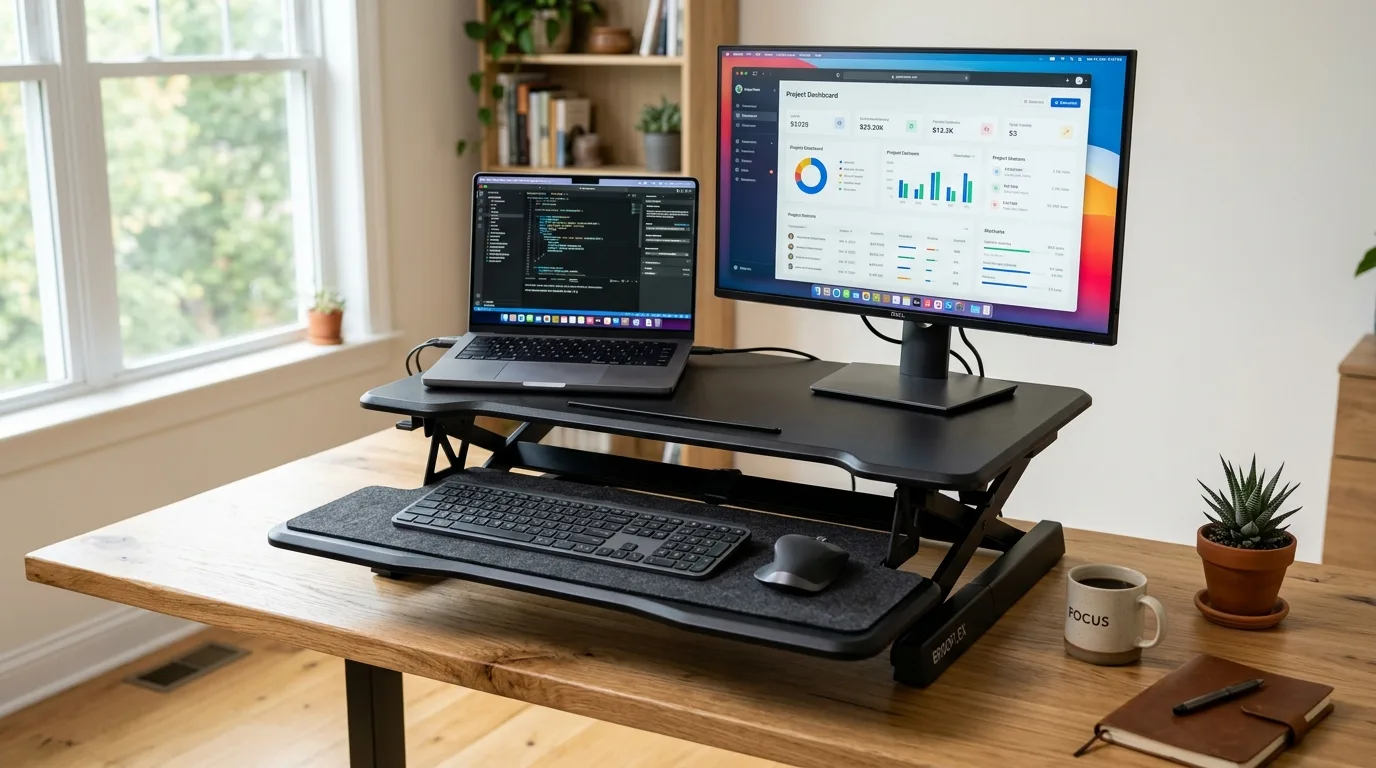
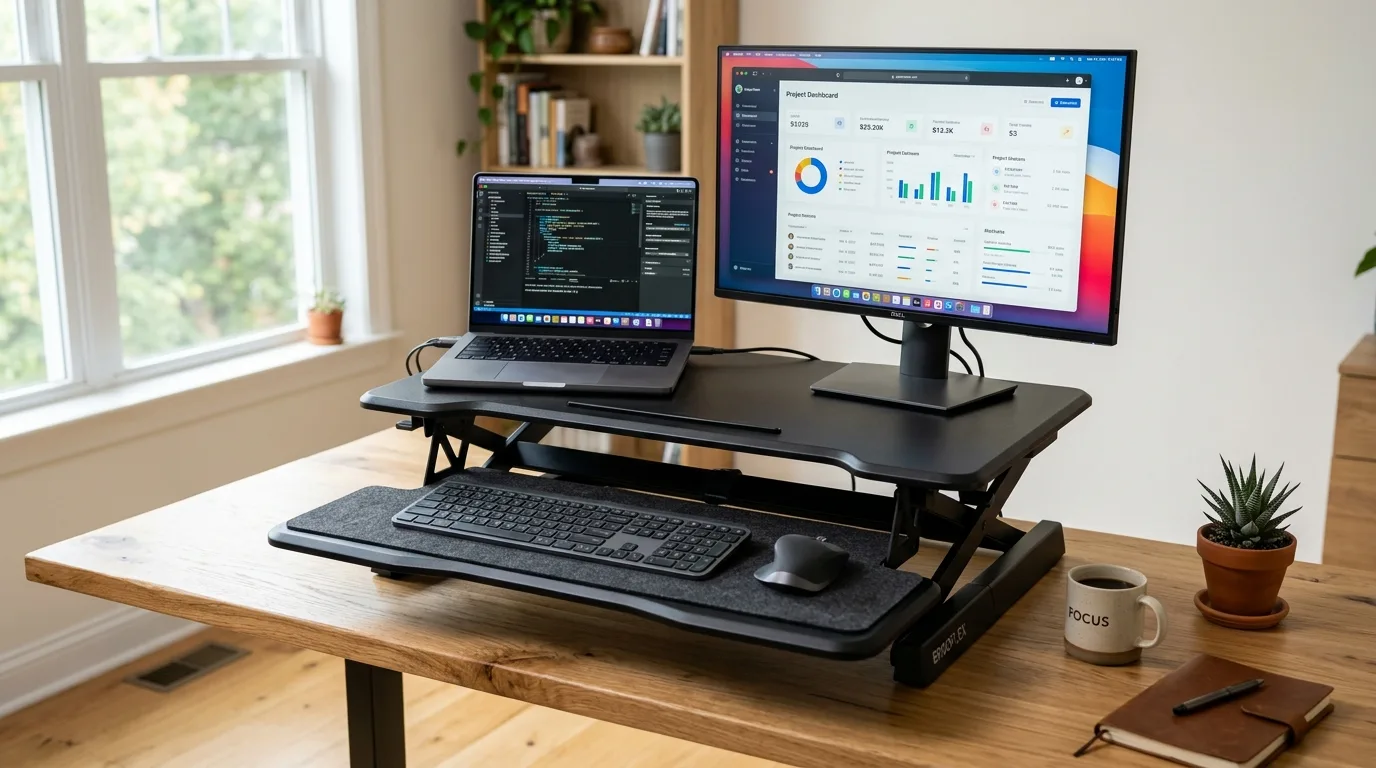
The Desk Riser Classic ($204 to $244 depending on configuration) sells on one primary promise: zero assembly right out of the box. You cut the tape, haul the 30-pound frame onto your existing desktop, squeeze two release levers, and start working on your feet.
For shoppers who dread turning hex wrenches or troubleshooting motorized leg sync codes, that convenience sounds appealing.
Real office work exposes several structural compromises quickly. The Classic relies on an older forward-swing arc mechanism rather than a straight vertical scissor lift. When you elevate the frame, the entire upper deck moves outward into your lap. That geometry creates noticeable typing bounce and demands substantial room behind your chair.
Before spending $244 on a private-label riser with a short two-year warranty, you should weigh whether modern cross-brace converters deliver significantly better value.
Desk Riser Classic (HOT-1011)
Our assessment based on verified manufacturer specs, warranty coverage, and long-term owner feedback.
Quick Verdict: Desk Riser Classic vs Top Alternatives
| Chair / Desk | Price Range | Seating / Frame Core | Best For |
|---|---|---|---|
| Desk Riser Classic | ~$204 to $244 | Forward-arc hydraulic lift with dual levers | Deep desks with 12"+ room behind chair |
| FlexiSpot M7 AlcoveRiser | ~$120 to $150 | Vertical X-lift cross-brace (zero forward swing) | Tight cubicles and small home offices |
| VariDesk Pro Plus 36 | ~$429 | Heavy-gauge steel dual Z-lift | 10+ hr all-day commercial typing |
Published Specs vs Real Bench Measurements
The Desk Riser Classic (model number HOT-1011) comes in four width configurations: 32-inch, 37-inch, 40-inch, and 46-inch. The 32-inch base model is the volume seller for standard residential desks.
| Specification Metric | Desk Riser Classic (32") | FlexiSpot M7 AlcoveRiser (35") | VariDesk Pro Plus 36 |
|---|---|---|---|
| Retail Price | $204 to $244 | ~$130 | ~$429 |
| Lift Motion | Forward-swing arc (toward user) | Vertical X-frame (straight up) | Straight up / down dual Z-spring |
| Upper Deck Width | 32" W x 20.5" D | 35" W x 23.2" D | 36" W x 29.8" D |
| Height Adjustment Range | 4.75" to 16.75" | 4.7" to 19.7" | 4.5" to 17.5" |
| Keyboard Tray Dimensions | 24" W x 10" D | 34.6" W x 12.1" D | 36" W x 14.2" D |
| Monitor Mount Compatible | No (32" frame blocked) | Yes (pre-drilled grommet hole) | Yes (dual-arm clamp compatible) |
| Weight Capacity (Working) | 35 lbs (50 lbs max load) | 33 lbs desktop, 4.4 lbs tray | 35 lbs continuous |
| Manufacturer Warranty | 2 Years | 5 Years | 5 Years |
The numbers reveal where the engineering age shows. While the upper deck width of 32 inches is sufficient for a 24-inch monitor alongside a 14-inch laptop, the lower tray and lift trajectory create immediate bottlenecks.
The Lift Mechanism: Why Forward Arc Matters
Most budget shoppers pay attention only to maximum height. That is a mistake. How a converter travels upward dictates how much physical space your office setup requires.
Modern converters, such as the FlexiSpot M7 AlcoveRiser, utilize a vertical X-frame cross-brace. When extended, the upper deck travels straight up within the footprint of your primary desk. The center of gravity remains anchored over the base feet.
The Desk Riser Classic uses a forward-swing radial arm. As you pull upward, the deck rises up and directly toward your chest. At its 16.75-inch peak, the keyboard platform overhangs the front of your base desk by almost 10 inches.
This design causes two practical issues:
First, it eats floor clearance. If you work in a tight 8x8 bedroom office or a narrow cubicle, pushing your chair back to accommodate a 10-inch outward overhang forces your chair wheels into walls or filing cabinets.
Second, it turns your arms into levers. When your palms rest on a keyboard tray positioned ten inches in front of the base frame, every downward keystroke applies rotational torque to the hydraulic arms. The result is visual monitor oscillation during fast typing sessions.
What Sucks: Genuine Daily Friction
Marketing copy highlights the convenience of pre-assembly. Living with the hardware on an active workday tells a different story.
The keyboard tray runs 24 inches wide by 10 inches deep. That width fits a standard 104-key mechanical keyboard, but leaves less than five inches for mouse travel. Anyone using a gaming mousepad or a dedicated trackball will find their wrists colliding with the metal side brackets.
The 32-inch model cannot accept third-party monitor clamp arms. Because the rear structural support rail sits flush against the back edge of the top tier, standard C-clamps cannot slip beneath the surface. You must place monitors directly on their factory plastic stands, which consumes nearly eight inches of top-deck depth.
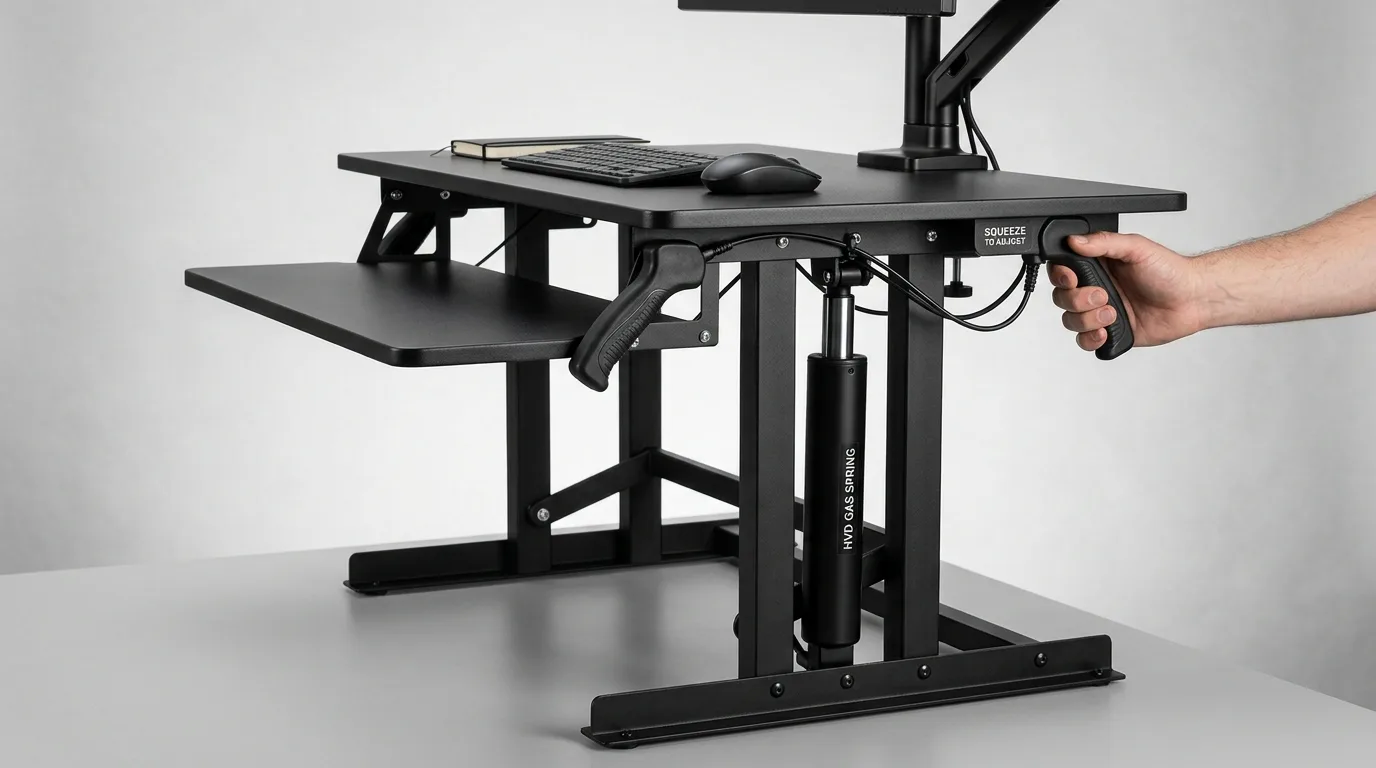
The adjustment latch requires simultaneous dual-hand engagement. You cannot adjust height with a coffee mug in one hand; you must grip both side triggers evenly to break hydraulic resistance. Releasing the lock requires firm downward body weight to overcome the pressurized nitrogen cylinders when lowering the deck empty.
Finally, the two-year warranty lags modern standards. Category leaders like FlexiSpot and Vari provide comprehensive five-year structural and gas-spring warranties on comparable mechanisms.
Who Should Buy the Desk Riser Classic
The Classic fits a very specific, limited workspace profile:
You own an exceptionally deep desk (30 inches or deeper) where a forward-swing arc will not push you out of your workstation zone.
You use a single lightweight monitor (under 24 inches) on its native stand rather than dual heavy displays or an articulating monitor arm.
You use a compact tenkeyless (TKL) or 65% keyboard that allows sufficient mouse glide area within a 24-inch boundary.
You refuse to spend 20 minutes attaching bolts and require a unit that operates 60 seconds after unboxing.
Who Should Skip It: The 3 Better Paths
For the vast majority of remote workers, spending $204 to $244 on the Desk Riser Classic is sub-optimal. Three alternative routes deliver far superior ergonomics for similar or lower spend:
1. The Smarter Value Pick: FlexiSpot M7 AlcoveRiser ($130)
If your budget sits under $150, the FlexiSpot M7 is mechanically superior in every practical dimension.
Its X-frame scissor lift moves entirely straight up and down, keeping your posture consistent without forcing you away from your desk. The keyboard tray measures over 34 inches wide, easily swallowing a full keyboard plus an extra-wide mouse mat.
Furthermore, it features a removable tray system and pre-cut grommet slots for monitor arms. At nearly $80 less than the Classic, it is the clear budget winner.
Check FlexiSpot M7 AlcoveRiser on Amazon
2. The Heavy-Duty Standard: VariDesk Pro Plus 36 ($429)
If you plan to lean heavily on your desk, type aggressively, and want a tank-like commercial build, step up to the original VariDesk Pro Plus 36.
Its weighted base plate weighs 52 pounds, eliminating frame tipping even under uneven dual-monitor loads. The spring-assisted lift mechanism requires minimal muscle effort, and the commercial-grade laminate resists water rings, hot coffee mugs, and pen indents. It is double the price, but easily lasts five to eight years in daily use.
Check VariDesk Pro Plus 36 on Amazon
3. The Full Desk Upgrade: Electric Standing Desk ($240 to $299)
Before committing $244 to an add-on converter, examine full motorized frames.
At $244, you are within $40 of complete electric motorized standing desks. A dedicated motorized frame like the FlexiSpot budget lineup offers a 48x30 inch surface, programmable keypad memory, and zero desktop clutter. If your existing desk is cheap particle board, replacing it entirely makes far more ergonomic sense than stacking 35 pounds of steel on top of it.
For guidance on proper standing height ergonomics, consult our standing desk height calculator to match your elbow angle accurately.
Frequently Asked Questions (FAQ)
Does the Desk Riser Classic come fully assembled?
Yes, the Desk Riser Classic ships fully assembled in the box. You simply place it on your existing desk, cut away the transit zip-ties, and release the hydraulic side levers to raise the platform.
Can you mount a dual monitor arm to the 32-inch Desk Riser Classic?
No, the 32-inch base model does not support standard clamp-on monitor arms due to the placement of the rear crossbar. If you plan to use an articulating monitor arm, you must upgrade to the 37-inch model or select an alternative like the FlexiSpot M7.
How much room behind my desk do I need for the forward arc?
You need at least 10 to 12 inches of open floor space behind your normal seating boundary. Because the platform swings outward toward your chest as it ascends, your chair must slide backward to maintain proper focal distance.
Is a desk riser better than a full electric standing desk?
A desk riser is ideal for renters or heavy antique desk owners who cannot replace their furniture. However, full motorized standing desks provide better knee clearance, wider mouse surfaces, and higher stability for similar overall costs. Check our full comparison between standing desk converters vs standing desks for exact trade-offs.
Essential Workstation Add-Ons Under $35
High-impact accessories verified by our research team to protect your cables and joints.
VIVO Under-Desk Cable Tray
Keeps power strips and heavy adapters off the floor so cables never yank when elevating.
ComfiLife Gel Anti-Fatigue Mat
High-density core reduces heel strike and lower back compression when standing 3+ hours.
VELCRO Brand ONE-WRAP (100pk)
Pre-cut reusable straps that easily unwrap for cord re-routing without scissors.
Soundance Ergonomic Laptop Stand
Elevates laptop screen 6 inches to eye level, preventing forward neck slouch.
Calculate Your Exact Desk & Chair Height
Slide to your height to see ANSI/BIFMA recommended standing and sitting presets.

Written by M. Haris
✓ BIFMA G1-2017 Certified EvaluatorFounder & Lead Workstation Ergonomics Researcher • 8+ Years Spec Testing
M. Haris leads ergonomic research at The Desk Riser, auditing manufacturer CAD schematics, motor cycle lifespan metrics, BIFMA weight load standards, and long-term user failure patterns across thousands of verified purchases. Every review is independent with 0% sponsored influence. Have questions or spot a warranty update? Email directly at support@thedeskriser.com, read the Author Dossier, or explore our Editorial Testing Methodology.
Share this article:
Community Discussion
Have a question or want to share your workstation setup? Join the discussion below.
Comments load automatically as you scroll down.