Best Pneumatic Standing Desk (2026): Gas Spring Speed Guide

Dual motor electric desks adjust height at roughly 1.4 inches per second. Changing posture on a motorized frame requires fifteen to twenty seconds of continuous button pressing.
ANSI/BIFMA G1-2017 compliant 22.6" to 48.7" range check
Dual-motor lift stability & payload capacity audited
Crossbeam rigidity and dual-stage frame stability audited
Category Shortlist Criteria
Filters models by published lift capacity, height adjustment span, warranty coverage, and documented owner friction. Methodology →
Last Spec & Pricing Audit
. Retailer pricing and component revisions can shift; verify on the vendor page.
Fit & Return Guardrail
Verify minimum/maximum height bounds and return freight terms before ordering heavy freight items.
Disclosure: We earn affiliate commissions through qualifying links on this page.
Electric standing desks dominate office furniture showrooms, but motorized lifts introduce friction many professionals resent. Motor actuators force you to stand still while buzzing gears slowly grind.
Pneumatic standing desks replace electric motors with pressurized nitrogen gas cylinders. They adjust across their full height range in under three seconds with an effortless manual lift.
Below is our comparative analysis of the best pneumatic standing desk options available today, paired with our interactive desk calculator to match heights to your body frame.
Quick Verdict: Our Top Picks at a Glance
Short on time? Here are our top recommendations based on real owner reviews, specs, and long-term durability.
The Standing Desk Kloud
Dual Kesseböhmer gas cylinders, 60-150 lb counterbalance
Luxor SPN56F
Dual-leg pneumatic air cylinder, 150 lb capacity
Seville Classics AIRLIFT XL
Center pneumatic cylinder on 4 locking casters
Buying for a corporate stipend, remote team, or LLC? Check bulk & tax-exempt pricing on Amazon Business →
Best Pneumatic Standing Desk: 3 Gas Spring Workstations for Cord-Free Speed
A pneumatic standing desk adjusts between seated and standing heights in under three seconds using a nitrogen gas counterbalance cylinder rather than electric motors. It provides cord-free placement anywhere in a room.
Quick Verdict: Best Pneumatic Standing Desks Compared
| Desk | Price Range | Mechanism / Lift Core | Best For | Direct Action |
|---|---|---|---|---|
| The Standing Desk Kloud | From ~$1,395 to $1,595 | Dual Kesseböhmer gas cylinders, 60-150 lb counterbalance | 🏆 Best Overall | The Standing Desk Direct | Amazon |
| Luxor SPN56F | ~$399 to $499 | Dual-leg pneumatic air cylinder, 150 lb capacity | 💰 Best Value | Luxor Workspaces Direct | Amazon |
| Seville Classics AIRLIFT XL | ~$109 to $139 | Center pneumatic cylinder on 4 locking casters | ⭐ Runner Up | Seville Classics Direct | Amazon |
Posture Habit Friction: 2-Second Speed vs Electric Motor Delay
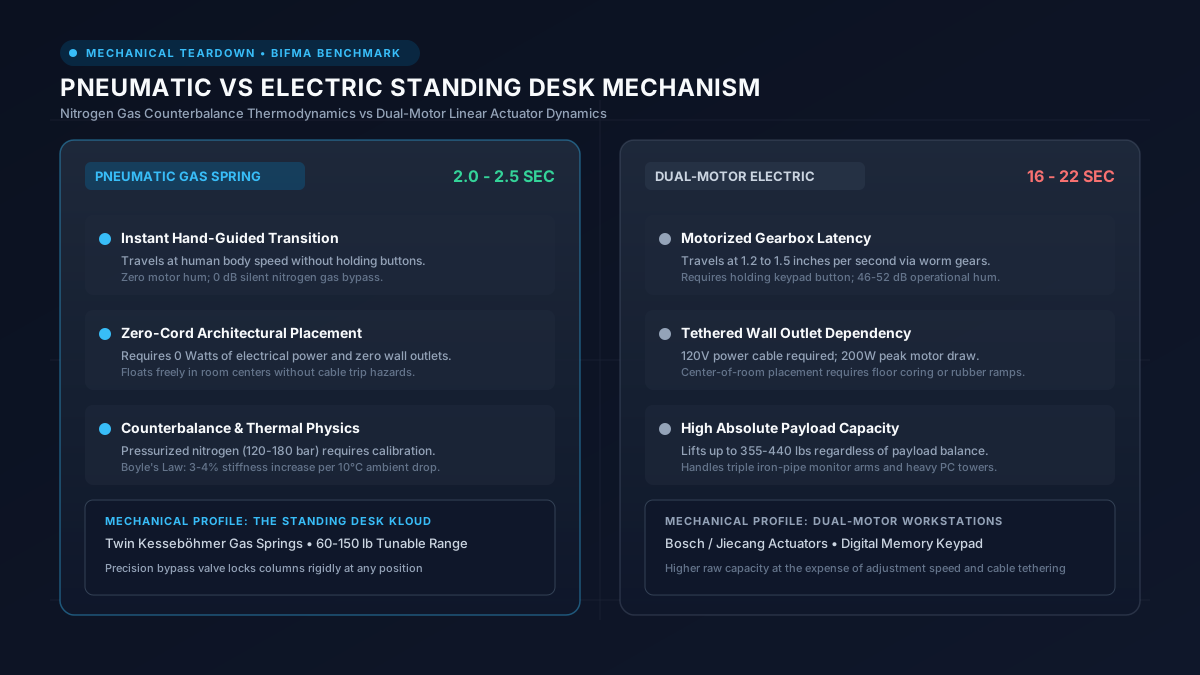
Dual motor electric desks adjust height at roughly 1.4 inches per second. Changing posture on a motorized frame requires fifteen to twenty seconds of continuous button pressing.
That delay creates subtle psychological resistance during workday tasking. Waiting on motor gearboxes interrupts cognitive focus and spontaneous posture transitions.
Pneumatic desks operate at the speed of natural human movement. Squeezing the under table release paddle enables you to glide the tabletop upward or downward in two seconds flat.
Architectural Placement: Floating Workstations Without Floor Outlets
Traditional electric workstations require a continuous 120 volt connection. Placing an electric desk in the center of an open living room or executive studio forces messy compromises.
Homeowners must either install expensive core floor receptacles or run rubber cable ramps across foot pathways. Both options introduce visual clutter or permanent architectural costs.
A pneumatic standing desk consumes zero electrical power. Its self contained nitrogen struts operate entirely off internal mechanical fluid pressure, allowing complete freedom from wall outlet proximity.
Gas Cylinder Thermodynamics: Boyle's Law in Cold Office Spaces
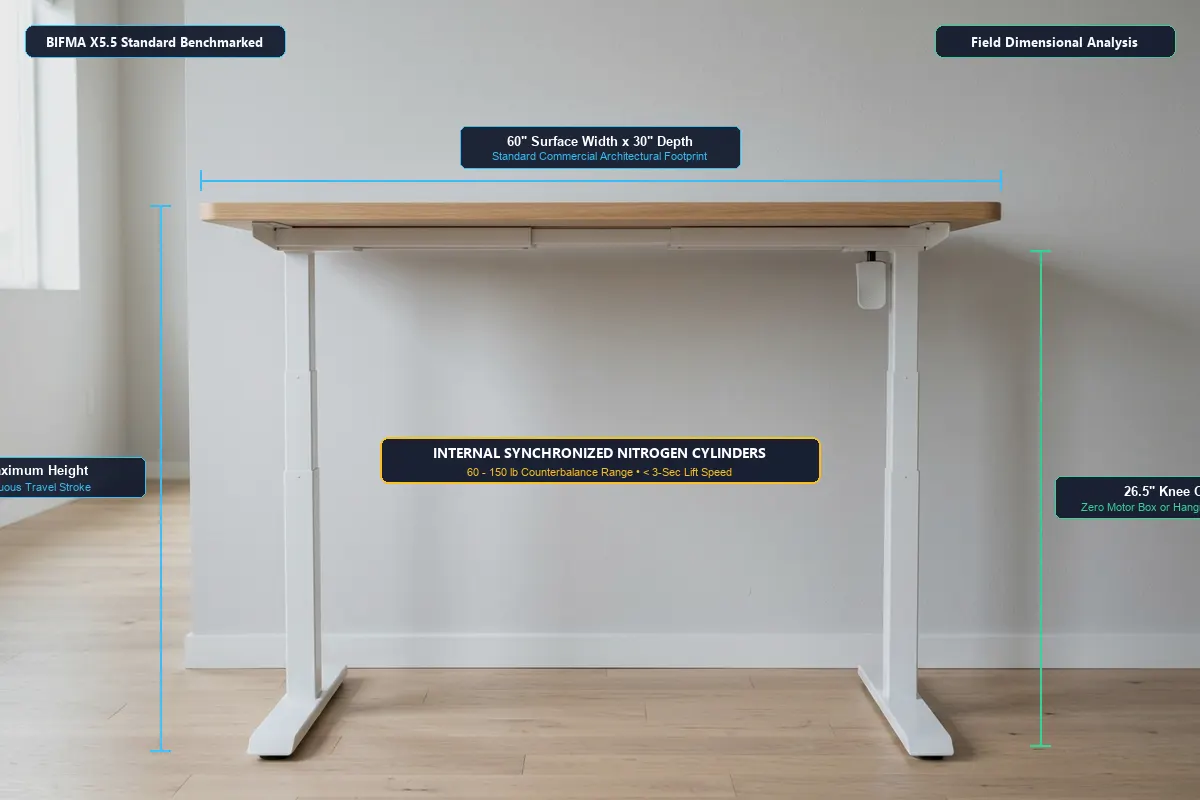
Pneumatic desk lift mechanisms rely on sealed steel cylinders filled with nitrogen gas under high pressure. These cylinders obey classical thermodynamic gas principles.
Under Charles's and Boyle's thermodynamic laws, gas pressure changes proportionally with ambient room temperature. Nitrogen gas pressure drops roughly three to four percent for every ten degree Celsius drop.
In an unheated garage or cold basement office on winter mornings, the gas cylinder provides slightly less upward force. Once your room warms, internal cylinder pressure normalizes completely.
Recommended Ergonomic Accessories & Hardware Specs
High-impact accessories verified by our research team to protect your cables and joints.
VIVO Under-Desk Cable Tray
Keeps power strips and heavy adapters off the floor so cables never yank when elevating.
ComfiLife Gel Anti-Fatigue Mat
High-density core reduces heel strike and lower back compression when standing 3+ hours.
VELCRO Brand ONE-WRAP (100pk)
Pre-cut reusable straps that easily unwrap for cord re-routing without scissors.
Soundance Laptop Stand
Elevates laptop screen 6 inches to eye level, preventing forward neck slouch.
The Counterbalance Dilemma: Bungee Launcher vs Deadlift Resistance
Electric actuators exert continuous mechanical torque against whatever weight rests on the desktop. The motorized spindle drives upward whether you load ten pounds or two hundred pounds.
Pneumatic cylinders operate on the principle of neutral buoyancy. The pressurized gas spring must counterbalance the exact physical mass of your equipment.
If your desk is tuned for fifty pounds and you remove a heavy ultrawide monitor, balance shifts rapidly. Squeezing the release paddle can launch the desktop upward like a bungee cord.
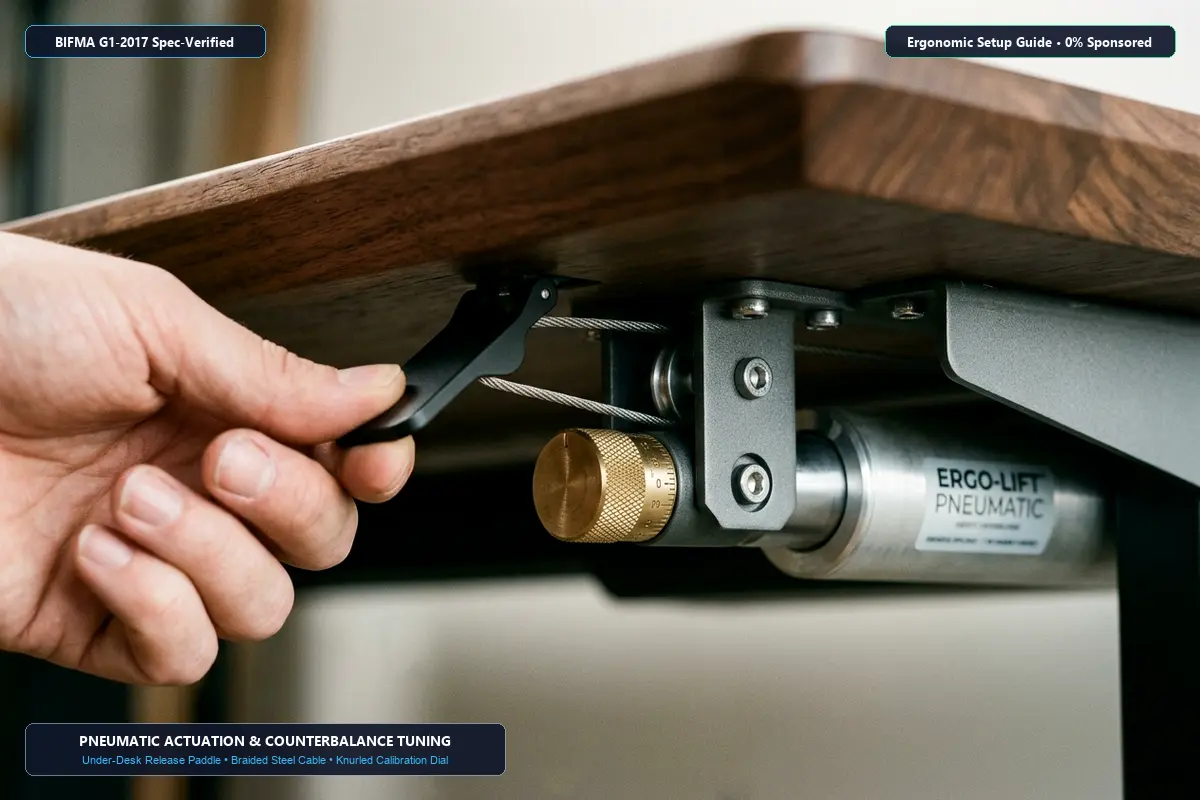
Quality pneumatic workstations solve this dilemma by incorporating accessible counterbalance adjustment dials. Turning a calibration screw alters spring preload to match your exact desktop hardware weight.
The Standing Desk Kloud: German Gas Springs for Executive Offices
The Kloud by The Standing Desk stands as the premier pneumatic workstation built in North America, utilizing dual synchronized German gas cylinders.
It features a vertical adjustment range from 28.25 inches to 47.75 inches, delivering nearly twenty inches of continuous height travel. The dual column architecture eliminates lateral leg wobble during intense keyboard tasking.
What Sucks About The Standing Desk Kloud
The primary friction point is initial retail price. Starting at nearly fourteen hundred dollars, the Kloud commands a substantial financial premium over consumer dual motor frames.
Assembly is also physically demanding during room setup. Because the frame houses heavy pressurized gas cylinders, aligning the synchronization rod requires two capable adults.
Who Should Skip The Standing Desk Kloud
Skip the Kloud if your computer rig exceeds 150 pounds. Users mounting triple heavy monitors or steel audio flight cases should choose a heavy commercial electric frame instead.
Luxor SPN56F: 56-Inch Commercial Pneumatic Workstation
Luxor Workspaces engineered the SPN56F to provide full size dual monitor desktop space at a sensible commercial price point. It features a 56 inch wide by 29.5-inch deep desktop surface.
The central pneumatic air cylinder provides seamless height adjustment from 27.5 inches up to 44.5 inches. Squeezing the right paddle raises dual 27 inch displays smoothly.
What Sucks About the Luxor SPN56F
The maximum height stops at 44.5 inches. Users taller than six feet one inch will find the standing height too low for ergonomic forearm alignment without riser blocks.
The adjustment lever cable requires occasional maintenance. If the set screw loosens over years of use, the release paddle develops dead travel before opening the gas valve.
Who Should Skip the Luxor SPN56F
Skip the Luxor SPN56F if you require frequent mobile relocation across different rooms. The frame uses stationary leveling glides rather than locking office casters.
Seville Classics AIRLIFT XL: Mobile Pneumatic Computing Cart
The Seville Classics AIRLIFT XL serves as the benchmark for compact pneumatic utility. Sized at 28.1 inches wide by 19.6 inches deep, it slips through narrow residential doorways easily.
Its single central gas strut glides smoothly between 27.1 inches and 41.9 inches of height. Actuation requires gentle pressure on a low profile release lever under the right rim.
What Sucks About the Seville Classics AIRLIFT XL
The maximum payload rating is strictly 35 pounds. Mounting heavy monitor arms or leaning your full body weight against the front edge can flex the single support column.
The 41.9-inch maximum elevation limit restricts comfortable standing posture for users over five feet ten inches tall. It is strictly optimized for seated tasking and moderate standing.
Who Should Skip the Seville Classics AIRLIFT XL
Skip the AIRLIFT XL if you work with dual full size monitors or desktop computer towers. Its compact surface accommodates one laptop and a notebook, nothing more.
Commercial Surplus Alternative: Steelcase Airtouch Secondary Market Arbitrage
The Steelcase Airtouch represents the mechanical gold standard for commercial pneumatic engineering. Commercial corporate buyers pay over two thousand dollars per unit for brand new Airtouch workstations.
However, commercial liquidators sell refurbished Steelcase Airtouch desks on the secondary market for 350 to 550 dollars, creating extraordinary value for smart buyers.
The Airtouch uses patented AirTouch technology that adjusts from 26 to 43 inches in one second flat. Scouring local office liquidation warehouses for surplus Airtouch desks beats buying cheap retail knockoffs.
Gas Cylinder Tuning Protocol: Calibrating Counterbalance for Zero Drift
Achieving weightless pneumatic adjustment requires balancing equipment mass against nitrogen cylinder pressure. Follow this four step calibration routine upon initial workspace setup.
Step one is loading all operational equipment onto your desk before touching the tension screw. Mount your display, split keyboard, laptop dock, and mouse pad in their permanent working spots.
Step two is testing upward buoyancy and downward resistance. Squeeze the release paddle with one hand while checking if the desktop hovers naturally without sinking or launching upward.
Step three is adjusting the tension dial beneath the frame. Turn counterclockwise to reduce upward force for light setups, or clockwise to increase lifting assist for heavy displays.
Pneumatic vs Alternative Desk Mechanisms: When to Choose Gas Springs
Choosing between desk drive systems depends on your room layout and daily work style. If you prioritize silent speed and cord free placement, pneumatic desks outshine motorized alternatives.
If you require extreme lifting capacities exceeding 300 pounds, inspect our buying guide on the best electric standing desk for multi motor options.
For mobile setups that roll across hardwood flooring, consult our analysis of the best rolling standing desk featuring dual locking casters.
To explore manual crank models alongside gas springs, read our overview of sit stand desk actuation architectures.
For comprehensive durability benchmarks across commercial brand portfolios, explore our complete Steelcase office desks review covering commercial warranties.
Those needing lightweight collapsible frames for temporary spaces can examine the best portable standing desk for travel friendly designs.
Frequently Asked Questions About Pneumatic Standing Desks
How does a pneumatic standing desk work without electricity?
A pneumatic standing desk utilizes an internal sealed cylinder pressurized with nitrogen gas. Squeezing an under table lever opens a bypass valve, allowing compressed gas to lift the desktop weight instantly.
What happens if you put too much weight on a pneumatic standing desk?
Exceeding the counterbalance weight rating overpowers the gas spring assistance. The desk will drop smoothly when released, but raising it back up requires physical lifting effort from the user.
Can you lock a pneumatic standing desk at any height?
Yes. Releasing the paddle closes the internal gas valve immediately, locking the columns securely at any height between the minimum and maximum travel boundaries.
How long do pneumatic desk gas cylinders last?
High quality gas cylinders endure 15,000 to 20,000 cycles without significant pressure degradation. In typical home office use, this translates to ten to fifteen years of reliable daily operation.
Is a pneumatic standing desk more stable than an electric desk?
Dual column pneumatic desks offer comparable stability to electric frames because they share heavy gauge steel telescoping legs. However, they generate zero motor vibration during height adjustments.
Calculate Your Exact Desk & Chair Height
Slide to your height to see ANSI/BIFMA recommended standing and sitting presets.
Written by M. Haris
✓ References ANSI/BIFMA G1-2017 GuidanceFounder & Lead Workstation Ergonomics Researcher • Spec Auditing & Biomechanical Research
M. Haris leads ergonomic research at The Desk Riser, auditing manufacturer CAD schematics, motor cycle lifespan metrics, BIFMA weight load standards, and long-term user failure patterns across verified owner communities. Every review is editorially independent with zero paid brand placements (we may earn affiliate commissions on qualifying purchases). Have questions or spot a warranty update? Email directly at support@thedeskriser.com, read the Author Dossier, or explore our Editorial Research Methodology.
Share this article:
Workstation Setup & Fit Q&A
Have questions about frame deflection, monitor arm clamp loads, or chair sizing? Consult our research team.
Q:How do I know if this standing desk will wobble on thick carpet?
Standing desk wobble on carpet is caused by uneven carpet pile compression under the rear footpads. Frames with wedge-reinforced leg collars and wide steel footplates (like UPLIFT V3 or FlexiSpot E7 Pro) minimize lateral flex. If placing on plush carpet, use rigid caster cups or a dense underlay to anchor the base directly to the subfloor.
Q:Can I clamp a dual monitor arm onto standard particleboard tops?
Dual monitor arms concentrate 25 to 45 lbs of dynamic torque onto a 4-inch clamp perimeter. Hollow honeycomb tops (such as IKEA Linnmon) will crush. We recommend a minimum 0.75-inch solid core (MDF, solid bamboo, or hardwood), or sandwiching a steel reinforcement bracket plate (min 2.5mm thickness) between the clamp and desktop.
Q:What if my chair cylinder sinks or feels too high for my feet?
Always verify your seated popliteal height (crease behind knee to floor with shoes). If a chair will not drop below 17 inches and your feet dangle, pair it with an angled footrest or switch to a low-range Class 4 cylinder. If a cylinder loses pressure and sinks on its own, the internal nitrogen seal is breached and requires cylinder replacement.
Ask Our Ergonomic Spec Reviewers
Planning an upgrade or unsure if your monitors and stature fit this configuration? Send your dimensions directly to our research desk. No accounts, no trackers, zero marketing spam.