How to Fix an Office Chair: Diagnose Any Problem

To fix an office chair, isolate the mechanical failure point: spray white lithium grease into the tilt spring housing to silence squeaks, replace worn caster stems to eliminate rolling drag, and tighten seat plate bolts to kill wobble. For sinking pneumatic cylinders, snap an external shaft clamp onto the piston or replace the gas cartridge.
Sacral L5-S1 unloading & forward tilt evaluated
2" minimum knee crease clearance to safeguard bloodflow
ANSI/BIFMA X5.1 commercial cylinder durability verified
Chair Mechanism & Fit Scope
Evaluates commercial cylinder tolerances, mechanical fasteners, caster specifications, and ergonomic seat pan geometry. Methodology →
Last Spec & Pricing Audit
. Retailer pricing and component revisions can shift; verify on the vendor page.
Fit & Return Guardrail
Check cylinder class, mechanism bolt patterns, and caster stem dimensions before ordering replacement parts.
Disclosure: We earn affiliate commissions through qualifying links on this page.
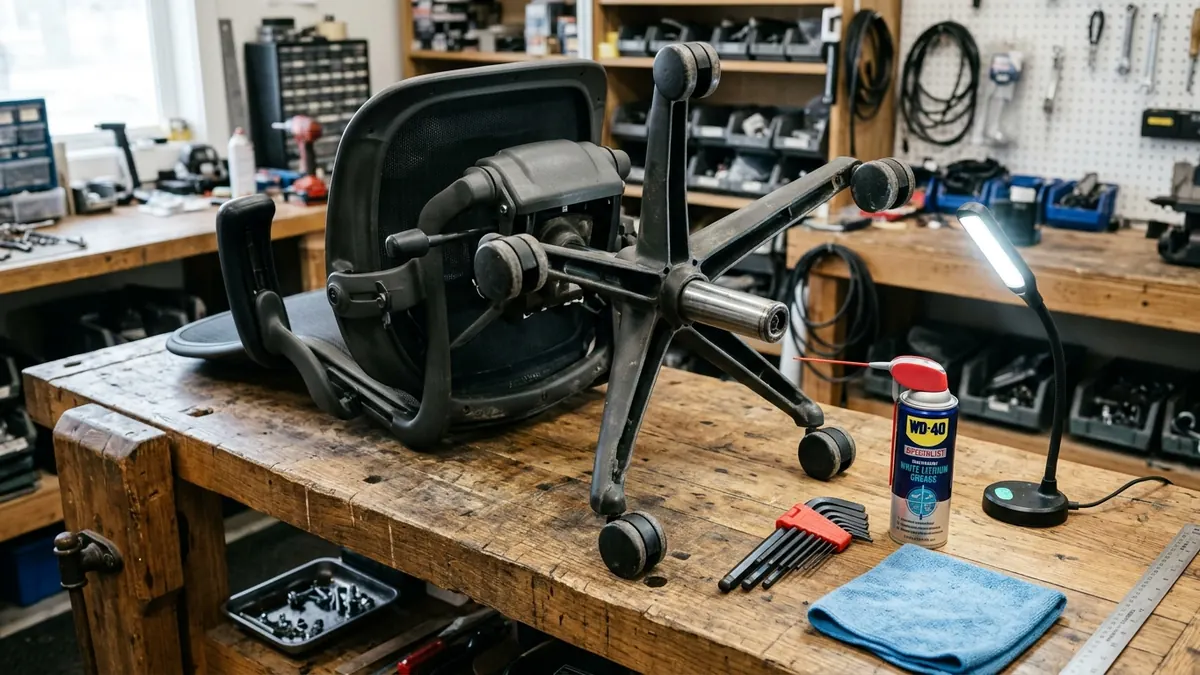
Flipping an office chair upside down reveals an honest mechanical reality. Most seating failures originate from five accessible friction points beneath the seat pan.
Factory grease dries out inside torsion housings after eighteen months of daily use. Fasteners also back out of threaded steel plates under shifting seated posture.
You do not need industrial machinery to restore stability. Basic garage hand tools and proper lubricants resolve ninety percent of seating problems.
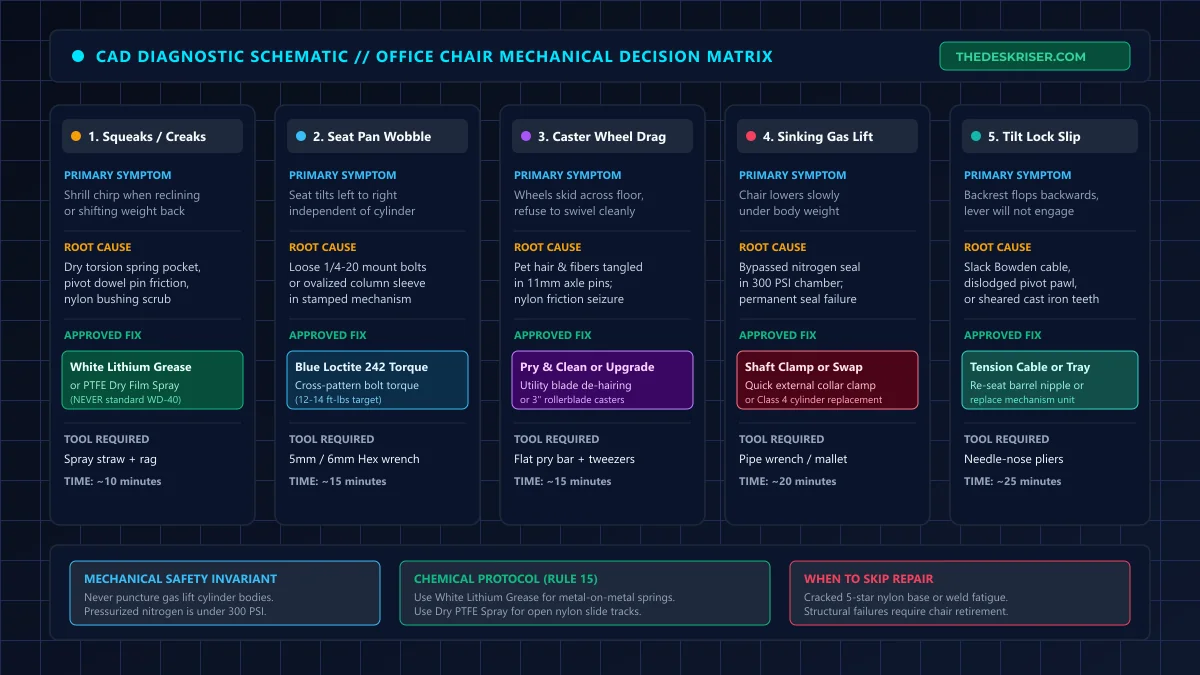
Fix Office Chair: Fast Diagnostic Decision Matrix
To fix an office chair, isolate the mechanical failure point before replacing components. Spraying white lithium grease silences squeaking springs, while tightening seat bolts eliminates lateral wobbles.
Sinking gas lifts require an external shaft clamp or drop in cylinder swap, whereas dragging casters demand clearing tangled hair from wheel axle pins.
| Symptom | Root Cause | Repair Time | Primary Tool |
|---|---|---|---|
| Squeaks Under Recline | Dry torsion spring coils or pivot dowel friction | 10 Minutes | White lithium grease with straw |
| Lateral Seat Pan Wobble | Loose mounting bolts or ovalized housing socket | 15 Minutes | 5mm hex wrench and blue Loctite |
| Caster Rolling Drag | Hair and fiber ingress wrapping axle pins | 15 Minutes | Flat pry bar and utility blade |
| Sinking Gas Cylinder | Failed internal nitrogen seal in 300 PSI chamber | 20 Minutes | Shaft collar clamp or Class 4 lift |
| Tilt Lock Slipping | Slack Bowden cable or sheared iron pawl | 25 Minutes | Needle nose pliers or replacement tray |
Isolating the symptom first prevents buying unneeded replacement components. Every seating assembly reacts predictably to targeted torque.
Silencing Squeaks and Creaks Under Recline
Shrill chirps and metallic groans when leaning backward point directly to dry pivot points. The primary culprit is almost always the heavy recline tension spring or steel cross dowel.
As you lean back, coiled steel grinds against the stamped housing without lubrication. Temperature shifts turn old factory paste into gritty sludge over time.
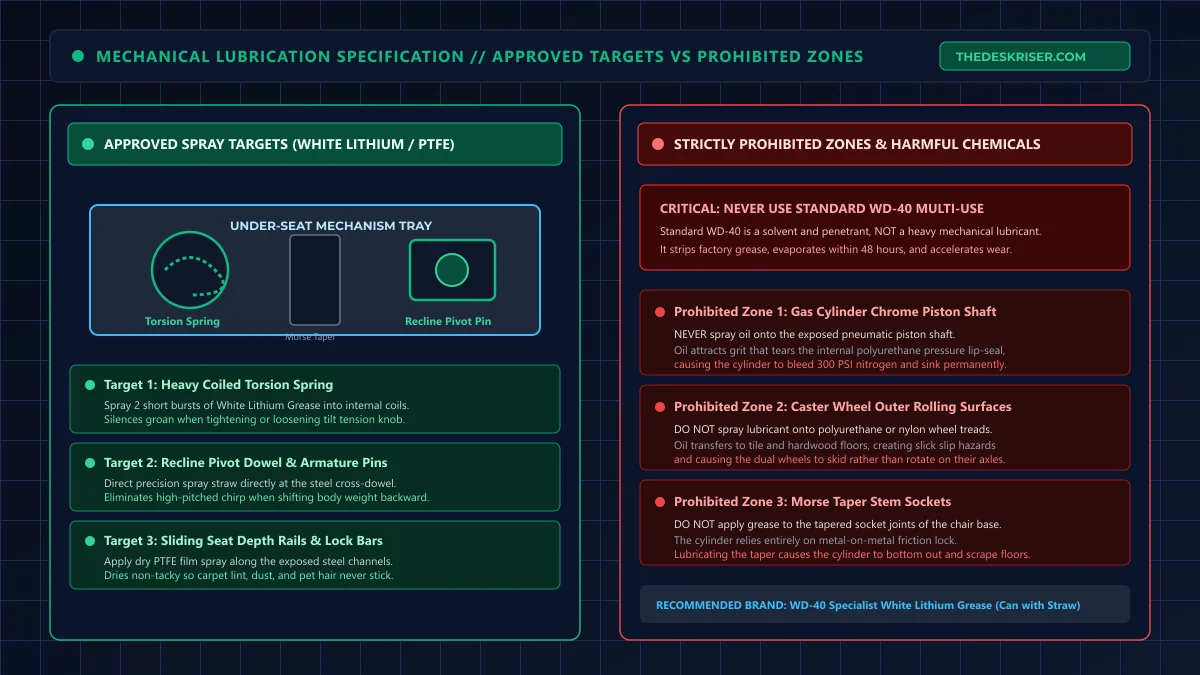
Never grab a standard can of multi use WD-40 to quiet a noisy office chair. Standard WD-40 acts primarily as a solvent rather than a durable boundary lubricant.
It dissolves remaining factory grease before evaporating completely within two days. Bare metal surfaces then grind together worse than before.
Reach instead for heavy white lithium grease or high grade PTFE dry film lubricant. Lithium grease creates a thick cushion that withstands repeated high pressure friction cycles.
Direct the precision spray straw straight into the coiled torsion spring cavity. Next, coat both outer pivot dowel pins where the backrest hinges against the seat to complete lubrication.
Eliminating Lateral Seat Pan Wobble
A seat that tips sideways when you lean indicates fastener slop or housing wear. Four mounting bolts secure the stamped steel tilt mechanism directly to the seat core.
Daily posture shifts exert rotational shear against these threaded steel inserts. Over months of active seating, machine screws gradually back out of their sleeves.
Begin your inspection by checking the tightness of all four under seat fasteners. Most ergonomic task chairs rely on metric M6 machine screws requiring a 5mm hex key.
Tighten each fastener using an alternating diagonal cross pattern to distribute clamping pressure evenly. If screws turn freely without snugging down, remove them to inspect threads.
Coat the first four threads of each bolt with blue Loctite 242 threadlocker. Medium strength threadlocker cures without air and prevents vibration loosening.
Reinstall bolts to twelve foot pounds of torque using firm hand pressure. If bolts remain rigid yet the seat wobbles, ovalization inside the welded cylinder collar confirms tray fatigue.
Freeing Stuck Casters and Restoring Floor Glide
When an office chair resists rolling across flooring, check the wheel assemblies. Factory twin wheel nylon casters collect shedding pet hair, carpet threads, and floor dust.
Hair wraps tightly around the steel axle pin between rotating nylon wheels. Eventually, this compacted fiber ring acts like a brake, stopping rotation completely.
Pry stuck caster assemblies directly out of the five star base sockets. Standard office chairs use universal 11mm grip ring steel stems that pull free with firm pressure.
Slip a flat pry bar beneath the caster shoulder if stubborn. Use a utility razor blade to slice through wrapped hair bands along the center axle.
Pull severed threads out using needle nose pliers until both wheel halves rotate freely. Clean the steel grip ring stem with rubbing alcohol to remove sticky residue.
Replacing worn nylon casters with heavy duty rollerblade style chair wheels provides a permanent upgrade. Their sealed ball bearings reject hair ingress and protect sensitive hardwood floors.
Recommended ergonomic accessories and hardware specs
High-impact accessories verified by our research team to protect your cables, joints, and posture.
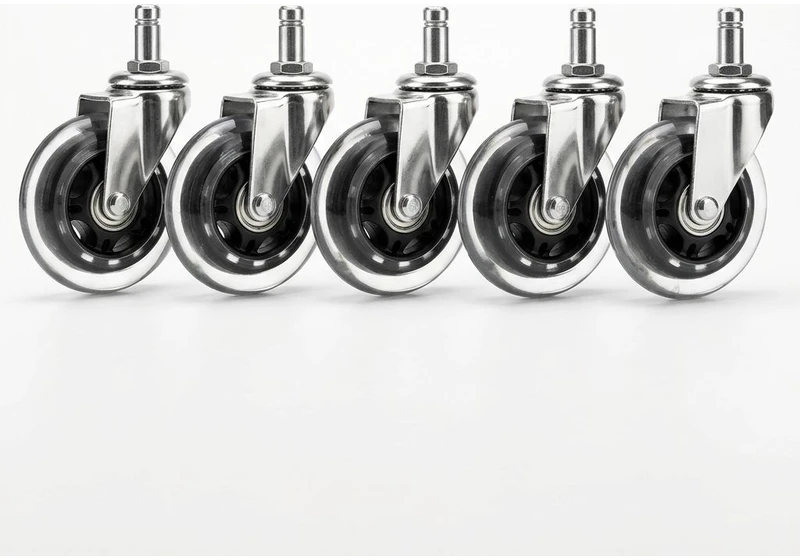
Rollerblade Chair Caster Wheels (5pk)
Heavy-duty polyurethane wheels glide smoothly on hardwood floors without plastic floor mats.
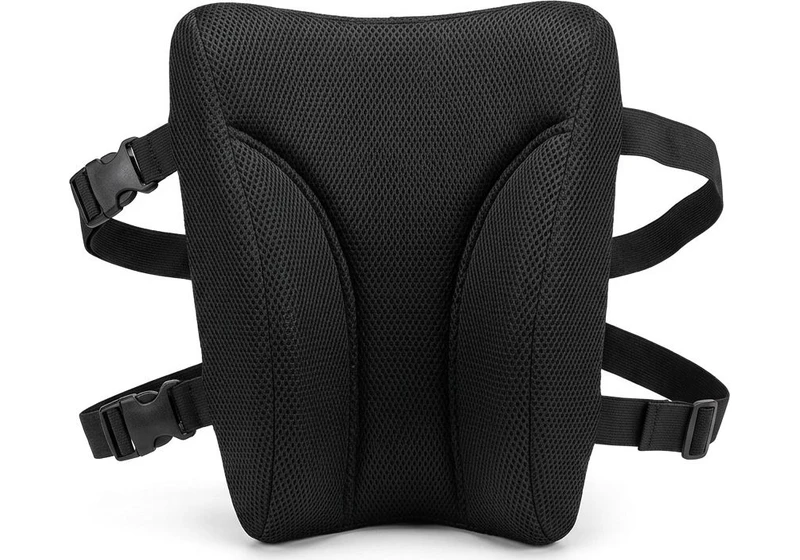
Memory Foam Lumbar Support Pillow
Contoured high-density foam with dual adjustable straps fills lumbar gap on firm office chairs.
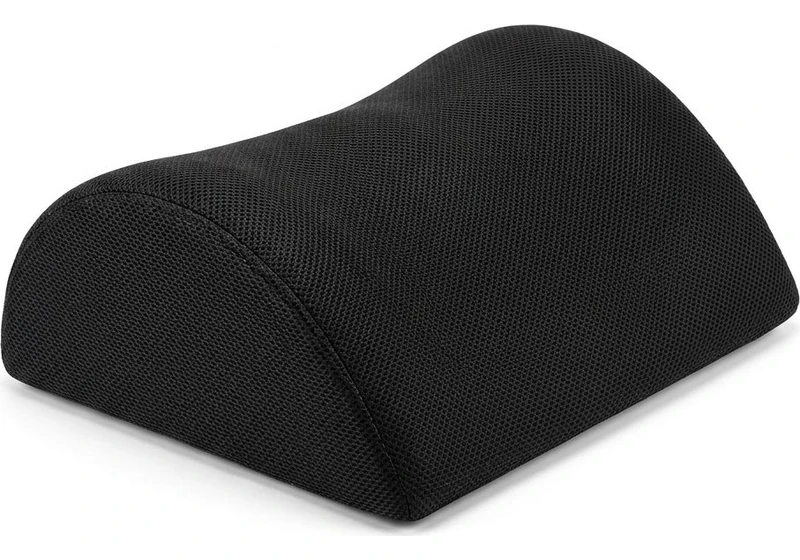
Ergonomic Teardrop Desk Footrest
Elevates feet 5 inches to reduce posterior thigh compression and improve pelvic posture when seated.
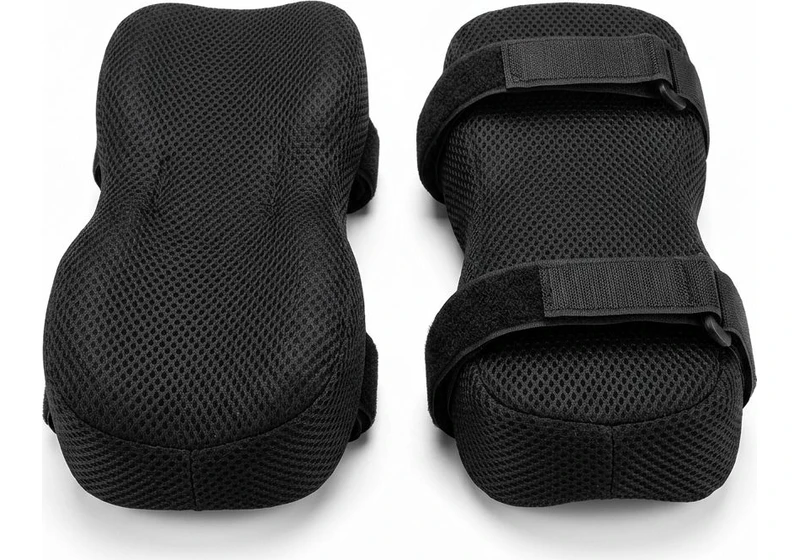
Contoured Chair Armrest Pads (Pair)
Thick memory foam cushions relieve elbow and forearm pressure points during 8+ hour workdays.
Diagnosing a Sinking Pneumatic Gas Cylinder
A chair that slowly descends under your weight suffers from internal seal leakage. Ergonomic office chairs utilize sealed Class 4 pneumatic cartridges.
These cylinders contain nitrogen gas pressurized to roughly three hundred pounds per square inch. An internal polyurethane lip seal separates chambers while regulating piston rod travel.
Microscopic scratches on the piston rod allow pressurized nitrogen to bypass the internal seal slowly. When internal pressure drops, the gas spring can no longer support seated weight.
Never spray lubricating oil onto the shiny chrome cylinder piston shaft. Oil attracts abrasive airborne grit that cuts into the wiper seal and speeds up failure.
If your chair sinks repeatedly during work sessions, review our dedicated guide on how to fix a sinking office chair for mechanical solutions.
You can install a split shaft collar around the exposed piston rod as an instant zero cost fix. Replacing the pneumatic cartridge restores permanent factory height adjustment.
Fixing an Uneven Seat Tilt or Broken Tilt Lock
A seat that permanently leans to one side indicates asymmetrical mechanism wear or damaged springs. Many tilt assemblies incorporate dual rubber stop bumpers or twin leaf springs.
If one elastomer bumper degrades faster than its mate, the chair tilts unevenly under center loads. Inspect the underside mechanism using a shop light to observe resting stops.
Tilt lock failure presents a different breakdown inside the control tray. Engaging the tilt lock lever slides a hardened steel pawl into a slotted locking sector.
If the chair slips past its lock position, inspect the steel Bowden cable linkage. Slack cables prevent the locking pawl from seating fully into its mating gear teeth.
Loosen the cable adjustment barrel with pliers and remove two millimeters of inner wire slack. If locking teeth have sheared off, adjustment cannot fix it.
A sheared cast iron locking pawl requires replacing the universal under seat mechanism box. Replacement mechanism plates cost roughly thirty dollars and bolt directly to standard mounting hole patterns.
Complete Teardown and Disassembly Protocol
Replacing internal components requires separating the chair base, cylinder, and seat mechanism. Office chair joints do not use threaded fasteners between major structural sections.
Instead, manufacturers connect components using precision Morse tapers that lock tightly through friction. Separating these tapered press fits requires controlled mechanical shock rather than brute force.
Before beginning a full teardown, review our detailed guide on how to disassemble an office chair safely. Using proper pipe wrenches and rubber mallets prevents crushing the pneumatic release valve.
Take this maintenance opportunity to assess your overall ergonomic setup and working posture. You can evaluate your seating dimensions against standard body proportions using our interactive chair finder.
Proper seat depth and lumbar positioning reduce uneven pressure that causes premature mechanical wear. Discover additional zero dollar postural refinements in our guide on how to make an office chair more comfortable.
What Sucks About DIY Chair Repairs and Who Should Skip
DIY office chair repair saves usable furniture from landfills, but the process carries genuine frustrations. Factory Morse taper joints often seize permanently after years of supporting human body weight.
Hammering on a stubborn gas cylinder inside a small home office creates loud noise. Black lubricating sludge from old mechanism trays also stains carpets instantly.
Certain structural failures should never be repaired with DIY home hacks. Never attempt to weld, glue, or clamp a cracked five star nylon wheel base.
A fractured star base can snap suddenly under dynamic loads, dumping the seated worker. Similarly, cracked seat pans or warped brackets present collapse hazards.
Skip DIY repairs if structural metal shows hairline fractures near load bearing welds. If your chair frame flexes unnaturally under your ribs, retire the chair immediately.
Home workers weighing over two hundred fifty pounds should prioritize structural safety over cheap fixes. Investing in a commercial grade task chair remains the safest path forward.
Frequently Asked Questions
What is the best lubricant for a squeaky office chair?
White lithium grease and PTFE dry film lubricants work best for silencing chair squeaks. Never use standard multi use WD-40 because it acts as a degreasing solvent and evaporates.
Why does my office chair lean forward or to the left?
A persistent lean usually stems from uneven mounting bolts or degraded internal rubber stop bumpers. If all bolts are tight, metal fatigue in the center collar requires component replacement.
Can you fix an office chair cylinder without replacing it?
You cannot repressurize a failed factory gas cylinder at home safely. You can clamp the piston at fixed height using a split shaft collar or install a replacement cartridge.
How do I know if my chair mechanism or cylinder is broken?
If the seat wobbles while the center cylinder shaft remains rigid, the mechanism tray is worn. If the entire cylinder assembly rocks inside the base socket, the base has failed.
How tight should the tilt tension knob be?
Adjust the tilt tension knob so the backrest supports your torso without forcing muscles to push. Rotate clockwise to tighten resistance or counterclockwise if reclining strains your core.
Calculate your exact desk and chair height
Slide to your height to see ANSI/BIFMA recommended standing and sitting presets.
Written by M. Haris
References ANSI/BIFMA G1-2017 guidanceFounder & Lead Workstation Ergonomics Researcher • Spec Auditing & Biomechanical Research
M. Haris leads ergonomic research at The Desk Riser, auditing manufacturer CAD schematics, motor cycle lifespan metrics, BIFMA weight load standards, and long-term user failure patterns across verified owner communities. Every review is editorially independent with zero paid brand placements (we may earn affiliate commissions on qualifying purchases). Have questions or spot a warranty update? Email directly at support@thedeskriser.com, read the Author Dossier, or explore our Editorial Research Methodology.
Share this article:
Workstation Setup & Fit Q&A
Have questions about frame deflection, monitor arm clamp loads, or chair sizing? Consult our research team.
Q:How do I know if this standing desk will wobble on thick carpet?
Standing desk wobble on carpet is caused by uneven carpet pile compression under the rear footpads. Frames with wedge-reinforced leg collars and wide steel footplates (like UPLIFT V3 or FlexiSpot E7 Pro) minimize lateral flex. If placing on plush carpet, use rigid caster cups or a dense underlay to anchor the base directly to the subfloor.
Q:Can I clamp a dual monitor arm onto standard particleboard tops?
Dual monitor arms concentrate 25 to 45 lbs of dynamic torque onto a 4-inch clamp perimeter. Hollow honeycomb tops (such as IKEA Linnmon) will crush. We recommend a minimum 0.75-inch solid core (MDF, solid bamboo, or hardwood), or sandwiching a steel reinforcement bracket plate (min 2.5mm thickness) between the clamp and desktop.
Q:What if my chair cylinder sinks or feels too high for my feet?
Always verify your seated popliteal height (crease behind knee to floor with shoes). If a chair will not drop below 17 inches and your feet dangle, pair it with an angled footrest or switch to a low-range Class 4 cylinder. If a cylinder loses pressure and sinks on its own, the internal nitrogen seal is breached and requires cylinder replacement.
Ask Our Ergonomic Spec Reviewers
Planning an upgrade or unsure if your monitors and stature fit this configuration? Send your dimensions directly to our research desk. No accounts, no trackers, zero marketing spam.
Free Workstation Tools
Related Ergonomic Chairs Guides & Reviews
Colamy Atlas Review (2026): Sub-$300 Aluminum Ergonomic Chair
Steelcase Amia Review: Cushion Comfort & LiveLumbar Teardown
Best Wobble Stool: Active Sitting and Core Engagement (2026)
Reconditioned Office Chairs: Remanufactured Guide (2026)