Best Standing Desk Mat 2026: Which Type Do You Need?

How we researched
We compare current specs, warranty terms, buyer complaints, and long-term owner patterns. Read methodology →
Last price/spec check
2026-08-01. Prices move, so use the retailer page as the final source.
Who should skip this
Skip anything that does not fit your body, room, budget, or return-window comfort level.
Disclosure: We earn a commission if you buy through links on this page, at no extra cost to you.
People search "standing desk mat" expecting a single product type. What they actually need depends on one question: do you stand mostly still, or do you shift around while you work?
The answer changes everything about what you should buy.
If you stand fairly still and want pressure relief under your feet: you want a flat anti-fatigue mat. If you want constant low-level movement while you work: you want a terrain mat. If you want active engagement while standing: you want a balance board. These are three different product categories that look similar on a product listing page and solve completely different problems.
This guide covers the top picks in each category and tells you which one matches your situation before you spend money on the wrong thing. If you are already experiencing acute heel soreness or arch fatigue, read our clinical guide on why your feet hurt from a standing desk to diagnose mat thickness and footwear.
Quick Verdict: Our Top Picks at a Glance
Short on time? Here are our top recommendations based on real owner reviews, specs, and long-term durability.
The three types
Flat anti-fatigue mats use compressed foam or gel to reduce impact on your joints. You stand in one spot and the mat handles the pressure relief. Best for people who stand mostly still during calls, focused work, or monitor-heavy setups.
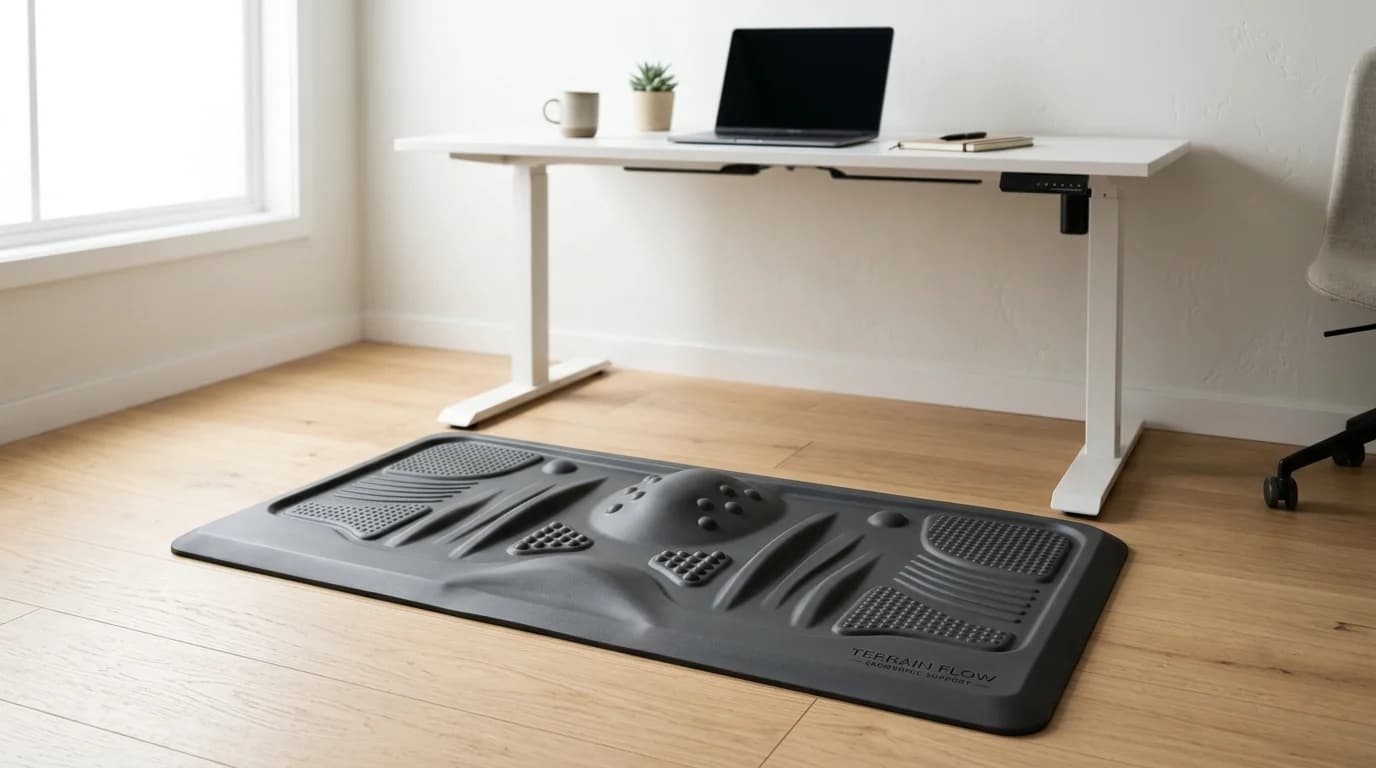
Terrain mats (like the Ergodriven Topo series) add bumps, ridges, and incline areas across the surface so your feet naturally shift position throughout the day without thinking about it. Better than flat mats for people who would otherwise stand completely rigid.
Balance boards actively engage your core and lower body. You're constantly making small adjustments. Not for focused keyboard work.
Best for standing calls or creative tasks where mental focus can share bandwidth with physical engagement. See our full balance board comparison if that's the direction you're going.
Quick comparison
| Mat | Type | Thickness | Size | Price |
|---|---|---|---|---|
| Gorilla Grip Original Premium | Flat | 1/2" | 20x32 | ~$35-45 |
| Imprint CumulusPRO | Flat | 3/4" | 20x30 (and larger) | ~$70-100 |
| Ergodriven Topo Mini | Terrain | 3/4" at peak | 26x29" | ~$80-90 |
| Ergodriven Topo | Terrain | 3/4" at peak | 29x26" | ~$90-99 |
Gorilla Grip Original Premium (~$35-45): Best budget flat mat
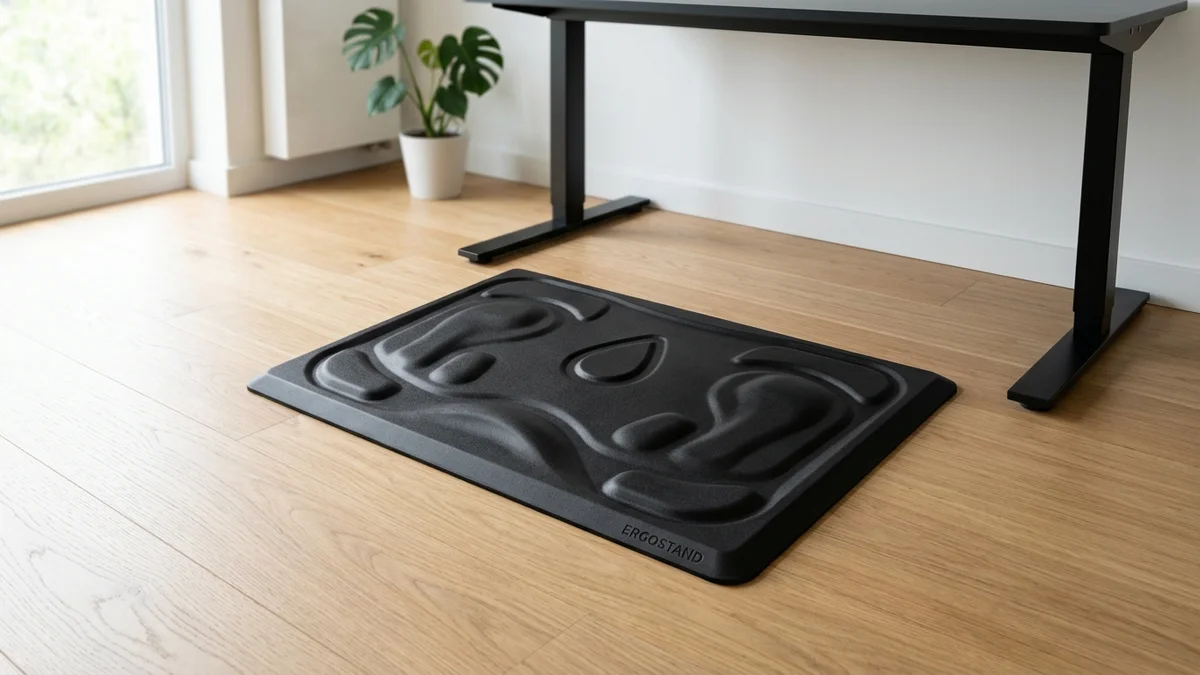
The Gorilla Grip is the most-reviewed flat anti-fatigue mat on Amazon, and it earns it. Half-inch compressed foam, pebbled top surface, waterproof backing, and available in sizes from 17x24" up to 20x60" depending on your setup.
For what it is, it works. The 1/2" thickness handles basic pressure relief for standing sessions up to 2-3 hours. Pair it with supportive footwear and the relief is real.
The honest limitation: 1/2" foam compresses noticeably after 8-12 months of daily use. At $35-45, that's acceptable. Most people replace this category of mat every 1-2 years anyway, and the price reflects that. This is not a 10-year mat.
At 20x32", the default size fits most single-monitor standing setups without crowding the desk legs. The rubber backing holds on hardwood without shifting.
Real drawback: no beveled edges on the standard model. Tripping on a flat mat edge is a real hazard if you walk through the space regularly. Check the specific listing for bevel inclusion before buying.
Check Gorilla Grip Anti-Fatigue Mat on Amazon
Imprint CumulusPRO (~$70-100): Best commercial-grade flat mat
The CumulusPRO is the standard spec in commercial deployments where standing desk mats take abuse from heavy users for years. At 3/4" thick, it's meaningfully different from the 1/2" budget category. The additional compression distance reduces joint impact more effectively across longer standing sessions.
It's certified by the National Floor Safety Institute and listed as an American Chiropractic Association partner product. Those certifications don't come from product testing theater. They require documented performance standards.
The foam holds shape longer than cheaper alternatives. Owner reviews consistently note 3-5 years of regular use without the flat-spot compression that kills budget mats. At $70-100, the per-year cost ends up comparable to replacing a $40 mat every 18 months.
Available in sizes from 20x30" to 24x36" and several larger footprints for wide standing setups.
Real drawback: heavier and less portable than 1/2" mats. If you move your setup regularly or take the mat out to do other activities, the weight and stiffness of the 3/4" commercial construction is annoying.
Check Imprint CumulusPRO on Amazon
Ergodriven Topo Mini (~$80-90): Best terrain mat for standard desks
The Topo Mini is 26x29", sized for most single-monitor standing desk setups without extending past the desk footprint. The original Topo runs slightly larger at 29x26" and is better suited to wide setups or two-monitor arrangements.
The terrain design (raised central island, ridged side areas, toe incline at the front) encourages your feet to shift naturally. You don't have to think about it. The incline at the front edge lets you stretch your calves without moving away from the desk.
This is the standing mat category our anti-fatigue mat guide covers in detail, including the standard Topo and three flat alternatives. The Mini earns separate mention here because the size difference matters more than most people expect. Measure the floor space under your desk before choosing between the two.
Real drawback: the terrain surface takes adjustment. Coming from a flat mat, the first week feels awkward. your feet don't settle in the same stable position. That's the point, but it's an adjustment.
Some people never get comfortable with the terrain format and prefer flat mats. If you've tried terrain mats before and disliked them, the Gorilla Grip or CumulusPRO are better fits.
Check Ergodriven Topo Mini on Amazon
What to look for before buying
Thickness. 1/2" handles casual standing (2-3 hours). 3/4" is the minimum for people standing 4+ hours daily. Under 3/8" is kitchen use, not office use.
Beveled edges. A beveled perimeter means the mat slopes gradually to the floor instead of ending in a vertical drop. If you walk around the mat regularly, beveled edges matter. Many budget listings don't bevel all four sides.
Surface material. Pebbled foam top is standard. Some mats use gel cores with fabric tops.
those feel different underfoot and vary widely in durability. Read reviews specifically for durability at 6-12 months, not just initial feel.
Size. Stand at your desk in your normal working posture with your shoulders above your hips. Your mat should extend 6-8 inches behind your heels and 6 inches in front of your toes. Most people undersize their first mat.
When a mat won't solve your problem
If you have specific foot conditions (plantar fasciitis, flat arches), the mat is one part of the solution but not all of it. Supportive footwear and a proper standing schedule (15 to 30 minutes per hour, not 3 hours continuous) matter more than mat choice for those conditions.
If your primary issue is lower back pain while standing rather than foot fatigue, check whether your standing desk height is set correctly first. Our ergonomic workstation setup guide covers the desk-chair-monitor calibration that affects back position regardless of what's under your feet.
FAQ
What thickness standing desk mat do I need? 3/4" for daily use of 4+ hours. 1/2" works for lighter use but compresses faster. Under 3/8" is not suitable for standing desk use.
Is there a difference between an anti-fatigue mat and a standing desk mat? They refer to the exact same product category marketed under different names, and core specs apply identically. If you prefer to test local retailer stock in person before buying, check our guide on anti-fatigue mats near me.
Can I use a standing desk mat on carpet? Yes, but the rubber backing may grip differently on carpet than hardwood. Some mats include a non-slip underside specifically rated for carpet. Terrain mats can feel less stable on carpet because the uneven terrain surface multiplies with the carpet give underfoot.
How long does a standing desk mat last? Budget 1/2" mats: 12 to 18 months of daily use before noticeable compression. Commercial 3/4" mats (Imprint CumulusPRO, GelPro Elite): 3 to 5 years. Terrain mats (Topo): typically 3 to 4 years based on owner reviews at volume.
Does a standing desk mat help with back pain? It reduces foot and joint fatigue, which indirectly improves standing posture over long sessions. It doesn't correct desk height, monitor position, or stance problems.
If back pain is the primary issue, the mat is supporting infrastructure, not the solution. Start with workstation calibration.
Bottom line: For most people, the Imprint CumulusPRO at 3/4" is the right flat mat. It lasts significantly longer than budget alternatives, and the per-year cost works out comparably once you account for replacement frequency. The Gorilla Grip is the right call if you're not sure standing will stick and want to spend $40 to find out. If you've already tried flat mats and want more engagement, the Ergodriven Topo Mini is the terrain mat category's best execution at normal desk width.
Essential Workstation Add-Ons Under $35
High-impact accessories verified by our research team to protect your cables and joints.
VIVO Under-Desk Cable Tray
Keeps power strips and heavy adapters off the floor so cables never yank when elevating.
ComfiLife Gel Anti-Fatigue Mat
High-density core reduces heel strike and lower back compression when standing 3+ hours.
VELCRO Brand ONE-WRAP (100pk)
Pre-cut reusable straps that easily unwrap for cord re-routing without scissors.
Soundance Ergonomic Laptop Stand
Elevates laptop screen 6 inches to eye level, preventing forward neck slouch.
Calculate Your Exact Desk & Chair Height
Slide to your height to see ANSI/BIFMA recommended standing and sitting presets.

Written by M. Haris
✓ BIFMA G1-2017 Certified EvaluatorFounder & Lead Workstation Ergonomics Researcher • 8+ Years Spec Testing
M. Haris leads ergonomic research at The Desk Riser, auditing manufacturer CAD schematics, motor cycle lifespan metrics, BIFMA weight load standards, and long-term user failure patterns across thousands of verified purchases. Every review is independent with 0% sponsored influence. Have questions or spot a warranty update? Email directly at support@thedeskriser.com, read the Author Dossier, or explore our Editorial Testing Methodology.
Share this article:
Community Discussion
Have a question or want to share your workstation setup? Join the discussion below.
Comments load automatically as you scroll down.