The 20-8-2 Sit-Stand Rule (2026): Does It Actually Work?

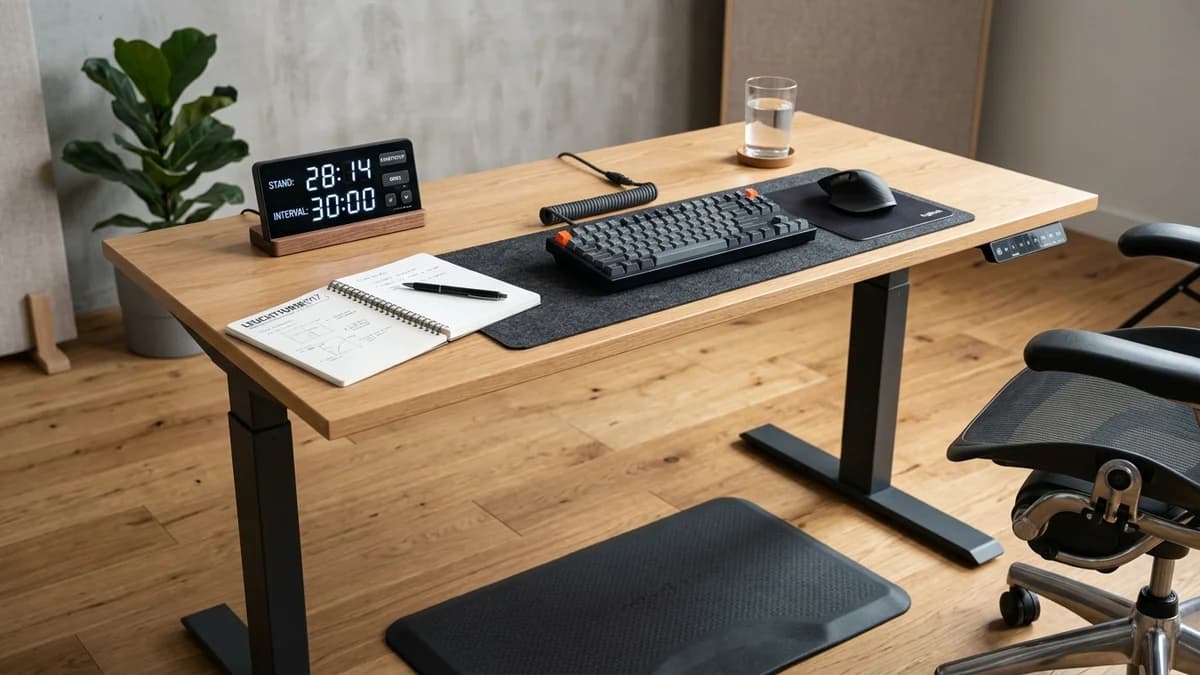
How we researched
We compare current specs, warranty terms, buyer complaints, and long-term owner patterns. Read methodology →
Last price/spec check
2026-08-02. Prices move, so use the retailer page as the final source.
Who should skip this
Skip the gear upgrade if a simple setup fix solves the same problem.
The 20-8-2 rule came from a Cornell ergonomics lab, not a marketing team. That's worth knowing upfront, because most standing desk "rules" are just guesses dressed up as advice.
Here's what it says: for every 30 minutes at your desk, sit for 20, stand for 8, and move for 2. Developed by Dr. Alan Hedge at the Cornell University Ergonomics Web, it is one of the few sit-stand ratios backed by peer-reviewed research rather than guesswork.
Does it work? Yes, with one big caveat we'll get to in a minute.
What the 20-8-2 Rule Actually Means

The math is simpler than it sounds. Each 30-minute block looks like this:
- Minutes 0-20: Sitting (ideally with good posture)
- Minutes 20-28: Standing at your desk
- Minutes 28-30: Moving around, walking, stretching
Over an 8-hour workday, you'd cycle through this pattern 16 times. That's what the research recommends. That's also the problem, but we'll get there.
The "2 minutes moving" part is the piece most people skip. It's also the most important part of the cycle.
Where It Came From
Dr. Alan Hedge published research at Cornell around 2015 showing that 20-minute sitting intervals reduced musculoskeletal discomfort better than longer sit or stand periods. The 2-minute movement break wasn't arbitrary either. Short walks or stretches interrupt the muscle tension patterns that build up even when you're standing.
This isn't a blogger's opinion. It's from one of the few ergonomics labs that has been studying office posture since the 1980s.
What the Research Actually Shows
The evidence for alternating sitting and standing is solid. A 2018 Cochrane review found that sit-stand desks reduced sitting time by about 1-2 hours per day and improved neck and back pain in office workers.
The 20-8-2 ratio specifically wasn't tested in that Cochrane review, but the principle holds: any alternating pattern beats staying in one position all day. The exact minutes matter less than the consistent switching.
Here's the honest version. You don't have to hit 20-8-2 perfectly to get the benefits. You just have to stop sitting for hours without a break.
The Real Problem With 20-8-2
This is the catch I mentioned at the start.
Sixteen position changes in a workday sounds manageable until you're 45 minutes deep in a complex task or on your third back-to-back call. The schedule breaks. You look up and realize you've been sitting for 90 minutes straight.
That's not a discipline failure. It's just how focused work goes.
The people who actually stick to something close to 20-8-2 are using automated reminders or desks with memory presets. Relying on memory alone almost never works long-term.
How It Compares to Other Ratios
There are a few competing recommendations worth knowing.
The 30-30 rule (30 min sitting, 30 min standing) is easier to remember, but 50% standing time is hard to maintain and not necessarily more effective than 20-8-2 for most people.
Cochrane's 1-2 hours standing per day is the bare minimum. Better than nothing, but far below what the 20-8-2 cycle produces (roughly 2.7 hours standing in an 8-hour day).
The 1:1 ratio (equal sitting and standing) is often recommended but not well-supported over the Cornell research for general office workers.
The 20-8-2 sits in a reasonable middle ground. Enough standing to matter, not so much that your legs ache by 3 PM. See how this compares to general standing desk timing recommendations in our full guide on how long to stand at a standing desk.
How to Actually Stick to It
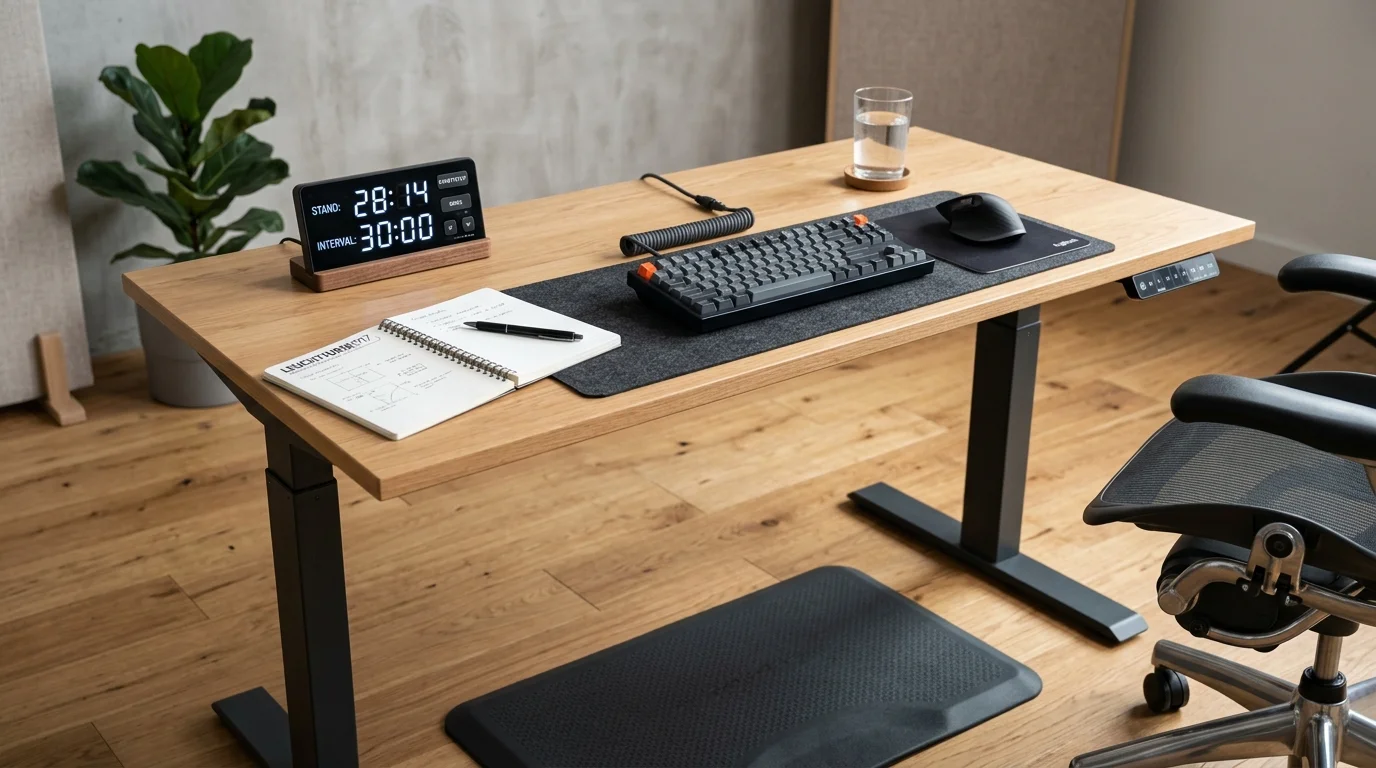
You need an external trigger. Here are the options that work.
Timer apps: Stretchly (free, open source, Windows and Mac) lets you set custom intervals. Set your sitting block to 20 minutes, your standing reminder at minute 20, and a move alert at minute 28. It works quietly in the background and won't wreck your focus with loud interruptions.
Memory presets on your motorized desk: Most electric standing desks, including the FlexiSpot E7 and comparable models, have 2-4 programmable height presets. One button switches positions. Pair that with a timer and the friction drops to almost zero.
Check FlexiSpot E7 with Memory Presets
Check Ergonomic Anti-Fatigue Desk Mats on Amazon
Calendar blocks: Set recurring 8-minute "Stand" blocks starting at the :20 mark of each hour. Crude, but effective for people who live in their calendar app.
The goal isn't perfect compliance. It's keeping your average unbroken sitting time below 30 minutes.
Who Should Follow It Strictly
If you have chronic back pain, hip flexor tightness, or neck strain from desk work, 20-8-2 is worth taking seriously. The structured movement breaks are specifically what help with these conditions. A looser version works fine if you're just trying to avoid future problems: aim for roughly 2 hours of accumulated standing across the day and take a short walk every hour or so.
Understanding why a standing desk helps your body gives you the context to decide how strictly you want to follow the schedule.
Do You Need an Expensive Desk for This?
No, but it helps a lot. A motorized standing desk makes position switching so easy that the barrier basically disappears. Without one, you're manually adjusting a converter or stuck with a fixed-height setup, which makes frequent switching much harder to sustain.
You don't need an E7 Pro or a $1,500 UPLIFT to follow 20-8-2. A decent standing desk converter gets you there. But the memory-preset feature on electric desks is genuinely useful for this specific use case, and it's one of the best arguments for spending the extra money on a motorized base.
To dial in your precise desk height settings during the standing intervals, read our master guide on how high should a standing desk be.
FAQ
What is the 20-8-2 rule for standing desks?
It's a sit-stand-move cycle developed by Dr. Alan Hedge at Cornell: 20 minutes sitting, 8 minutes standing, 2 minutes moving, repeated throughout the workday. The goal is to prevent the musculoskeletal problems that come from staying in any one position too long.
Does the 20-8-2 rule actually work?
The alternating principle behind it is supported by ergonomics research. The specific 20-8-2 numbers are well-reasoned but not magic. Any consistent pattern that keeps you from sitting more than 30 unbroken minutes produces similar benefits.
Is standing for 8 hours better than sitting for 8 hours?
Neither is good. Prolonged standing causes its own problems: lower-limb fatigue, varicose veins, and lower back strain. The benefit comes from alternating, not from standing more overall.
What app should I use for the 20-8-2 rule?
Stretchly is free, open source, and lets you set custom intervals. It runs on Windows and Mac. A simple phone timer set to repeat every 20 minutes also works if you don't want another app.
Do I need a standing desk to follow the 20-8-2 rule?
No. A desk converter achieves the same result. A motorized standing desk makes it significantly easier because position changes take about 2 seconds, but it's not required to follow the schedule.
What does the 2 in 20-8-2 stand for?
The 2 represents 2 minutes of movement per 30-minute cycle. Walking to get water, doing a few stretches, pacing during a phone call. It interrupts the muscle tension that builds up even during the standing phase.
Essential Workstation Add-Ons Under $35
High-impact accessories verified by our research team to protect your cables and joints.
VIVO Under-Desk Cable Tray
Keeps power strips and heavy adapters off the floor so cables never yank when elevating.
ComfiLife Gel Anti-Fatigue Mat
High-density core reduces heel strike and lower back compression when standing 3+ hours.
VELCRO Brand ONE-WRAP (100pk)
Pre-cut reusable straps that easily unwrap for cord re-routing without scissors.
Soundance Ergonomic Laptop Stand
Elevates laptop screen 6 inches to eye level, preventing forward neck slouch.
Calculate Your Exact Desk & Chair Height
Slide to your height to see ANSI/BIFMA recommended standing and sitting presets.

Written by M. Haris
✓ BIFMA G1-2017 Certified EvaluatorFounder & Lead Workstation Ergonomics Researcher • 8+ Years Spec Testing
M. Haris leads ergonomic research at The Desk Riser, auditing manufacturer CAD schematics, motor cycle lifespan metrics, BIFMA weight load standards, and long-term user failure patterns across thousands of verified purchases. Every review is independent with 0% sponsored influence. Have questions or spot a warranty update? Email directly at support@thedeskriser.com, read the Author Dossier, or explore our Editorial Testing Methodology.
Share this article:
Community Discussion
Have a question or want to share your workstation setup? Join the discussion below.
Comments load automatically as you scroll down.