Standing Desk Posture Guide 2026: The Setup Most People Get Wrong
Published 2026-08-09
How we researched
We compare current specs, warranty terms, buyer complaints, and long-term owner patterns. No fake hands-on claims.
Last price/spec check
2026-08-09. Prices move, so use the retailer page as the final source.
Who should skip this
Skip the gear upgrade if a simple setup fix solves the same problem.
Disclosure: We earn a commission if you buy through links on this page, at no extra cost to you.
A standing desk doesn't fix your posture. It just gives you a new way to get it wrong.
Most people raise their desk, stand up, and assume the hard part is done. Then after a few weeks their neck hurts, their wrists ache, and they lower the desk and never use the standing position again. The desk wasn't the problem. The setup was.
This guide gives you the exact formula for standing desk height, the right monitor position, and the five posture mistakes that send people back to sitting permanently.
Step 1: Get the Desk Height Right First
Everything else depends on this. Wrong height means your shoulders, wrists, and neck are compensating every minute you stand.
The formula: Set the desk so your elbows are at 90 degrees when your arms hang naturally at your sides.
Here's how to measure it properly. Stand in your normal shoes (or barefoot, if that's how you work). Let your arms hang relaxed at your sides.
Bend your elbows to 90 degrees. Measure the distance from the floor to the bottom of your forearm. That number is your standing desk height.
For most people this lands between 38" and 46" depending on height. Don't use someone else's setting. The formula is personal.
Two things that mess this up:
First, shoes. If you wear shoes sometimes and go barefoot other times, your desk height changes by 0.5-1.5 inches.
Either pick one and stick to it, or set two memory presets.
Second, the keyboard. Your desk height sets keyboard position, not monitor position. These are two separate problems. Solving one correctly often reveals the other.
Step 2: Set Monitor Height Independently
Once the desk is at the right keyboard height, your monitor is probably in the wrong place. Desk height and monitor height are not the same thing on a standing desk without a monitor arm.
The rule: The top of your monitor should be at or slightly below eye level. Your eyes should naturally fall on the upper third of the screen when your head is level and relaxed.
If you're looking up at your monitor, your neck is extended. If you're looking significantly down, your neck is flexed. Both cause fatigue faster than you'd expect.
Distance: 20-28 inches from your eyes to the screen. Arm's length is a useful quick check. Reach toward the screen with your arm extended. Your fingertips should almost touch the surface.
Tilt: 10-20 degrees back from vertical. This matches your natural downward gaze angle and reduces glare from overhead lighting.
If your monitor is sitting flat on the desk, you almost certainly can't get both keyboard height and monitor height right at the same time. This is exactly what a monitor arm solves: it adjusts monitor height independently so you're not choosing between wrist comfort and neck comfort.
The 5 Posture Mistakes That Make Standing Worse Than Sitting
Mistake 1: Leaning into the desk
This is the most common one and the hardest to notice because it feels natural. You shift your weight forward, rest your forearms on the desk surface, and lean.
Your neck and upper back absorb all of it. Within an hour you have the same forward-head posture you were trying to escape from sitting.
The fix: desk height check. If you're leaning in, the desk is usually too low and you're resting your weight on it. Raise it 1-2 inches and stand up straight with arms hanging before resting them on the keyboard.
Mistake 2: Locking your knees
Standing with locked knees cuts off circulation in your legs and adds compression to your lower back. You'll feel it as fatigue in your lower back and heavy legs, usually within 30-45 minutes.
Knees should have a very slight bend. Not a squat, just not rigid. It's a small adjustment that makes a noticeable difference in how long you can stand comfortably.
Mistake 3: Dropping your wrists below keyboard level
When people type at a standing desk, their wrists often drop below the keyboard level because the desk is slightly too high. This puts the wrist in extension under load, which is exactly the position that causes repetitive strain issues over time.
Check: when your fingers rest on the keyboard, your wrist should be flat or very slightly elevated. Not bent downward. If it is, lower the desk 0.5-1 inch.
Mistake 4: Standing completely still
The health argument for standing over sitting isn't that standing is inherently better. It's that standing enables movement. If you stand completely still for 60 minutes, you're just exchanging one static load for another.
Shift your weight between legs. Do a slow heel raise. Step to the side. Use a contoured anti-fatigue mat, which naturally encourages small movement by giving your feet an uneven surface to balance on.
Mistake 5: Standing too long too fast
If you just got a standing desk and you're trying to stand for two hours on day one, you're going to hurt. Your stabilizer muscles in your core and lower back aren't used to this load. They fatigue fast.
Start with 15-20 minutes of standing per hour. Add 5 minutes per week. After 4-6 weeks you can comfortably stand for 45-60 minute stretches. Ignore anyone who says you should stand for 4 hours on day one.
Your Sitting Posture Matters Too
You'll still sit for large parts of the day. Getting the standing position right doesn't help if you collapse into a bad sitting position when you lower the desk.
When sitting at a standing desk, the same elbow-at-90-degrees rule applies. Your feet should be flat on the floor or on a footrest. Lumbar support from the chair should fill the natural curve of your lower back.
The one thing most people miss: set a specific memory preset for your sitting height too. Don't eyeball it every time. One button to sitting height, one button to standing height. Friction is what kills the habit.
The 30-Second Posture Check
Run this once every time you switch positions:
Head: Level, facing forward, not dropped toward the screen.
Shoulders: Relaxed, not raised or hunched.
Elbows: Roughly 90 degrees, close to your body.
Wrists: Flat or slightly elevated above keyboard.
Knees: Slight bend, not locked.
Feet: Shoulder-width apart, weight even on both sides.
That's it. 30 seconds when you stand up. If you catch yourself leaning forward 20 minutes in, stand straight and do the check again.
Two Accessories That Actually Help Posture
Monitor Arm
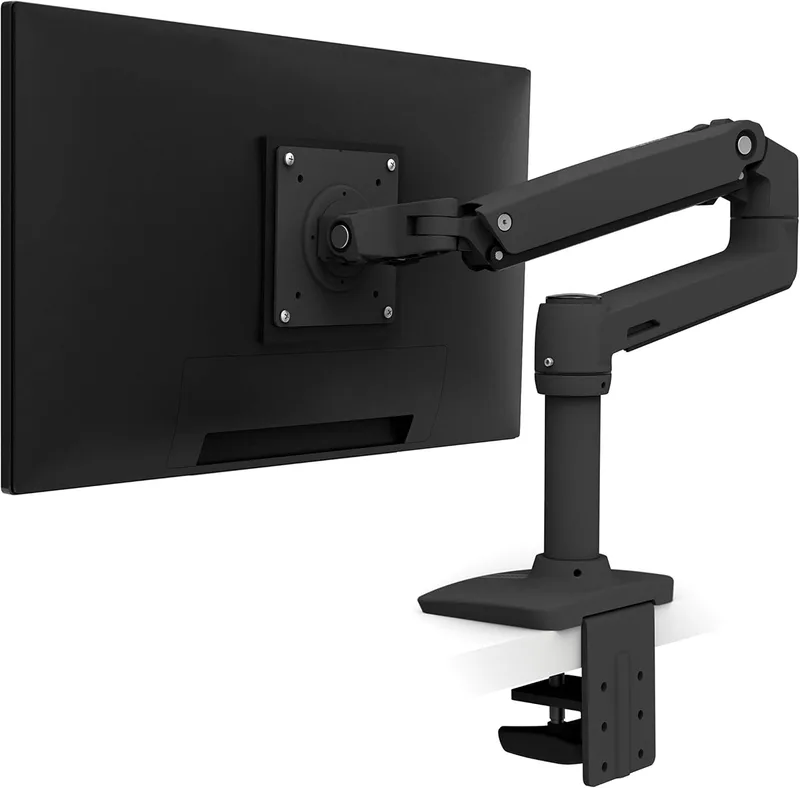
If there's one accessory that directly improves standing desk posture, it's a monitor arm. It lets you set keyboard height and monitor height independently, which is the only way to get both right at the same time.
The Ergotron LX (~$139) is the standard recommendation. Gas spring mechanism holds position without drooping. Smooth enough that you'll actually adjust it when you switch heights.
Without a monitor arm, you're trading one posture problem for another.
Anti-Fatigue Mat
The mat solves mistake #4 (standing still) without requiring you to think about it. The contoured surface of the Topo by Ergodriven (~$99) creates micro-movements through your legs and feet as you shift to stay balanced.
Flat mats provide cushioning. Contoured mats provide cushioning plus movement. If you're standing for 30+ minutes at a stretch, the difference is real.
Check Topo Anti-Fatigue Mat on Amazon
FAQ
What is the correct posture for a standing desk? Elbows at 90 degrees, monitor at or slightly below eye level, shoulders relaxed, knees with a slight bend, weight even on both feet. The desk height sets keyboard position. The monitor arm sets screen position independently.
How high should a standing desk be? At the height of your elbows when your arms hang naturally at your sides and bend to 90 degrees. Measure this yourself while wearing the shoes (or not) that you'll be working in. For most adults this is 38-46 inches.
Why does my back hurt when I use a standing desk? Usually one of three reasons: desk is the wrong height, you're standing too long without building up gradually, or you're standing completely still. Check height first. If correct, reduce standing time and add movement.
Should a standing desk be at elbow height? Yes, the desk surface should be at elbow height when your arms hang naturally and bend to 90 degrees. This puts your forearms parallel to the floor and wrists neutral when typing.
How long should I stand at my standing desk? Start with 15-20 minutes per hour and build from there. Research suggests 2-4 hours of standing per day total, split into multiple sessions, is the target range. See our how long to stand at a standing desk guide for the full breakdown.
Does a standing desk help with posture? Only if set up correctly. A standing desk at the wrong height can cause worse neck and shoulder problems than sitting.
The desk is a tool. The setup determines whether it helps or hurts.
Bottom Line
Get the desk height right with the elbow formula. Set the monitor independently with a monitor arm. Check for the five mistakes above, especially leaning and locking knees. Build standing time gradually.
None of this is complicated once you know what to look for. The problem is that nobody tells you these things when you buy the desk.
For the full ergonomic workstation setup beyond just the desk, our ergonomic workstation setup guide covers chairs, monitors, keyboards, and lighting in one place. And if you're deciding between standing desk models, our best standing desks for home office guide covers what actually matters in the frame and motor.
Posture guidelines based on published ergonomics standards from CCOHS and BIFMA.
The Desk Riser Research Team
Standing Desk & Home Office Researchers
We research standing desks, ergonomic chairs, and home office gear by analyzing manufacturer specs, warranty terms, and real owner review patterns across thousands of purchases. No sponsored placements. No fake hands-on claims.
Share this article: