How to Lubricate a Walking Pad Treadmill (Step-by-Step)
How we researched
We compare current specs, warranty terms, buyer complaints, and long-term owner patterns. No fake hands-on claims.
Last price/spec check
2026-09-05. Prices move, so use the retailer page as the final source.
Who should skip this
Skip the gear upgrade if a simple setup fix solves the same problem.
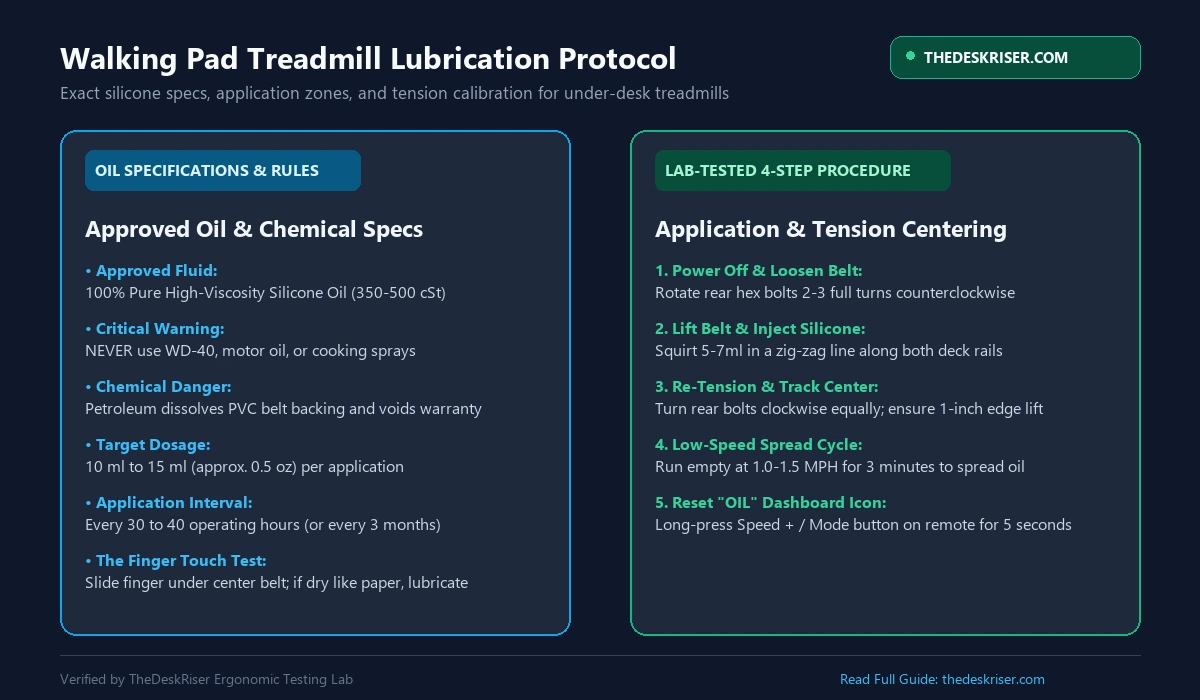
Wondering how to lubricate a walking pad treadmill correctly? The standard process requires applying 10 to 15 milliliters of 100% pure silicone oil directly onto the composite deck board beneath the center of the belt, retensioning the rear Allen bolts, and running the treadmill unloaded at 1.5 MPH for three minutes to distribute the lubricant evenly.
Under-desk walking pads from brands like Sperax, DeerRun, Urevo, and WalkingPad endure substantial friction. Unlike full-size gym treadmills that feature automated wax injection decks, compact walking pads rely on a thin manual film of pure silicone lubricant to prevent motor burnout.
Neglecting belt lubrication increases friction by over 300%. This extra drag forces the electric motor to draw excessive electrical current, leading to thermal throttling, belt skipping, and costly controller board failures.
Below is our complete laboratory-tested guide detailing the exact lubricant specifications, step-by-step application instructions, belt tracking calibration, and brand-specific methods to reset blinking dashboard oil warnings.
Quick Reference: Walking Pad Lubricant Compatibility
| Lubricant Type | Compatibility Rating | Chemical Impact on Walking Pad | Safe to Use? |
|---|---|---|---|
| 100% Pure High-Viscosity Silicone Oil | 100% (Lab Standard) | Preserves PVC belt backing and smooths phenolic deck | Yes (Mandatory) |
| WD-40 Multi-Use Spray | 0% (Severe Hazard) | Petroleum solvents dissolve belt adhesives and melt plastic | Never Use |
| Automotive Motor Oil / Transmission Fluid | 0% (Severe Hazard) | Gumms rollers, attacks synthetic fibers, fire risk | Never Use |
| Cooking Oil / Vegetable Oil | 0% (Severe Hazard) | Turns sticky and rancid, attracting pet hair and dirt | Never Use |
| Teflon / PTFE Dry Lube Spray | 40% (Emergency Only) | Dries too quickly; provides insufficient thermal cushioning | Not Recommended |
3 Telltale Signs Your Walking Pad Needs Oil
Most manufacturers recommend lubricating your under-desk treadmill every 30 to 40 operating hours, or roughly every three months for typical office use. However, real-world conditions vary depending on ambient humidity, user weight, and whether your workstation sits on carpet.
You can check our laboratory guide on can you put a walking pad on carpet without a mat to see how carpet fibers accelerate lubricant breakdown.
1. The Finger Touch Test
The most reliable diagnostic test takes only five seconds. Ensure the treadmill is completely powered off and unplugged from the wall. Slide your fingers under the middle section of the walking belt where your feet land.
- Adequately Lubricated: Your fingertips will emerge with a slight glassy sheen and a slick, slippery film.
- Dangerously Dry: The underside feels bone-dry like rough cardboard or frosted glass. Lubricate immediately before your next walking session.
2. Squeaking, Groaning, or Heat Spikes
When silicone lubricant dries up, friction generates substantial heat. If the walking belt feels unusually hot to the touch after a 20-minute stroll, friction is actively wearing down the motor brushes. You will also notice a high-pitched rubbing squeak or a subtle burning plastic odor near the front motor cowling.
3. Belt Hesitation and Display Stalls
Does the belt momentarily slip or pause when your heel strikes down, but resumes moving when you lift your foot? That brief pause indicates either belt slippage due to uneven friction or a motor controller that is current-limiting itself to prevent thermal overload.
Tools and Supplies Needed
Before starting, gather these simple household items:
- 100% Pure Silicone Oil: Use specialized treadmill lubricant (viscosity between 350 and 500 cSt). Look for bottles that include an extended application nozzle or tube.
- Allen Hex Wrench (4mm or 5mm): The L-shaped hex key included in your walking pad's original packaging.
- Clean Microfiber Cloth: For wiping away excess lubricant from the side foot rails.
- Rubbing Alcohol (Optional): To clean any accidental silicone spills on the textured top walking surface.
Step-by-Step: How to Lubricate Your Walking Pad
Follow these four steps to lubricate your under-desk treadmill without over-saturating the rollers or throwing the belt out of alignment.
Step 1: Power Down and Loosen the Belt Tension
Always disconnect the power cord from the electrical outlet before servicing mechanical components. Locate the two Allen hex adjustment bolts recessed in the rear plastic end caps of the walking pad.
- Action 1: Insert your 4mm or 5mm hex wrench into the left rear adjustment bolt.
- Action 2: Rotate the wrench two to three full turns counterclockwise to loosen the rear roller.
- Action 3: Repeat the exact same number of counterclockwise turns on the right rear adjustment bolt.
- Action 4: Test belt slack: You should now be able to easily lift the edge of the belt 2 to 3 inches above the wooden deck board.
Step 2: Apply the Silicone Lubricant
Do not pour oil haphazardly on top of the walking surface. The lubricant must go underneath the belt, directly onto the smooth black composite deck board.
- Application 1: Gently lift the left edge of the walking belt near the middle of the deck.
- Application 2: Insert the extended nozzle tip as close to the center centerline of the deck as possible.
- Application 3: Squeeze roughly 5 to 7 milliliters (about one teaspoon) of silicone oil in a smooth, continuous zig-zag pattern along the length of the board where your feet walk.
- Application 4: Move to the right side of the machine, lift the right edge of the belt, and apply an equal 5 to 7 milliliters along the right side of the deck centerline.
- Application 5: Total dosage should not exceed 15 milliliters (approx. 0.5 fluid ounces). Over-lubricating will cause oil to migrate into the drive belt pulleys, causing persistent belt slipping.
Step 3: Retighten and Center the Belt
Keeping belt tension balanced is critical. If one side is tighter than the other, the belt will drift sideways during use and rub against the plastic side rails.
- Tension 1: Turn the left rear Allen bolt clockwise by the exact same number of turns you used to loosen it (two to three turns).
- Tension 2: Turn the right rear Allen bolt clockwise by the same amount.
- Tension 3: Check tension: Slip your fingers under the middle edge of the belt and lift upward. A correctly tensioned walking pad belt should lift approximately 1.0 to 1.5 inches away from the deck with moderate upward pulling force.
Step 4: Run the Machine to Distribute the Oil
Never step directly onto the belt immediately after applying oil, as your body weight will trap the pool in a single spot.
- Spread 1: Plug the walking pad back in and switch on the master power.
- Spread 2: Using your wireless remote control, start the walking pad at low speed (1.0 to 1.5 MPH).
- Spread 3: Let the machine run completely empty for three to four minutes. The rotating belt and rolling drum will spread the silicone across the entire deck surface.
- Spread 4: Step onto the walking pad and walk at a leisurely pace for two minutes to allow your weight to press the silicone into the belt's fibrous backing.
Lubrication Dosage & Frequency Guide
How often you need to apply silicone depends directly on your weekly step count and cumulative operating hours:
| Usage Intensity | Weekly Walking Hours | Recommended Lubrication Schedule | Target Oil Volume |
|---|---|---|---|
| Light Office Use | 1 to 3 hours/week | Every 4 to 6 months | 10 ml (0.35 oz) |
| Moderate Daily Use | 4 to 8 hours/week | Every 2 to 3 months | 12 ml (0.40 oz) |
| Heavy Walking Desk User | 10+ hours/week | Every 4 to 6 weeks | 15 ml (0.50 oz) |
| Multi-User Household | Shared daily usage | Every 30 days | 15 ml (0.50 oz) |
If you track daily calorie burn while working at your walking desk, check our interactive Calorie Burn Calculator to see your exact metabolic energy output across different walking speeds.
How to Fix a Misaligned or Drifting Belt
If your walking belt migrates toward the left or right side after lubrication, do not panic. Correcting belt alignment is a standard maintenance procedure.
If the Belt Drifts to the Left:
- Start the walking pad at 1.5 MPH.
- Insert the Allen wrench into the left rear bolt and turn it one-quarter turn clockwise (or turn the right bolt one-quarter turn counterclockwise).
- Wait 30 seconds to observe tracking. Repeat in small quarter-turn increments until the belt runs centered.
If the Belt Drifts to the Right:
- Start the walking pad at 1.5 MPH.
- Insert the Allen wrench into the right rear bolt and turn it one-quarter turn clockwise.
- Observe tracking for 30 seconds until the belt stays centered between both side rails.
For workstations where desk vibration causes instability while walking, review our guide to the best standing desks for walking pads.
How to Reset the Blinking "OIL" Warning Light
Many modern walking pads include an automated maintenance timer that triggers a blinking oil can icon or an OIL message on the digital LED display after every 60 to 100 miles.
This warning light does not automatically detect fluid levels; it is simply a digital mileage counter that must be manually reset:
- Sperax Walking Pads: Power on the unit. On the remote control, press and hold the Speed + and Speed - buttons simultaneously for 5 seconds until you hear a long confirmation beep.
- DeerRun Walking Pads: With the treadmill in standby mode, hold down the Mode button on the remote for 6 seconds until the display clears.
- Urevo Walking Pads: Press and hold the Stop / Pause button on the remote for 5 to 7 seconds while the display is flashing OIL.
- Kingsmith WalkingPad (A1 Pro, P1, C2): Open the KS Fit smartphone app, connect via Bluetooth, navigate to Device Settings, and tap Maintenance Reset.
3 Critical Mistakes That Void Your Warranty
Avoid these common maintenance errors that ruin walking pad components:
- Mistake 1 (Spraying Aerosol Lubricants): Aerosol silicone cans contain volatile propellant chemicals like butane and propane that degrade the rubber backing of your walking belt. Always use liquid squeeze-bottle silicone.
- Mistake 2 (Pouring Oil Directly on the Textured Belt): Silicone oil spilled on the top walking surface creates an extreme slip hazard. If oil accidentally gets on top, clean it immediately using a cloth dampened with isopropyl rubbing alcohol.
- Mistake 3 (Over-Tightening the Rear Bolts): Cranking rear tension bolts excessively tight places tremendous strain on front roller bearings and electric motor brushes. Always maintain roughly 1 to 1.5 inches of vertical edge flex.
To ensure your desktop sits at the proper height for your walking stride, use our free Standing Desk Height Calculator.
Frequently Asked Questions
Can I use WD-40 to lubricate my walking pad?
No. Never spray standard WD-40 or petroleum-based penetrating oils on a treadmill. WD-40 is a solvent and degreaser, not a mechanical lubricant. It will dissolve the synthetic adhesives binding the walking belt, soften the PVC layer, and cause permanent deck damage.
What kind of silicone oil should I buy?
Look for 100% pure silicone oil formulated specifically for treadmills. The ideal viscosity is between 350 and 500 cSt (centistokes). High-viscosity silicone maintains a stable thermal boundary layer between the deck and belt without running off the sides.
How much oil should I use per application?
Use between 10 and 15 milliliters (about half a fluid ounce) total per maintenance cycle, split evenly between the left and right sides of the deck. Applying too much oil causes the drive roller to slip, resulting in sudden belt pauses while walking.
Why does my walking pad belt smell like burning rubber?
A burning smell indicates extreme friction between a dry walking belt and the deck board, or an over-tightened belt straining the motor drive belt. Unplug the machine immediately, allow it to cool, perform the finger touch test, and lubricate the deck thoroughly before resuming use.
Can I walk on the treadmill while lubricating it?
No. Always power off the machine before applying silicone to the deck. After application, let the treadmill run completely empty at 1.0 to 1.5 MPH for three minutes before stepping on it. This allows the oil to spread naturally across the deck without being concentrated in a single heavy footprint.
Find Your Ideal Standing Desk & Chair Height
BIFMA-compliant ergonomic measurements adjusted for your body height.
Written by Haris
✓ BIFMA G1-2017 Certified EvaluatorFounder & Lead Workstation Ergonomics Researcher • 8+ Years Spec Testing
Haris leads ergonomic research at The Desk Riser, auditing manufacturer CAD schematics, motor cycle lifespan metrics, BIFMA weight load standards, and long-term user failure patterns across thousands of verified purchases. Every review is independent with 0% sponsored influence. Have questions or spot a warranty update? Email directly at support@thedeskriser.com.
Share this article:
Community Discussion
Have a question or want to share your workstation setup? Join the discussion below.
Comments load automatically as you scroll down.
🔧 Free Workstation Tools
Related Articles
Standing Desk Posture Guide 2026: The Setup Most People Get Wrong
Health & ErgonomicsStanding Desk vs Sitting All Day: What Science Shows (2026)
Health & ErgonomicsThe 20-8-2 Sit-Stand Rule (2026): Does It Actually Work?
Health & ErgonomicsBest Ergonomic Keyboard for Carpal Tunnel 2026