DIY Desk Shelf: Dimensions, Cut List & Build Guide

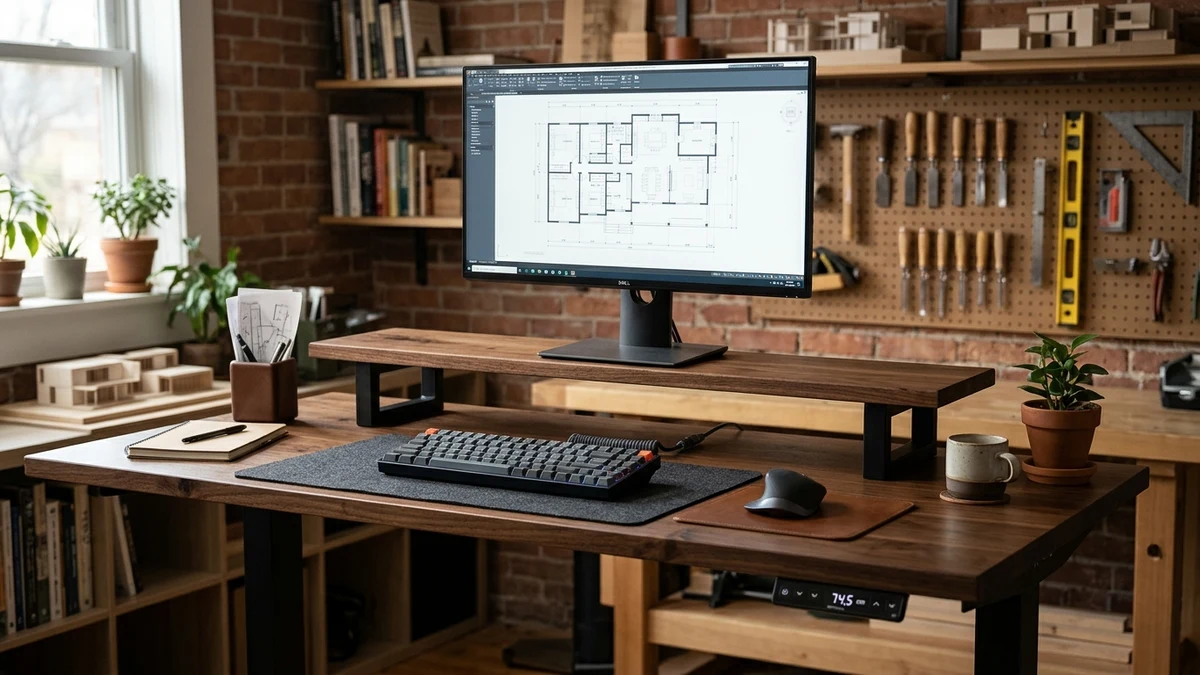
A DIY desk shelf elevates computer monitors to ergonomic eye level while creating dedicated under-shelf parking for keyboards and notebooks. Using a 3/4-inch Baltic birch or solid hardwood board with 4-inch standoff legs, you can build a custom single (24-inch) or dual (42-inch) monitor shelf for under $60 in a single afternoon.
20" to 32" ergonomic eye-to-screen viewing distance
Under-desk cable routing & surge protection verified
Neutral 90° elbow and flat-foot alignment enforced
Desk Shelf Spec & Load Scope
Filters models by solid timber deflection resistance, center span load capacity, keyboard clearance height, and modular organizer fit. Methodology →
Last Spec & Pricing Audit
. Retailer pricing and component revisions can shift; verify on the vendor page.
Center Span Deflection Guardrail
Check desktop depth and measure dual-monitor base footprints to avoid center span sag or keyboard interference.
Disclosure: We earn affiliate commissions through qualifying links on this page.
Commercial desk shelves often cost between $170 and $340 from boutique workspace brands.
Factory monitor stands consume valuable surface area directly inside your primary reach zone.
Building a custom timber riser allows you to match your exact desktop dimensions and wood species.
You reclaim lost desk depth while positioning your screen at healthy focal distance.
Before cutting lumber, calculate your seated eye horizon and elbow clearance using our interactive desk height calculator.
DIY Desk Shelf: Dimensions, Cut List and Workshop Setup
A DIY desk shelf elevates computer displays while creating dedicated keyboard parking underneath. Using 3/4 inch hardwood with 4 inch standoff legs, you can build a custom riser for under $60.
Shallow desktops suffer from visual clutter when large monitor feet occupy front work zones.
The upper platform holds heavy display panels safely without center sag or long term deflection.
| Dimension and Component | Single Monitor Build (Compact Desktop) | Dual Monitor Build (Standard Desktop) |
|---|---|---|
| Target Workstation Width | 36 to 48 inches wide desktops | 48 to 72 inches wide desktops |
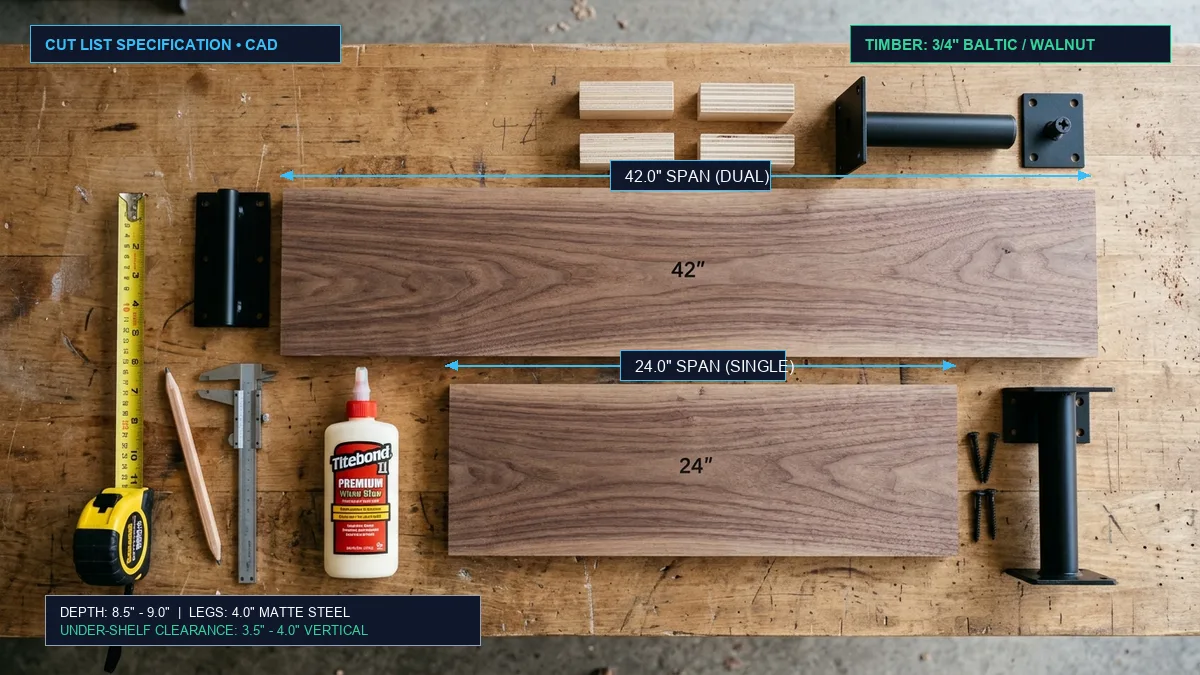
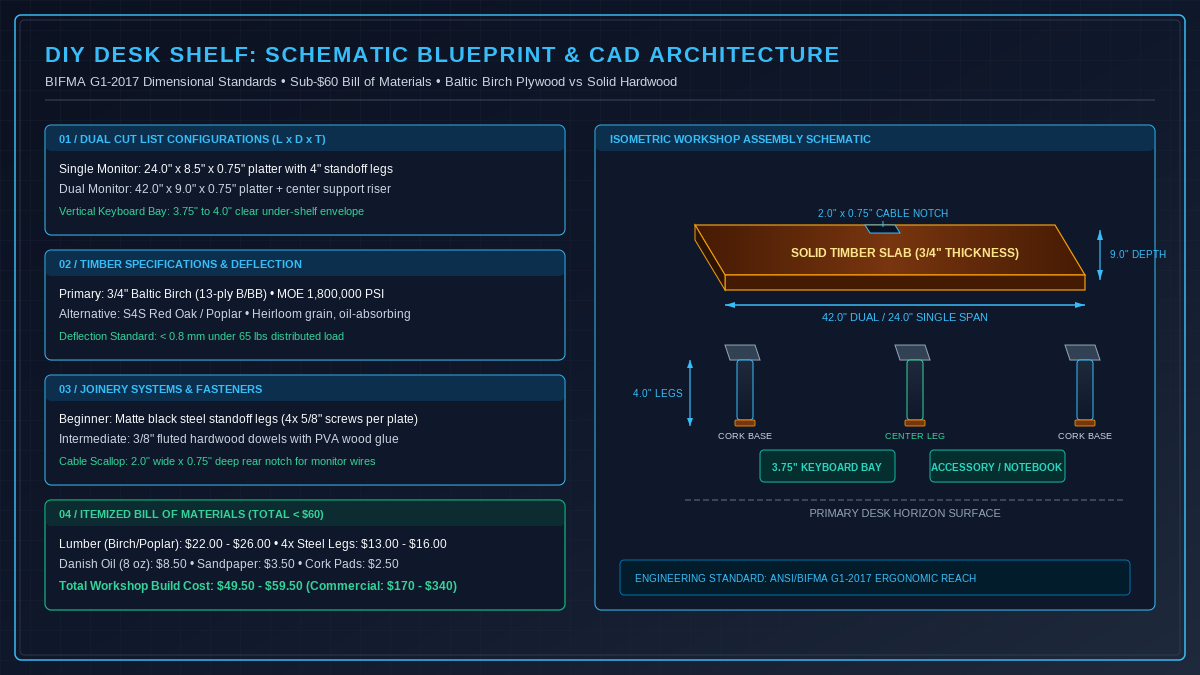
| Top Platter Timber Cut | 24.0 inches long by 8.5 inches deep | 42.0 inches long by 9.0 inches deep |
| Timber Thickness | 0.75 inch (3/4 inch nominal) | 0.75 inch (3/4 inch nominal) |
| Riser Leg Height | 4.0 inches vertical standoff | 4.0 inches vertical standoff |
| Usable Under Shelf Height | 3.75 to 4.0 inches clear vertical space | 3.75 to 4.0 inches clear vertical space |
| Under Shelf Bay Width | Single bay: 22.5 inches wide | Dual bays: 19.5 inches wide each |
| Center Deflection Rating | Under 0.5 mm at 40 pounds centered | Under 0.8 mm at 65 pounds distributed |
| Rear Cable Notch Cutout | 2.0 inches wide by 0.75 inch deep | Two notches: 2.0 inches by 0.75 inch |
The 24 inch compact configuration fits shallow computer tables between 24 and 28 inches deep.
For detailed analysis on shallow table constraints, read our guide on standard desk depth.
The 42 inch wide configuration spans multi screen workstations without bending under heavy load.
A center support leg prevents creeping timber deflection over years of continuous monitor weight.
Selecting Timber: Baltic Birch vs Solid Hardwood
Choosing the correct wood species determines structural stiffness and long term surface durability.
Desk shelves support heavy concentrated downward force from steel display mounts.
| Timber Material | Modulus of Elasticity | Surface Hardness | Edge Profile Aesthetic |
|---|---|---|---|
| 3/4 Inch Baltic Birch (13-Ply) | 1,800,000 PSI | High resistance to dents | Distinctive multi layer edge |
| Solid White Oak / Walnut | 1,850,000 PSI | Maximum dent resistance | Rich natural wood grain |
| Solid Poplar Hardwood | 1,580,000 PSI | Moderate dent resistance | Smooth fine grain |
Thirteen ply Baltic birch plywood offers superior dimensional stability compared to standard sheet goods.
Solid white oak and American walnut provide exceptional structural rigidity and rich natural coloration.
If you prefer buying a commercial factory manufactured unit, compare options in our solid wood desk shelf guide.
Joinery Systems: Metal Standoffs vs Dowels
Connecting the top timber slab to riser supports requires a rigid, wobble free joinery system.
Wobbly desk shelves transmit typing vibration directly into monitor screens, causing eye fatigue.
| Joinery Method | Required Workshop Tools | Mechanical Joint Strength | Visual Fastener Concealment |
|---|---|---|---|
| Metal Standoff Furniture Legs | Cordless drill, pilot bit, driver | High tensile steel screw plates | Modern industrial look |
| Fluted Hardwood Dowels | Doweling jig, drill, clamps, glue | Chemical wood bond, high shear | Completely hidden fasteners |
Matte black steel standoff furniture legs offer the fastest installation path for home makers.
Internal fluted hardwood dowels provide an authentic craft appearance without exposed metal hardware.
Always pre drill pilot holes to prevent splitting hardwood planks near the end grain boundaries.
Protective Finishes: Danish Oil vs Polyurethane
Raw timber absorbs moisture from humid air and collects skin oils during daily use.
Applying a protective finish seals the wood grain and highlights natural figure patterns.
| Protective Finish Type | Finish Chemistry | Application Method | Curing Duration |
|---|---|---|---|
| Hand Rubbed Danish Oil | Polymerized oil with resin | Wipe on with rag, buff dry | 24 to 48 hours |
| Satin Wipe On Poly | Oil modified polyurethane | Wipe 3 thin coats with cloth | 4 to 6 hours per coat |
Danish oil penetrates deep into timber cell walls rather than building a thick plastic film.
Wipe on polyurethane provides dependable defense against condensation rings from iced beverage glasses.
Recommended ergonomic accessories and hardware specs
Workstation accessories selected to support healthy ergonomics, joints, and cable routing.
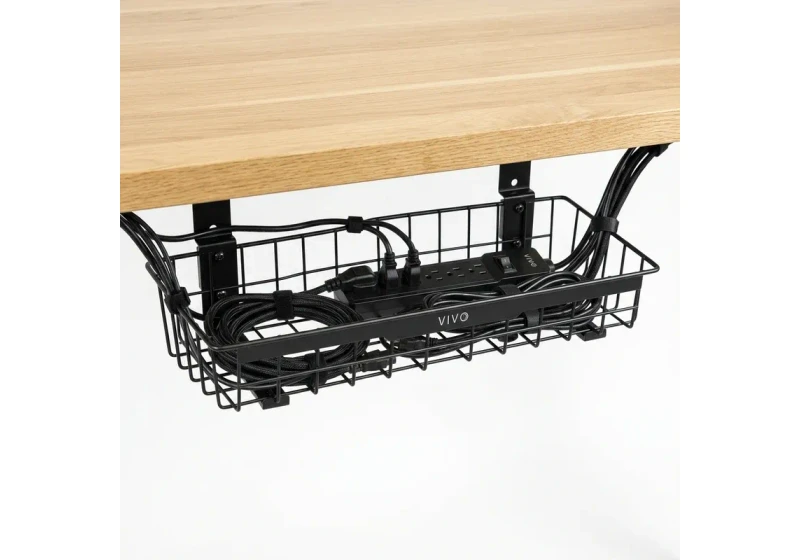
VIVO Under-Desk Cable Tray
Keeps power strips and heavy adapters off the floor, routing cords neatly beneath your desktop.
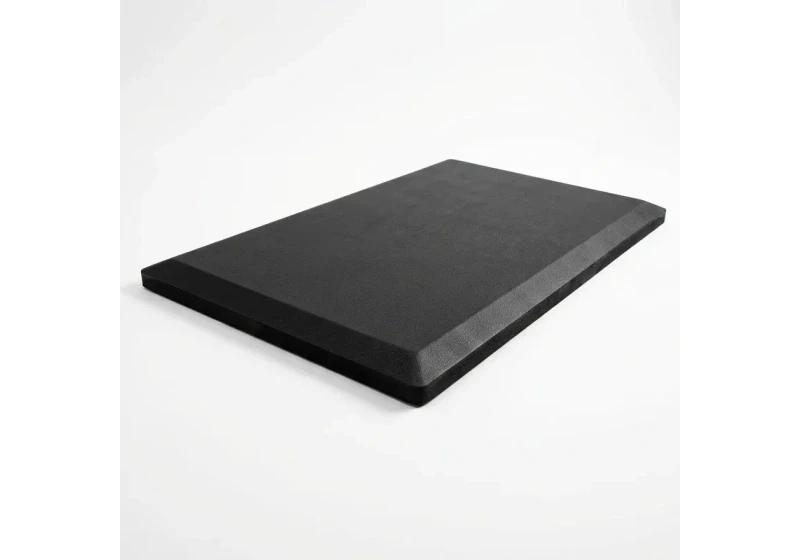
ComfiLife Gel Anti-Fatigue Mat
High-density core cushions heel strike and helps ease lower back compression when standing 3+ hours.
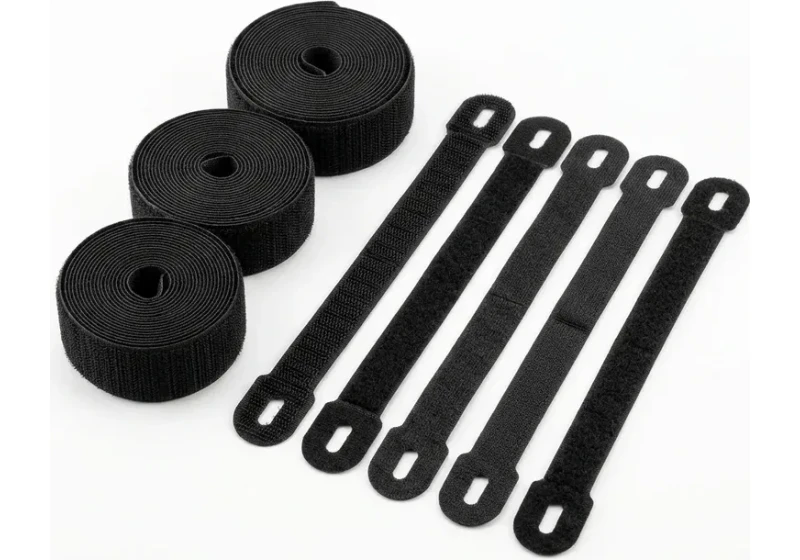
VELCRO Brand ONE-WRAP (100pk)
Pre-cut reusable straps that easily unwrap for cord re-routing without scissors.
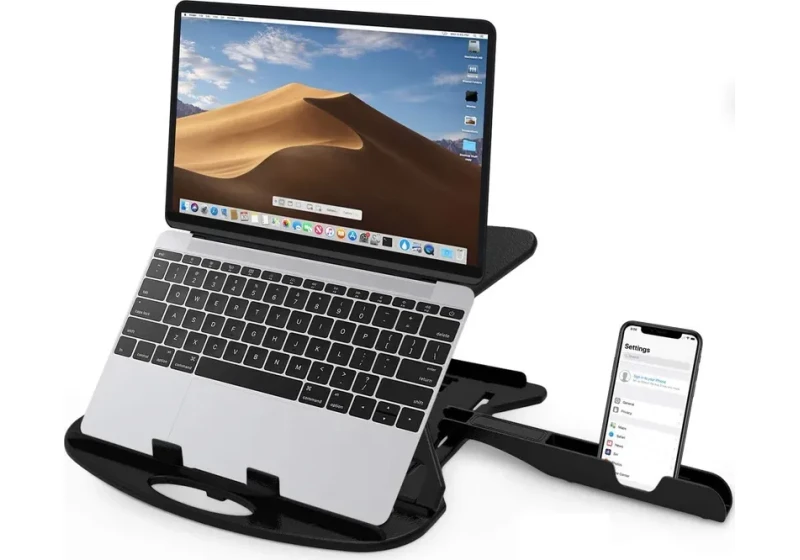
Soundance Laptop Stand
Raises laptop screen 6 inches to eye level, helping reduce forward neck slouch.
Itemized Bill of Materials: Building Under $60
Commercial studio shelves command steep markups due to boutique branding and distribution overheads.
Sourcing raw timber and hardware locally keeps your total build budget below sixty dollars.
| Bill of Materials Component | Item Specification and Source | Quantity Needed | Unit Sourcing Cost |
|---|---|---|---|
| Top Platter Timber Slab | 3/4 inch by 8.5 inch Poplar or Birch | 1 board | $24.00 |
| Matte Steel Standoff Legs | 4 inch powder coated steel legs | Set of 4 legs | $14.50 |
| Penetrating Finish | 8 oz can Danish Oil or wipe on poly | 1 can | $8.50 |
| Silicon Carbide Sandpaper | Multi pack in 120, 180, 220 grit | 1 pack | $4.00 |
| Dense Cork Surface Pads | 1/8 inch self adhesive cork pads | Pack of 8 pads | $2.50 |
| Total Workshop Project Cost | Complete custom furniture grade monitor shelf | Full assembly | $53.50 |
This itemized budget leaves six dollars of buffer under the sixty dollar spending target.
Compare this fifty dollar build against factory options in our monitor riser guide.
Step by Step Workshop Assembly Instructions
Building a custom desk shelf requires basic handheld tools and careful dimension layout.
Follow this sequenced workshop workflow to build your shelf in three hours.
Step 1: Measure Workstation Depth and Cut Timber
Cut your hardwood board to exact length using a circular saw with a straight guide rail.
For shallow tables, examine our ergonomic layout steps in computer table ergonomic guide.
Step 2: Mill Rear Cable Management Scallops
Mark a centered 2.0 inch wide by 0.75 inch deep notch along the rear edge.
Smooth the internal radius of the cable notch using a half round file and sandpaper.
Step 3: Sand Surfaces and Ease Sharp Edges
Sand all faces systematically through 120 grit, 180 grit, and 220 grit abrasives.
Creating a small edge chamfer makes forearm contact comfortable and resists corner chipping.
Step 4: Apply Protective Oil Finish
Pour a small puddle of Danish oil onto the wood and spread it with a cloth.
Buff the cured surface with a microfiber towel to produce a warm satin sheen.
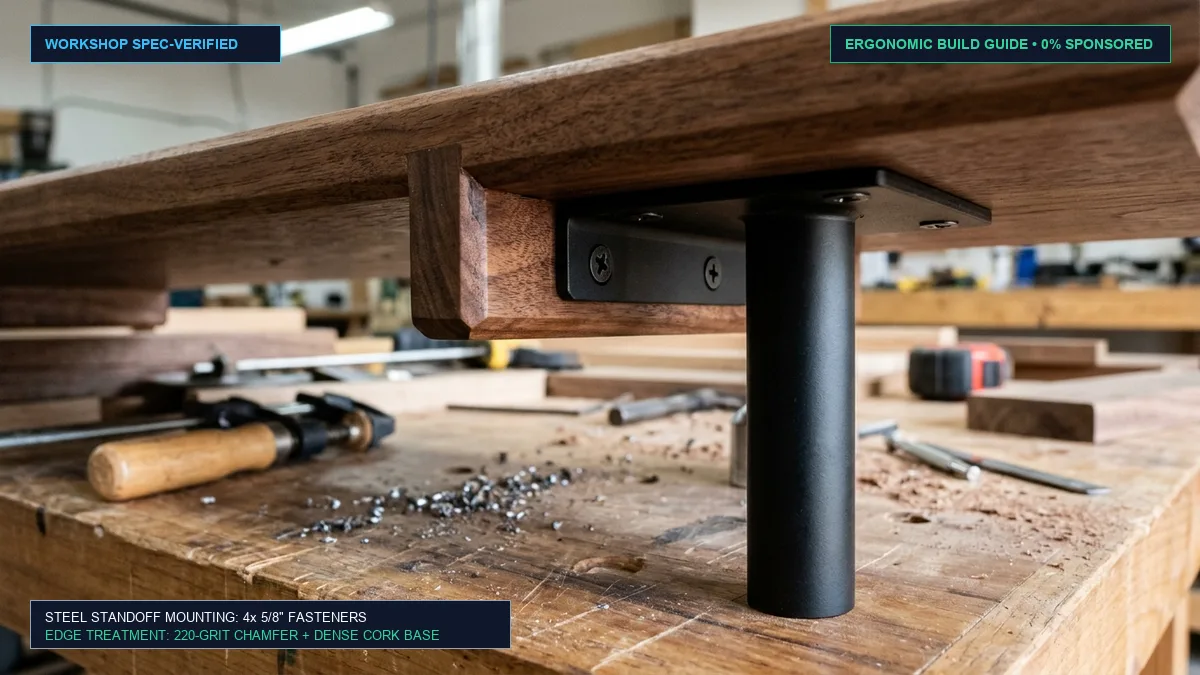
Step 5: Mount Standoff Legs and Align Cork Feet
Position the steel leg mounting plates 1.0 inch inward from side and end boundaries.
Fasten each steel leg securely using 5/8 inch wood screws and hand tighten the screws.
Apply dense adhesive cork pads to each metal foot base to protect your main desk desktop.
For additional tips on clearing workspace clutter, read our desk decluttering guide.
Ergonomic Alignment and Keyboard Clearance Standards
Proper screen height is linked to lower cervical spine strain during prolonged computer work.
ANSI/BIFMA G1-2017 ergonomic standards recommend positioning the top third of display panels at eye level.
Resting monitors flat on desk surfaces forces continuous downward head tilt exceeding twenty degrees.
Chronic forward head tilt is associated with increased muscular fatigue throughout the trapezius muscles.
A 4.0 inch riser elevates typical computer screens to neutral forward gazing horizons.
Our 3.75 inch under shelf clearance accommodates tall mechanical boards with room for hands.
When typing ends, slide your keyboard completely beneath the shelf to clear desktop writing area.
Frequently Asked Questions
What is the ideal height for a DIY desk shelf?
A finished leg height of 3.75 to 4.25 inches is ideal for seated computer workstations. This elevation aligns displays with natural eye horizons while providing generous under shelf storage.
How do I prevent long desk shelves from sagging in the middle?
For spans exceeding 36 inches, install a third center support leg beneath the rear edge. Using 3/4 inch Baltic birch plywood also resists long term creep under dual screen setups.
Can I build a sturdy desk shelf using basic hand tools?
Yes, you can build a sturdy desk shelf using a handsaw, drill, and sandpaper. Ordering precut dimensional lumber from a local lumberyard eliminates the need for table saws.
What wood species is best for a DIY monitor shelf?
Thirteen ply Baltic birch plywood offers the best combination of dimensional stability and stiffness. Solid white oak, American walnut, and poplar also perform exceptionally well with hand rubbed oil.
How much under shelf clearance do mechanical keyboards require?
Standard mechanical keyboards require 1.5 inches of vertical clearance for safe parking. Building your shelf with 3.75 inches of clearance guarantees smooth parking without switch scraping.
Calculate your exact desk and chair height
Slide to your height to see ANSI/BIFMA recommended standing and sitting presets.
By M. Haris
References ANSI/BIFMA G1-2017 guidanceSoftware engineer and founder of The Desk Riser
M. Haris is a software engineer and founder of The Desk Riser, auditing manufacturer engineering schematics, motorized desk cycle lifespans, ANSI/BIFMA G1-2017 ergonomic standards, and long-term user failure patterns across verified owner communities. Every guide is editorially independent with zero paid brand placements and zero PR samples (we may earn affiliate commissions on qualifying purchases). Have questions or spot a warranty update? Email directly at support@thedeskriser.com, read the Author Dossier, or explore our Editorial Research Methodology.
Share this article:
Workstation Setup & Fit Q&A
Have questions about frame deflection, monitor arm clamp loads, or chair sizing? Consult our workstation researchers.
Q:How do I know if this standing desk will wobble on thick carpet?
Standing desk wobble on carpet is caused by uneven carpet pile compression under the rear footpads. Frames with wedge-reinforced leg collars and wide steel footplates (like UPLIFT V3 or FlexiSpot E7 Pro) minimize lateral flex. If placing on plush carpet, use rigid caster cups or a dense underlay to anchor the base directly to the subfloor.
Q:Can I clamp a dual monitor arm onto standard particleboard tops?
Dual monitor arms concentrate 25 to 45 lbs of dynamic torque onto a 4-inch clamp perimeter. Hollow honeycomb tops (such as IKEA Linnmon) will crush. We recommend a minimum 0.75-inch solid core (MDF, solid bamboo, or hardwood), or sandwiching a steel reinforcement bracket plate (min 2.5mm thickness) between the clamp and desktop.
Q:What if my chair cylinder sinks or feels too high for my feet?
Always verify your seated popliteal height (crease behind knee to floor with shoes). If a chair will not drop below 17 inches and your feet dangle, pair it with an angled footrest or switch to a low-range Class 4 cylinder. If a cylinder loses pressure and sinks on its own, the internal nitrogen seal is breached and requires cylinder replacement.
Ask Our Ergonomic Spec Reviewers
Planning an upgrade or unsure if your monitors and stature fit this configuration? Send your dimensions directly to our research desk. No accounts, no trackers, zero marketing spam.