What is PU Leather (2026): Durability & Peeling Truth

PU leather is artificial leather made by applying a polyurethane polymer coating over fabric or split hide. Heat embossing creates the realistic surface grain texture.
Sacral L5-S1 unloading & forward tilt evaluated
2" minimum knee crease clearance to safeguard bloodflow
ANSI/BIFMA X5.1 commercial cylinder durability verified
Chair Mechanism & Fit Scope
Evaluates commercial cylinder tolerances, mechanical fasteners, caster specifications, and ergonomic seat pan geometry. Methodology →
Last Spec & Pricing Audit
. Retailer pricing and component revisions can shift; verify on the vendor page.
Fit & Return Guardrail
Check cylinder class, mechanism bolt patterns, and caster stem dimensions before ordering replacement parts.
Why PU Leather Office Chairs Peel & Fail (Hydrolysis Truth)
Watch our hands-on materials science teardown: testing polyurethane resin against room humidity, analyzing BIFMA Martindale 15,000 vs 100,000 rub cycles, and revealing why budget faux leather chairs peel after 18 months.
Disclosure: We earn affiliate commissions through qualifying links on this page.
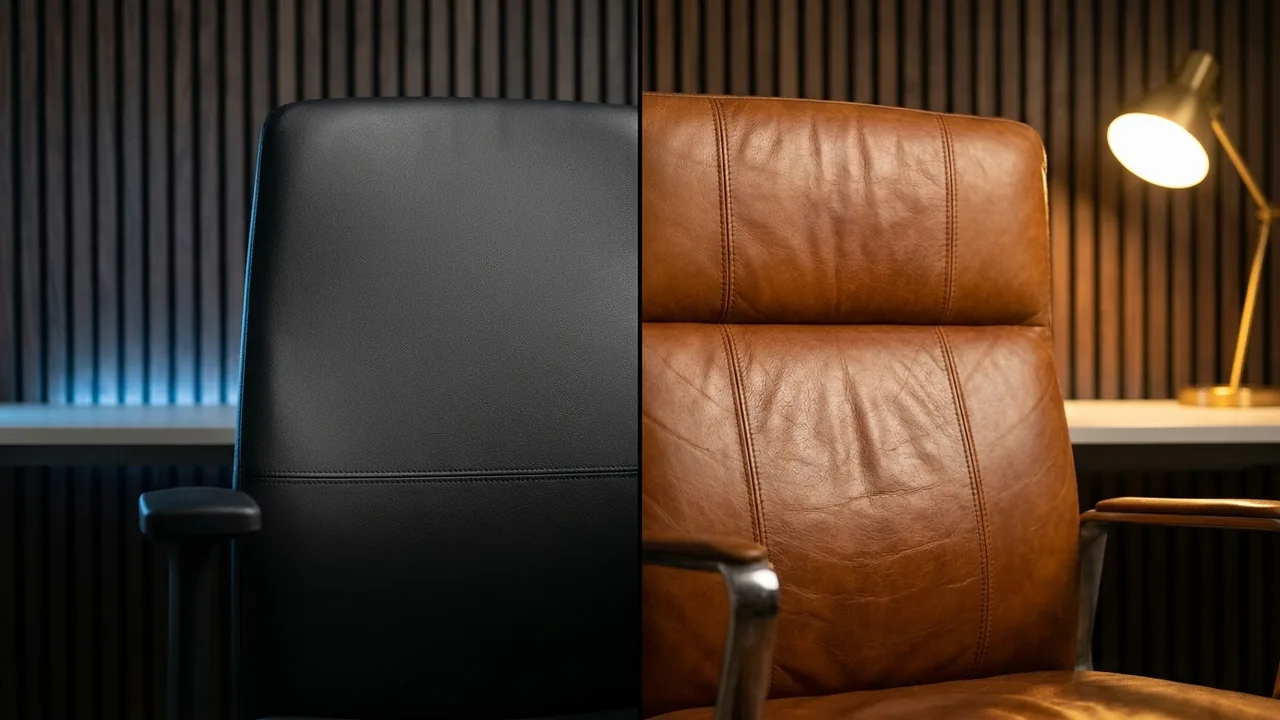
Glossy executive chairs wrapped in synthetic leather look identical to thousand dollar cowhide at one quarter of the price. That showroom shine hides an inevitable expiration date.
Marketing brochures promise executive luxury on a shoestring budget. In reality, chemical breakdown begins the day you unpack the chair.
Within two years of daily sitting, budget polyurethane coating cracks along seams and sheds flakes over clothing. Understanding material chemistry protects you from deceptive marketing claims.
What is PU Leather: Quick Verdict on Office Chair Durability
PU leather is artificial leather made by applying a polyurethane polymer coating over fabric or split hide. Heat embossing creates the realistic surface grain texture.
Daily sitting triggers hydrolysis breakdown from ambient humidity within 18 to 36 months. Surface delamination then flakes away the outer resin film from the backing cloth.
If you need a chair for eight hour workdays, budget PU leather will disappoint you. For resilient seating, inspect our guide on best office chair under $200 for durable upholstery choices.
Polyurethane Chemistry: How PU Leather is Manufactured
Polyurethane is a copolymer created by reacting diisocyanates with polyols. Chemical reactors link these molecules using urethane groups, forming a pliable polymer elastomer.
By balancing flexible polyols with rigid diisocyanates, chemists fine tune how soft or stiff the finished chair cover feels.
Manufacturers cast liquid resin onto embossed release paper. Heat ovens cure the resin, capturing microscopic dermal grain before backing fabric is applied.
The Tri-Layer Structure: Topcoat, Foam Tie Layer, and Substrate
Commercial PU leather is an engineered laminate consisting of three structural layers bonded under heated rollers.
The solid polyurethane topcoat provides color and fluid resistance, while a cellular foam tie layer bonds to woven fabric backing.
The cellular foam middle layer provides soft cushioning under bodyweight. Without it, the brittle topcoat would crack against rigid backing threads.
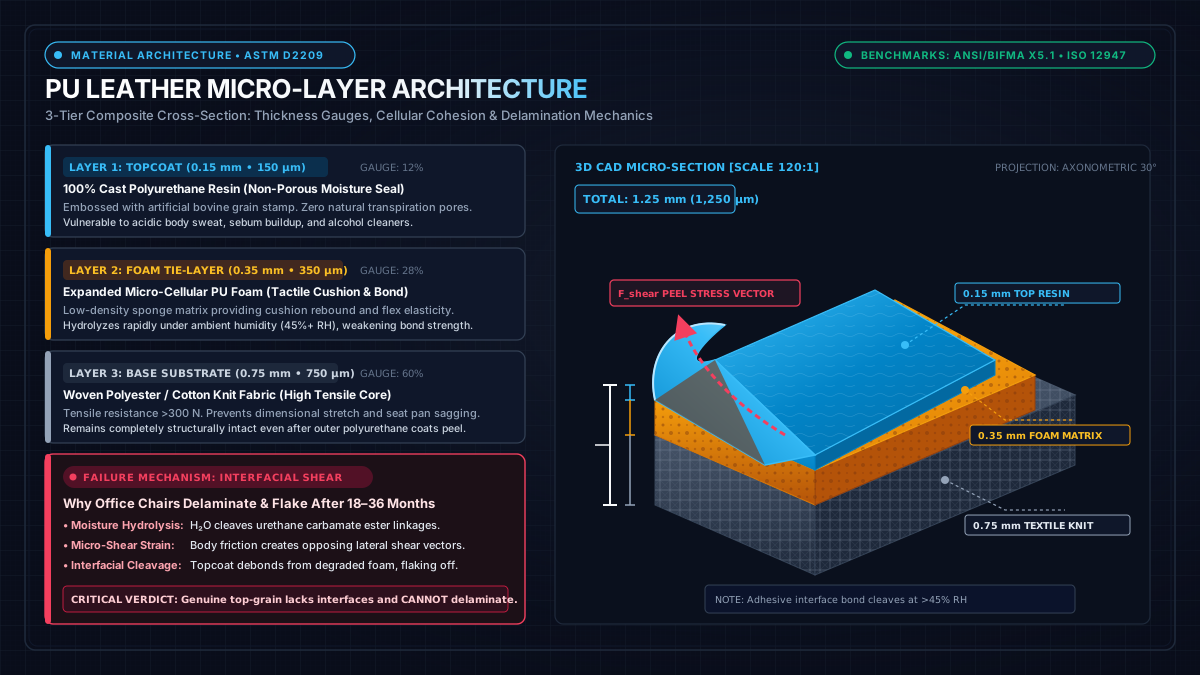
When room moisture weakens that central foam bond, the top resin skin delaminates from the woven fabric foundation.
Cast Polyurethane vs Thermoplastic Polyurethane (TPU)
Factories utilize cast polyurethane for executive chairs, curing liquid precursors into soft upholstery that drapes across foam cushions.
TPU remains flexible across extreme temperature swings. Cast PU stiffens in cold rooms, accelerating surface fracture lines during winter.
Thermoplastic TPU is extruded without volatile plasticizers, offering superior hydrolysis resistance at higher manufacturing costs.
PU Leather vs Genuine Leather vs Bonded Leather vs PVC
Retailers use terms like vegan leather or leatherette to disguise cheap synthetics. Genuine leather consists of interwoven collagen fibers that breathe freely, stretch without cracking, and develop natural patina.
The comparison table below details composition, breathability, peeling vulnerability, and lifespan benchmarks across common office chair upholstery materials.
| Upholstery Material | Core Composition | Breathability | Peeling Risk | Martindale Rubs | Typical Lifespan |
|---|---|---|---|---|---|
| Full Grain Leather | Unsplit animal hide and natural grain | High | Zero (Patina) | 150,000+ | 10 to 20+ Years |
| Top Grain Leather | Sanded cowhide with protective finish | Moderate | Zero (Creasing) | 100,000+ | 7 to 12 Years |
| Split Bicast Leather | Split animal hide with PU topcoat | Low | High (Delaminates) | 25,000 to 40,000 | 2 to 4 Years |
| Polyurethane (PU) | Polyurethane film over woven cloth | Low | High (Hydrolysis) | 20,000 to 50,000 | 18 to 36 Months |
| Bonded Leather | Shredded leather scraps and latex glue | Very Low | Extreme (Flakes) | 10,000 to 20,000 | 12 to 18 Months |
| PVC Vinyl Leather | Polyvinyl chloride with plasticizers | Zero | Moderate (Cracks) | 50,000 to 100,000 | 3 to 5 Years |
Why Bonded Leather Fails Faster Than Pure PU
Bonded leather mixes pulverized scrap shavings with latex glue spread over paper, containing under seventeen percent hide. Lacking textile weave, it disintegrates rapidly under daily sitting shear.
Bonded leather is prone to sudden catastrophic peeling across entire seating panels. Once adhesive dries out, structural integrity vanishes overnight.
Pure PU uses cohesive woven backing, outlasting bonded scraps by over a year. Compare authentic hides in our guide on best leather office chairs.
Why PU Leather Peels: Hydrolysis, Sebum, and Martindale Wear Cycles
Mechanical friction accelerates chair damage, but chemical breakdown within polymer chains triggers peeling.
Polyurethane deteriorates through ambient moisture breakdown, skin oil contamination, and mechanical cycle stress.
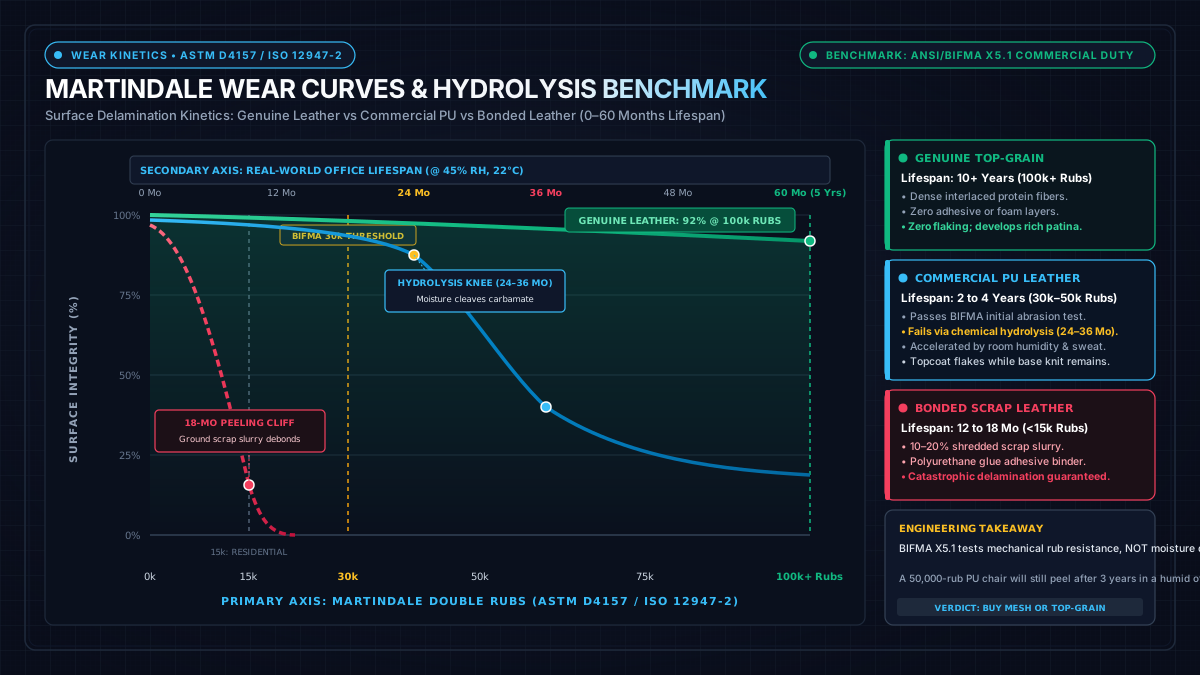
The benchmark above reveals how surface stability collapses once chemical bonds sever during daily office use.
Hydrolysis and Atmospheric Moisture Breakdown
Hydrolysis is the chemical cleavage of polymer bonds by airborne water vapor.
Offices kept above sixty percent relative humidity accelerate hydrolysis decay. Water molecules gradually unravel polymer chains, turning pliable coatings into chalky dust.
Ester groups in cheap polyester polyols hydrolyze rapidly in warm room air. Commercial seating uses polyether polyols that resist water cleavage, surviving humid climates without peeling.
Sebum Acid Reaction and Plasticizer Migration
Bare skin transfers sebum oils containing squalene and fatty acids onto chair upholstery.
Sweat salts crystallize inside surface pores, acting as abrasive micro grit. Combined with sebum acids, this residue erodes the protective clear coat.
These acidic lipids dissolve internal plasticizers, turning the polyurethane brittle. Armrests and front seat edges peel first because they receive maximum body oil and friction heat.
Martindale Abrasion Cycles: 20,000 vs 50,000 Rub Benchmarks
The Martindale test rubs worsted wool against upholstery swatches under fixed pressure to measure abrasion resistance.
Most budget desk chairs never undergo certified Martindale testing. Manufacturers rely on standard factory estimates that ignore real world sweat exposure.
Residential PU withstands only 20,000 double rubs, failing quickly under desk work. Commercial contract seating requires 50,000 rubs, while top grain cowhide surpasses 150,000 cycles.
Real-World Office Chair Durability: Breathability and Wear Timelines
Polyurethane creates a non porous barrier that blocks airflow, trapping body heat at 37 degrees Celsius. Heat and sweat accelerate the hydrolysis reactions destroying the surface.
Non breathable upholstery also causes pelvic fatigue during marathon work sessions. Without air circulation, seated workers fidget constantly to relieve trapped heat.
If your seat traps heat, review our guide on how to make an office chair more comfortable for ergonomic ventilation solutions.
The 36-Month Degradation Timeline
Eight hour daily sitting produces a predictable three stage wear lifecycle.
Months one through six remain pristine with supple texture. Months six through eighteen bring hairline cracks along front edges as plasticizers migrate.
Months eighteen through thirty six cause severe delamination, shedding brittle resin flakes over floors and exposing white woven backing.
Recommended Ergonomic Accessories & Hardware Specs
High-impact accessories verified by our research team to protect your cables and joints.
VIVO Under-Desk Cable Tray
Keeps power strips and heavy adapters off the floor so cables never yank when elevating.
ComfiLife Gel Anti-Fatigue Mat
High-density core reduces heel strike and lower back compression when standing 3+ hours.
VELCRO Brand ONE-WRAP (100pk)
Pre-cut reusable straps that easily unwrap for cord re-routing without scissors.
Soundance Laptop Stand
Elevates laptop screen 6 inches to eye level, preventing forward neck slouch.
How to Clean PU Leather and Prevent Peeling
Routine maintenance delays peeling by removing acidic sebum before it strips plasticizers.
Never place synthetic leather chairs in direct window sunlight. Ultraviolet radiation degrades polyurethane polymers as aggressively as high room humidity.
Wipe upholstery weekly using a damp microfiber cloth to clear skin oils and sweat salts. Maintain room humidity between forty and fifty percent to protect polymer chains from moisture breakdown.
Cleaning Protocols and Banned Chemical Solvents
Never clean PU leather with alcohol wipes, bleach, or acetone, which strip protective lacquer instantly.
Wipe spills immediately with dry paper towels before liquids penetrate needle stitch holes. Water pooling inside seams rots the foam tie layer underneath.
Mix three drops of mild pH neutral dish soap into warm water. Wipe surfaces gently with a damp cloth, dry immediately, and avoid gummy automotive conditioners.
Buying Verdict: Who Should Choose PU Leather and Who Should Skip
PU leather is an economical upholstery engineered for short term utility. Balancing sitting duration, climate, and replacement expectations ensures satisfaction.
Investing in durable upholstery prevents annual chair replacement costs. Factoring lifespan into initial purchase price reveals true long term value.
To evaluate which seating mechanisms match your body dimensions, try our free ergonomic office chair finder for personalized recommendations.
Who Should Buy PU Leather Office Chairs
PU leather suits secondary home desks, guest seating, and boardrooms used under three hours daily.
Shoppers on strict sub-$200 budgets needing wipe clean surfaces also benefit, gaining practical liquid spill resistance that woven fabrics lack.
Who Should Skip PU Leather: Friction and Drawbacks
Full time desk workers sitting eight hours daily should skip PU leather because trapped sweat accelerates peeling within two years.
Users in unconditioned rooms and individuals over two hundred pounds should choose mesh or genuine hide to avoid thermal discomfort and seam tears under shear loads.
Frequently Asked Questions (FAQ)
Does PU leather peel easily on office chairs?
Yes, PU leather peels when ambient humidity and sweat degrade polyurethane resin through hydrolysis. Friction along seat edges triggers flaking within 18 to 36 months.
How long does a PU leather office chair last before cracking?
An office chair used eight hours daily generally lasts two to three years before cracking. Chairs used lightly in climate controlled rooms survive five years.
Can you fix or stop PU leather from peeling once it starts?
You cannot reverse peeling once resin delaminates from cloth backing. You can temporarily patch damaged areas with vinyl repair tape or fit a fabric slipcover.
Is PU leather vegan and completely animal-free?
Most PU leather is completely vegan, utilizing woven polyester backing beneath polyurethane coating. Bicast leather coats split cowhide, requiring vegan shoppers to verify backing specifications.
Is PU leather better than bonded leather or genuine leather?
PU leather is far superior to bonded leather because it does not crumble into glued scraps. Authentic top grain cowhide remains superior to both, offering decade durability without peeling.
Calculate Your Exact Desk & Chair Height
Slide to your height to see ANSI/BIFMA recommended standing and sitting presets.
Written by M. Haris
✓ References ANSI/BIFMA G1-2017 GuidanceFounder & Lead Workstation Ergonomics Researcher • Spec Auditing & Biomechanical Research
M. Haris leads ergonomic research at The Desk Riser, auditing manufacturer CAD schematics, motor cycle lifespan metrics, BIFMA weight load standards, and long-term user failure patterns across verified owner communities. Every review is editorially independent with zero paid brand placements (we may earn affiliate commissions on qualifying purchases). Have questions or spot a warranty update? Email directly at [email protected], read the Author Dossier, or explore our Editorial Research Methodology.
Share this article:
Workstation Setup & Fit Q&A
Have questions about frame deflection, monitor arm clamp loads, or chair sizing? Consult our research team.
Q:How do I know if this standing desk will wobble on thick carpet?
Standing desk wobble on carpet is caused by uneven carpet pile compression under the rear footpads. Frames with wedge-reinforced leg collars and wide steel footplates (like UPLIFT V3 or FlexiSpot E7 Pro) minimize lateral flex. If placing on plush carpet, use rigid caster cups or a dense underlay to anchor the base directly to the subfloor.
Q:Can I clamp a dual monitor arm onto standard particleboard tops?
Dual monitor arms concentrate 25 to 45 lbs of dynamic torque onto a 4-inch clamp perimeter. Hollow honeycomb tops (such as IKEA Linnmon) will crush. We recommend a minimum 0.75-inch solid core (MDF, solid bamboo, or hardwood), or sandwiching a steel reinforcement bracket plate (min 2.5mm thickness) between the clamp and desktop.
Q:What if my chair cylinder sinks or feels too high for my feet?
Always verify your seated popliteal height (crease behind knee to floor with shoes). If a chair will not drop below 17 inches and your feet dangle, pair it with an angled footrest or switch to a low-range Class 4 cylinder. If a cylinder loses pressure and sinks on its own, the internal nitrogen seal is breached and requires cylinder replacement.
Ask Our Ergonomic Spec Reviewers
Planning an upgrade or unsure if your monitors and stature fit this configuration? Send your dimensions directly to our research desk. No accounts, no trackers, zero marketing spam.