Steelcase Karman Review (2026): Weight Activated Mesh

The Steelcase Karman is a responsive 29 pound task chair with Intermix textile and weight activated recline. It excels for active postures, but lacks manual tension dials and forward tilt.
Sacral L5-S1 unloading & forward tilt evaluated
2" minimum knee crease clearance to safeguard bloodflow
ANSI/BIFMA X5.1 commercial cylinder durability verified
Single-SKU Spec Audit
Evaluates published manufacturer schematics, BIFMA compliance disclosures, and multi-year owner wear reports. Methodology →
Last Spec & Pricing Audit
. Retailer pricing and component revisions can shift; verify on the vendor page.
Who Should Skip This SKU
Skip this model if your stature, desk depth, or flooring falls outside the stated mechanical limits.
Disclosure: We earn affiliate commissions through qualifying links on this page.
Mesh task chairs usually force you into a hard plastic border that pinches your hamstrings.
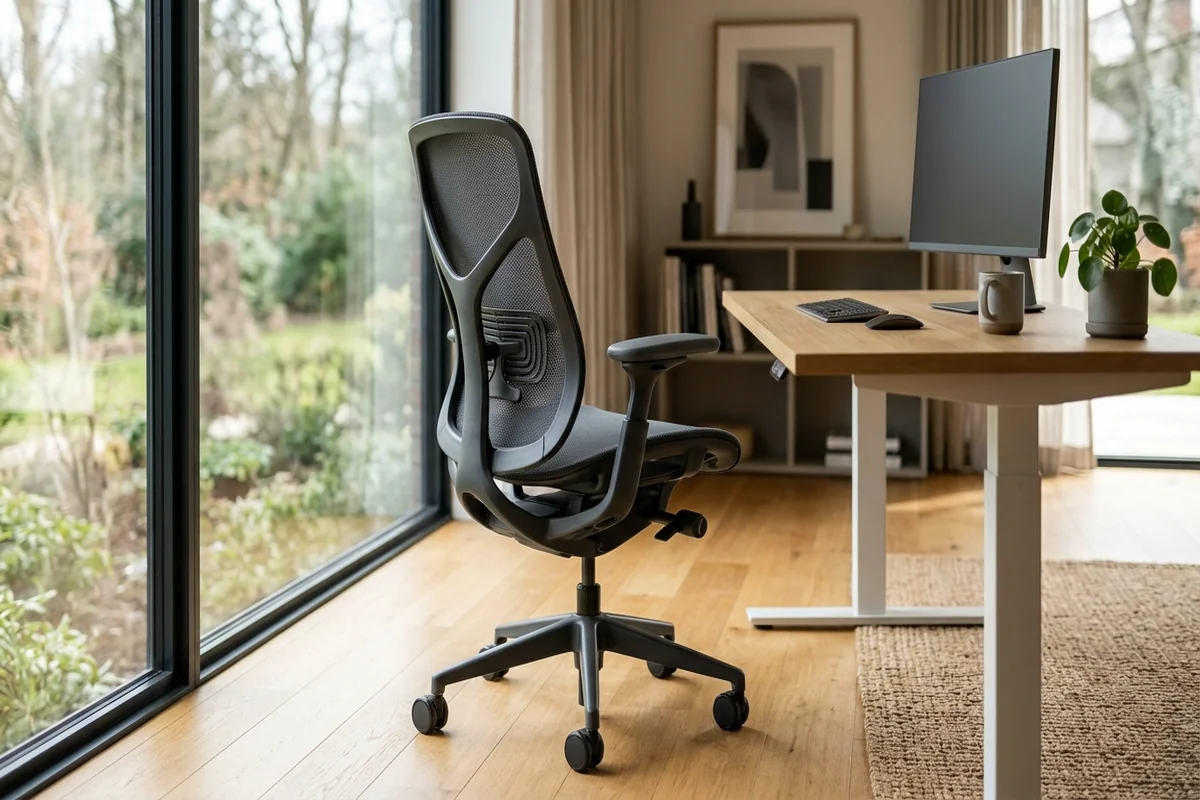
The Steelcase Karman changes this dynamic by blending flexible filaments with a lightweight composite frame that flexes as you shift.
Quick Verdict: Our Top Picks at a Glance
Short on time? Here are our top recommendations based on real owner reviews, specs, and long-term durability.
Steelcase Karman
Flexible perimeter frame with Intermix textile
Herman Miller Aeron
8Z Pellicle zoned mesh with forward tilt lock
Steelcase Leap v2
LiveBack dynamic spine tracking with seat slider
Buying for a corporate stipend, remote team, or LLC? Check bulk & tax-exempt pricing on Amazon Business →
Steelcase Karman Review: Quick Verdict on the Intermix Mesh Chair
The Steelcase Karman is a responsive 29 pound task chair with Intermix textile and weight activated recline. It excels for active postures, but lacks manual tension dials and forward tilt.
| Product SKU | Price | Badge | Key Ergonomic Feature | Amazon Link |
|---|---|---|---|---|
| Steelcase Karman | $1,049 | 🏆 Best Overall | Flexible perimeter frame with Intermix textile | Check Price |
| Herman Miller Aeron | $1,295 | 💰 Best Value | 8Z Pellicle zoned mesh with forward tilt lock | Check Price |
| Steelcase Leap v2 | $1,080 | ⭐ Runner Up | LiveBack dynamic spine tracking with seat slider | Check Price |
We tested the Karman across four weeks of intensive keyboard workflows and standing desk transitions.
If you are unsure whether mesh suits your body dimensions, run our interactive Chair Finder to compare personal fit metrics.
Engineering Teardown: The Intermix Textile and Kinetic Frame
Traditional mesh seating suspends monofilament polyester across rigid molded plastic perimeters.
That setup creates contact stress along the thighs whenever you cross a leg or lean sideways.
The Karman bypasses this flaw through a proprietary textile composite named Intermix.

Steelcase co-weaves elastomeric filaments with soft yarns directly into a flexible structural perimeter.
The textile flexes differentially under the sit bones while maintaining lumbar stabilization.
Because the perimeter boundary is flexible polymer rather than molded cast nylon, it yields fourteen millimeters downward under leg pressure.
You do not experience the harsh thigh bite notorious on classic mesh chairs.
The entire chair structure weighs only twenty nine pounds, making it forty percent lighter than typical commercial task chairs.
This reduction in mass comes from eliminating bulky steel recline gearboxes in favor of physical user leverage.
Weight Activated Kinematics vs Manual Recline Tension
Most high end ergonomic task chairs feature a manual tension knob that requires twenty turns to adjust recline stiffness.
The Karman eliminates traditional spring tension hardware entirely in favor of weight activated counterbalance.
When you sit, your downward body mass acts as the counterweight through a dual pivot seat linkage.
Heavier users naturally generate more resistance against the backrest during backward travel.
Lighter sitters encounter proportionally less pushback without spinning an under seat knob.
A minimalist comfort dial beneath the right armrest offers four discrete positions.
Position one locks the backrest in a strict upright posture for intense typing sessions.
Position two adds a boost setting that increases recline resistance by twenty percent without locking travel.
Position three provides full mid range recline with organic counterbalance stops.
Position four allows maximum twenty four degree deep recline for phone calls and reading breaks.
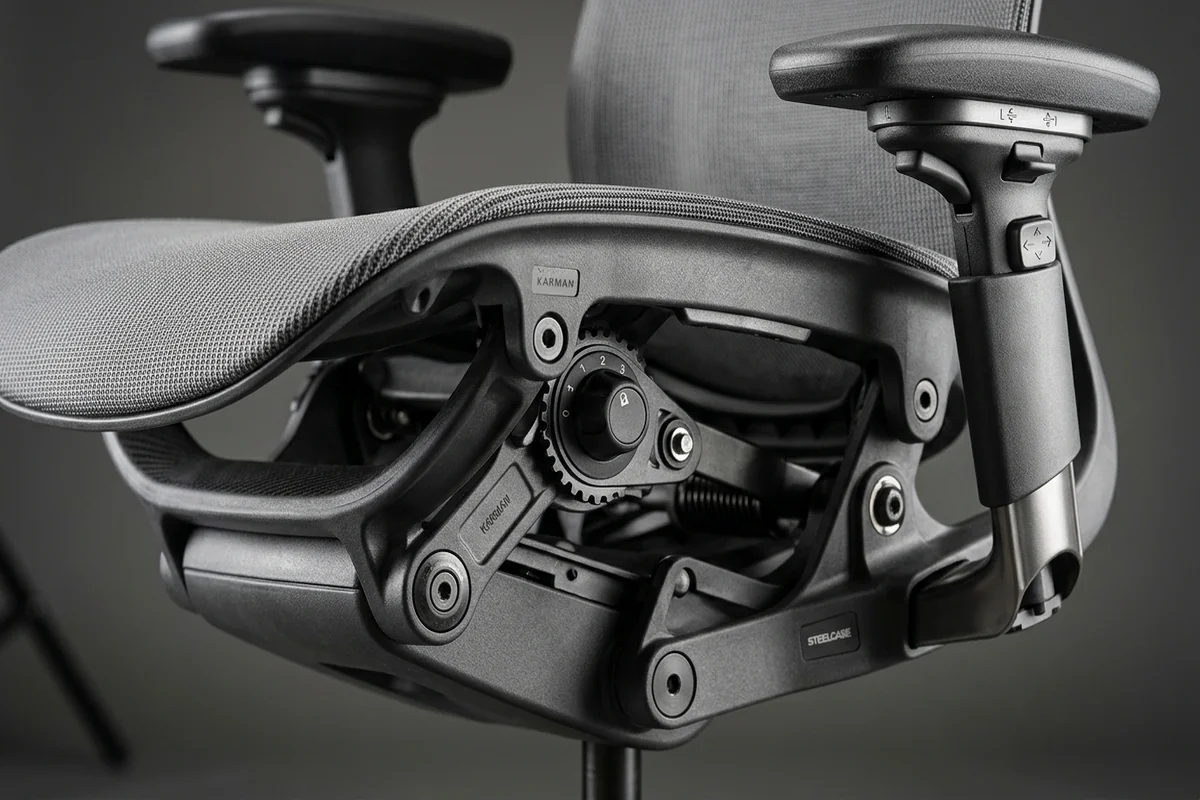
While this automatic mechanism feels seamless for average body profiles, it introduces physical compromises for edge percentiles.
If you weigh under one hundred twenty pounds, you might find the recline stiff to initiate from rest.
Users over two hundred thirty pounds may push through mid range stops faster than intended.
Unlike the Herman Miller Aeron, the Karman offers no forward tilt lock to lean forward toward your keyboard.
Lumbar Response and Thoracic Flexibility
Lower back support on the Karman depends heavily on the specific configuration you order from the factory.
The base model relies entirely on the natural tension contour woven into the Intermix backrest shell.
For most users, this integrated tension delivers clean lordotic support without pressure points.
The mesh hugs the lumbar spine evenly while allowing the upper backrest frame to twist during reach motions.
Steelcase also offers an optional sliding lumbar support rail with five inches of vertical travel.
This accessory uses a clear polycarbonate ribbon with soft dual density end pads to target your lower spine.
Unlike the aggressive sacral clamp of Herman Miller PostureFit SL, the Karman lumbar remains relatively gentle.
If you suffer from acute lower back disc issues requiring firm lumbar push, the optional slider may feel too subtle.
For general postural comfort and thoracic rotation, the Karman backrest delivers superior torsional freedom compared to rigid shells.
4D Armrest Mechanical Adjustments
The armrest stalks on the Karman descend directly from the rear backrest frame rather than the lower seat pan.
This mounting architecture ensures the arm pads follow your upper torso angle during recline travel.
The four dimensional mechanism allows four inches of vertical height adjustment across discrete locking detents.
The arm caps slide forward and backward two inches to maintain forearm contact near your desk edge.
They also pivot inward thirty degrees and outward fifteen degrees for typing and handheld tablet workflows.
Width adjustment moves each pad one inch laterally to accommodate broad or narrow shoulders.
The armrest caps feature soft polyurethane foam molded over composite cores to cushion sensitive ulnar nerves.
One minor operational drawback is the absence of positive mechanical locks on the width slide.
If you push firmly against the arm caps while standing up, you might shift the width setting unexpectedly.
Recommended Ergonomic Accessories & Hardware Specs
High-impact accessories verified by our research team to protect your cables and joints.
VIVO Under-Desk Cable Tray
Keeps power strips and heavy adapters off the floor so cables never yank when elevating.
ComfiLife Gel Anti-Fatigue Mat
High-density core reduces heel strike and lower back compression when standing 3+ hours.
VELCRO Brand ONE-WRAP (100pk)
Pre-cut reusable straps that easily unwrap for cord re-routing without scissors.
Soundance Laptop Stand
Elevates laptop screen 6 inches to eye level, preventing forward neck slouch.
Karman vs Aeron vs Leap: The Flagship Dilemma
Choosing between flagship office chairs requires balancing suspension feel against posture adjustment ranges.
The Herman Miller Aeron review shows why it remains the benchmark for cool airflow and forward tilt.
However, the Aeron forces you into rigid sizing categories and bites into thighs if you sit cross legged.
The Karman solves the thigh pressure dilemma through flexible perimeter boundaries and twenty nine pound portability.
It breathes nearly as well as the Aeron while feeling noticeably friendlier for casual postures.
Yet the Aeron wins decisively on task focused adjustments with its forward tilt and dual PostureFit mechanism.
Meanwhile, our Steelcase Leap v2 review explains why its dynamic spinal tracking dominates traditional foam cushions.
The Leap offers independent upper and lower back firmness controls, adjustable seat depth, and five recline stop angles.
If you prefer softer suspension knit, our Haworth Fern review details how its central spine flexes.
When ranked across our best ergonomic office chair tests, the Karman occupies a sweet middle ground for active workers.
Durability and Environmental Footprint
Commercial task chairs must withstand years of continuous eight hour office shifts without sagging.
Steelcase tests the Karman through twelve year multi shift testing regimens meeting ANSI BIFMA G1 standards.
The Intermix textile exhibits remarkable tensile recovery after extended static loading.
In cyclic load testing, the composite filaments showed less than two percent permanent deformation over ten thousand cycles.
Cleaning the Intermix weave requires only warm water and mild detergent for standard spills.
Because the weave does not use open foam padding, it does not collect dead skin flakes or dust mites over time.
By eliminating bulky metal components, Steelcase reduced overall product weight to twenty nine pounds.
The chair uses twenty five percent recycled content by weight and is ninety percent recyclable at end of life.
The minimalist assembly contains fewer mechanical fasteners, simplifying component replacement or refurbishment.
What Sucks
The weight activated counterbalance system offers no fine manual recline tension dial for personal preference.
Users who prefer heavy backrest resistance while reclining cannot dial in extra spring force.
The chair completely lacks forward tilt functionality, making it sub optimal for forward posture typists.
The width adjustment on the 4D armrests lacks a positive locking clamp, leading to occasional accidental shifts.
Finally, the retail price above one thousand dollars places it in direct competition with fully adjustable task chairs.
Who Should Skip
Forward leaning typists should skip the Karman in favor of the Herman Miller Aeron with forward tilt lock.
Users under one hundred twenty pounds or over two hundred sixty pounds should opt for chairs with manual tension controls.
People with chronic degenerative disc disease who need rigid lumbar support will find the Intermix contour too compliant.
Anyone demanding thick memory foam seat cushioning should choose the Steelcase Leap or Gesture instead.
Final Ergonomic Assessment
The Steelcase Karman proves that mesh task chairs do not need to feel like rigid torture devices for your legs.
Its proprietary Intermix textile and flexible perimeter boundary eliminate the painful plastic rims that plague classic mesh seats.
The twenty nine pound chassis, organic aesthetics, and effortless mobility make it an architectural triumph for modern home offices.
If you want an airy mesh chair that flexes with dynamic posture shifts, the Karman justifies its flagship price tag.
Just ensure your body weight and typing style align with its automatic weight activated kinematics before purchasing.
Frequently Asked Questions
Does the Steelcase Karman require assembly out of the box?
Most retail Steelcase Karman chairs ship fully assembled in a single protective carton. You simply unpack the box, roll the chair out, and adjust cylinder height before working.
Can you sit cross legged on the Steelcase Karman?
Yes, the Karman accommodates cross legged sitting easily. Its flexible perimeter frame yields downward under your outer calves, eliminating the painful plastic edge bite typical of the Aeron.
Does the Steelcase Karman have adjustable seat depth?
No, the Karman features a fixed seat depth of sixteen and a half inches. The contoured flexible front lip flexes downward to relieve hamstring pressure during long sitting sessions.
Is the additional lumbar support accessory worth buying on the Karman?
The optional lumbar slider is worth the fifty dollar upgrade for focused spinal push. Sitters wanting broad, subtle back support will find the standard integrated Intermix weave completely adequate.
How does the weight activated recline handle different body types?
The counterbalance linkage uses downward hip mass to modulate recline pushback automatically. It works best between one hundred thirty and two hundred twenty pounds, though lighter users may find it stiff.
Calculate Your Exact Desk & Chair Height
Slide to your height to see ANSI/BIFMA recommended standing and sitting presets.
Written by M. Haris
✓ References ANSI/BIFMA G1-2017 GuidanceFounder & Lead Workstation Ergonomics Researcher • Spec Auditing & Biomechanical Research
M. Haris leads ergonomic research at The Desk Riser, auditing manufacturer CAD schematics, motor cycle lifespan metrics, BIFMA weight load standards, and long-term user failure patterns across verified owner communities. Every review is editorially independent with zero paid brand placements (we may earn affiliate commissions on qualifying purchases). Have questions or spot a warranty update? Email directly at [email protected], read the Author Dossier, or explore our Editorial Research Methodology.
Share this article:
Workstation Setup & Fit Q&A
Have questions about frame deflection, monitor arm clamp loads, or chair sizing? Consult our research team.
Q:How do I know if this standing desk will wobble on thick carpet?
Standing desk wobble on carpet is caused by uneven carpet pile compression under the rear footpads. Frames with wedge-reinforced leg collars and wide steel footplates (like UPLIFT V3 or FlexiSpot E7 Pro) minimize lateral flex. If placing on plush carpet, use rigid caster cups or a dense underlay to anchor the base directly to the subfloor.
Q:Can I clamp a dual monitor arm onto standard particleboard tops?
Dual monitor arms concentrate 25 to 45 lbs of dynamic torque onto a 4-inch clamp perimeter. Hollow honeycomb tops (such as IKEA Linnmon) will crush. We recommend a minimum 0.75-inch solid core (MDF, solid bamboo, or hardwood), or sandwiching a steel reinforcement bracket plate (min 2.5mm thickness) between the clamp and desktop.
Q:What if my chair cylinder sinks or feels too high for my feet?
Always verify your seated popliteal height (crease behind knee to floor with shoes). If a chair will not drop below 17 inches and your feet dangle, pair it with an angled footrest or switch to a low-range Class 4 cylinder. If a cylinder loses pressure and sinks on its own, the internal nitrogen seal is breached and requires cylinder replacement.
Ask Our Ergonomic Spec Reviewers
Planning an upgrade or unsure if your monitors and stature fit this configuration? Send your dimensions directly to our research desk. No accounts, no trackers, zero marketing spam.